
Lateral Movement: Risks and Protection for Small Businesses
Small organisations face disproportionate lateral movement risks because attackers exploit trust relationships rather than technical vulnerabilities in isolated systems.
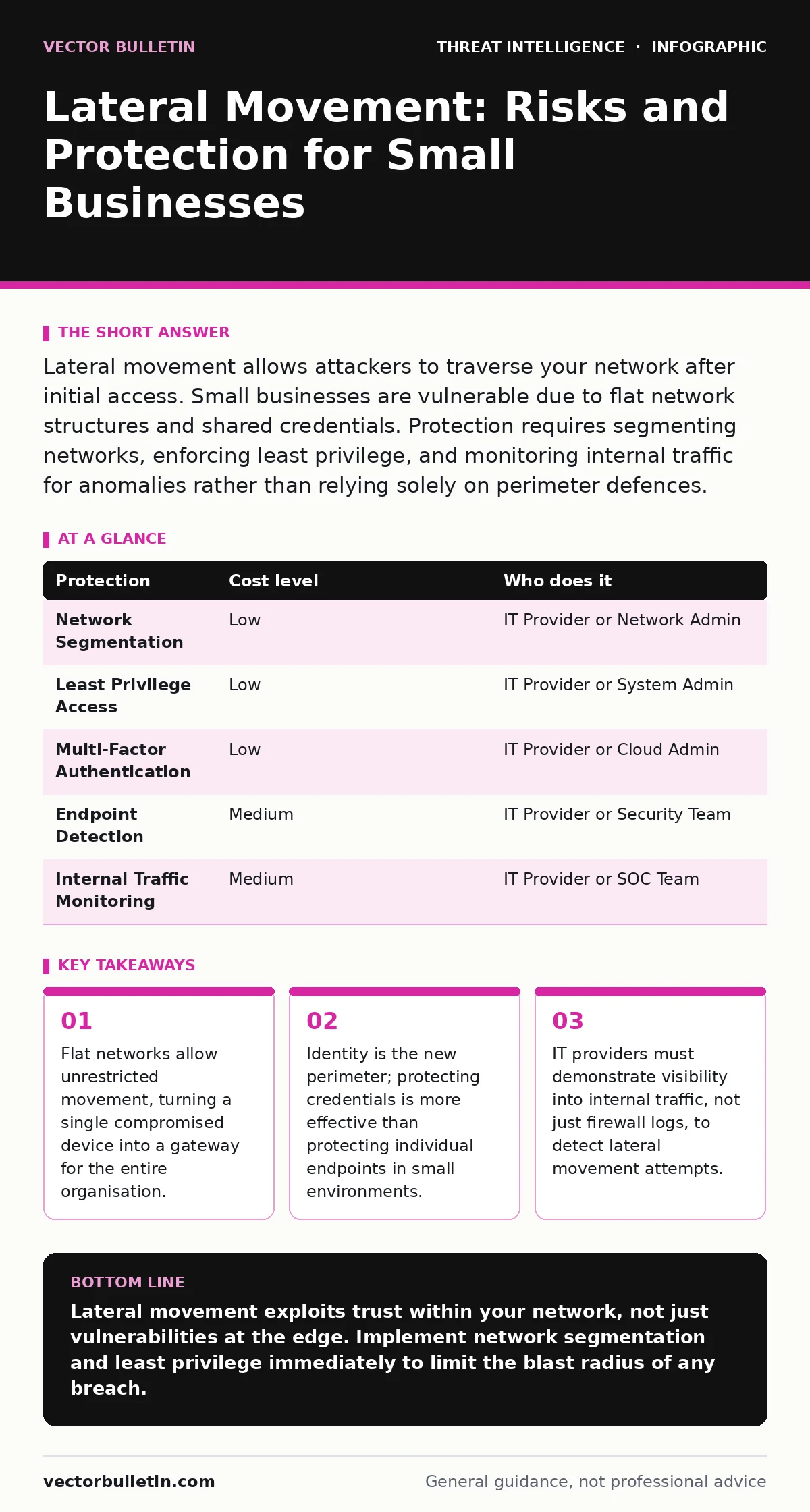
Lateral movement allows attackers to traverse your network after initial access. Small businesses are vulnerable due to flat network structures and shared credentials. Protection requires segmenting networks, enforcing least privilege, and monitoring internal traffic for anomalies rather than relying solely on perimeter defences.
The Myth of the Small Target
You might assume that small organisations are ignored by threat actors due to limited resources. This assumption is dangerous. Attackers often target smaller entities precisely because they lack the personnel to monitor internal traffic. Once an actor gains initial access, they do not need to break into your firewall again. They move laterally, using the trust your systems place in each other.
Lateral movement is the process by which an attacker navigates from one point in a network to another after gaining initial access. In large enterprises, this is hindered by complex segmentation. In small businesses, the network is often a single broadcast domain. This means every device can talk to every other device. An attacker on one machine can scan for others, copy credentials, and execute commands on remote systems without triggering alarms.
Why Flat Networks Fail
Most small organisations operate on a flat network architecture. This design is convenient for collaboration but catastrophic for security. It assumes that all devices and users are equally trustworthy. When an attacker compromises a user’s laptop, that trust extends to the file server, the email gateway, and the backup system.
The primary risk is not the initial breach but the time it takes to detect movement. Without segmentation, an attacker can map your network silently. They identify high-value assets, such as databases or administrative accounts, and move towards them. By the time you notice unusual activity, the attacker may have already exfiltrated data or encrypted files for ransom.
Identity as the New Perimeter
Traditional security focuses on protecting the network edge. Modern attacks bypass this by exploiting identity. If an attacker obtains valid credentials, they look like a legitimate user to the network. Firewalls allow their traffic because the source IP is internal and the user is authenticated.
You must shift your focus from protecting devices to protecting identities. This means implementing the principle of least privilege. Users should only have access to the data and systems necessary for their role. Administrative accounts should be separate from daily use accounts. If a standard user account is compromised, the attacker cannot access administrative functions without additional effort.
Multi-factor authentication adds a layer of defence against stolen credentials. Even if an attacker has a password, they cannot access the system without the second factor. This slows down lateral movement significantly. Attackers often give up if the friction becomes too high.
Low-Cost Protections for Limited Budgets
You do not need expensive hardware to mitigate lateral movement. Several low-cost measures can drastically reduce your risk. The first step is network segmentation. This involves dividing your network into smaller zones. For example, separate the Wi-Fi for guests from the Wi-Fi for staff. Isolate IoT devices, such as printers and cameras, on a different subnet.
| Protection | Cost level | Who does it |
|---|---|---|
| Network Segmentation | Low | IT Provider or Network Admin |
| Least Privilege Access | Low | IT Provider or System Admin |
| Multi-Factor Authentication | Low | IT Provider or Cloud Admin |
| Endpoint Detection | Medium | IT Provider or Security Team |
| Internal Traffic Monitoring | Medium | IT Provider or SOC Team |
Enforce least privilege by reviewing user permissions regularly. Remove access for employees who have left the organisation or changed roles. Disable unused accounts. These administrative tasks require time but little financial investment. They reduce the attack surface available to an attacker moving laterally.
What to Ask Your IT Provider
Many small businesses outsource their IT needs. Your provider must understand lateral movement risks. Do not accept vague assurances about "security". Ask specific questions about their monitoring capabilities.
- How do you monitor internal network traffic for anomalies?
- What is your process for identifying and isolating compromised accounts?
- Do you implement network segmentation, and how is it maintained?
- How do you detect lateral movement tools, such as PsExec or WMI?
If your provider cannot answer these questions, you are at risk. They may be managing your IT infrastructure but not your security posture. A competent provider will use open-source intelligence (OSINT) to understand emerging threats and adapt your defences accordingly. They should also integrate with frameworks like the MITRE ATT&CK Navigator to map your controls against known adversary tactics.
See also: Privileged Access Management: Answers to Your Hardest Questions · Cloud Network Segmentation: 6 Misunderstandings That Leave Gaps
The Hidden Cost of Visibility
The biggest challenge in detecting lateral movement is visibility. You cannot protect what you cannot see. Many small organisations lack log management systems that aggregate data from multiple sources. Without centralized logs, you cannot correlate events across different systems.
An attacker might log in from a legitimate IP address but access a file they never touch. This anomaly is invisible if you only look at the file server logs. You need to combine data from endpoints, network devices, and identity providers. This allows you to spot patterns that indicate lateral movement.
Implementing basic log management is a low-cost step. It does not require expensive software. Open-source solutions can aggregate logs and alert you to suspicious activities. However, you must define what is suspicious. Establish a baseline of normal behaviour. Deviations from this baseline, such as logins at unusual hours or access to multiple systems in a short period, warrant investigation.
Beyond the Basics
While network segmentation and least privilege are foundational, they are not sufficient on their own. Attackers adapt. They use legitimate administrative tools to move laterally, blending in with normal traffic. This is known as living off the land.
You need to monitor for the use of these tools in unusual contexts. For example, a user running PowerShell scripts on a remote server is normal for an IT administrator but suspicious for a marketing manager. Endpoint detection and response tools can help identify such behaviour.
Consider the role of honeypots in your strategy. These are decoy systems designed to attract attackers. If an attacker accesses a honeypot, you know they are present and can observe their movements. This provides early warning and insight into their techniques.
For deeper context on how threat actors operate, review our guide on deep web marketplaces to understand the tools they acquire. Additionally, our article on fast flux DNS explains how attackers hide their infrastructure, making attribution difficult. Understanding these tactics helps you anticipate their next move.
Building a Resilient Posture
Protecting against lateral movement is an ongoing process. It requires continuous monitoring, regular review of access controls, and updates to your security posture. Do not rely on a single solution. Layer your defences. Combine network segmentation, identity protection, and traffic monitoring.
Test your defences regularly. Conduct internal penetration tests to identify gaps. Simulate lateral movement to see if your controls detect it. This proactive approach reveals weaknesses before an attacker does.
Remember that security is not a product but a process. It requires discipline and attention to detail. By implementing these measures, you reduce the risk of lateral movement and protect your organisation from significant damage.
Key takeaways
- Flat networks allow unrestricted movement, turning a single compromised device into a gateway for the entire organisation.
- Identity is the new perimeter; protecting credentials is more effective than protecting individual endpoints in small environments.
- IT providers must demonstrate visibility into internal traffic, not just firewall logs, to detect lateral movement attempts.
Lateral movement exploits trust within your network, not just vulnerabilities at the edge. Implement network segmentation and least privilege immediately to limit the blast radius of any breach.
Frequently asked questions
How do I know if an attacker is moving laterally in my network?
Look for unusual internal connections, such as a user accessing multiple servers in a short time or using administrative tools from a non-admin account.
Is network segmentation difficult for small businesses?
It can be challenging initially, but basic segmentation using VLANs or separate Wi-Fi networks is manageable and provides significant security benefits.
What is the role of multi-factor authentication in stopping lateral movement?
MFA protects credentials, which attackers often steal to move laterally. It adds friction, making it harder for attackers to access additional systems.
How often should I review user permissions?
Review permissions quarterly or whenever an employee changes roles or leaves the organisation to ensure least privilege is maintained.
How this guide was produced: written by the Vector Bulletin editorial team with AI assistance, checked against the public references listed below, and reviewed when the facts change. See our editorial policy or report an error.