
Fast Flux DNS Misconceptions: What Operators Actually Miss
Fast flux networks survive not through speed alone, but by exploiting the inherent trust and caching mechanisms of the global DNS infrastructure to evade static blocking.
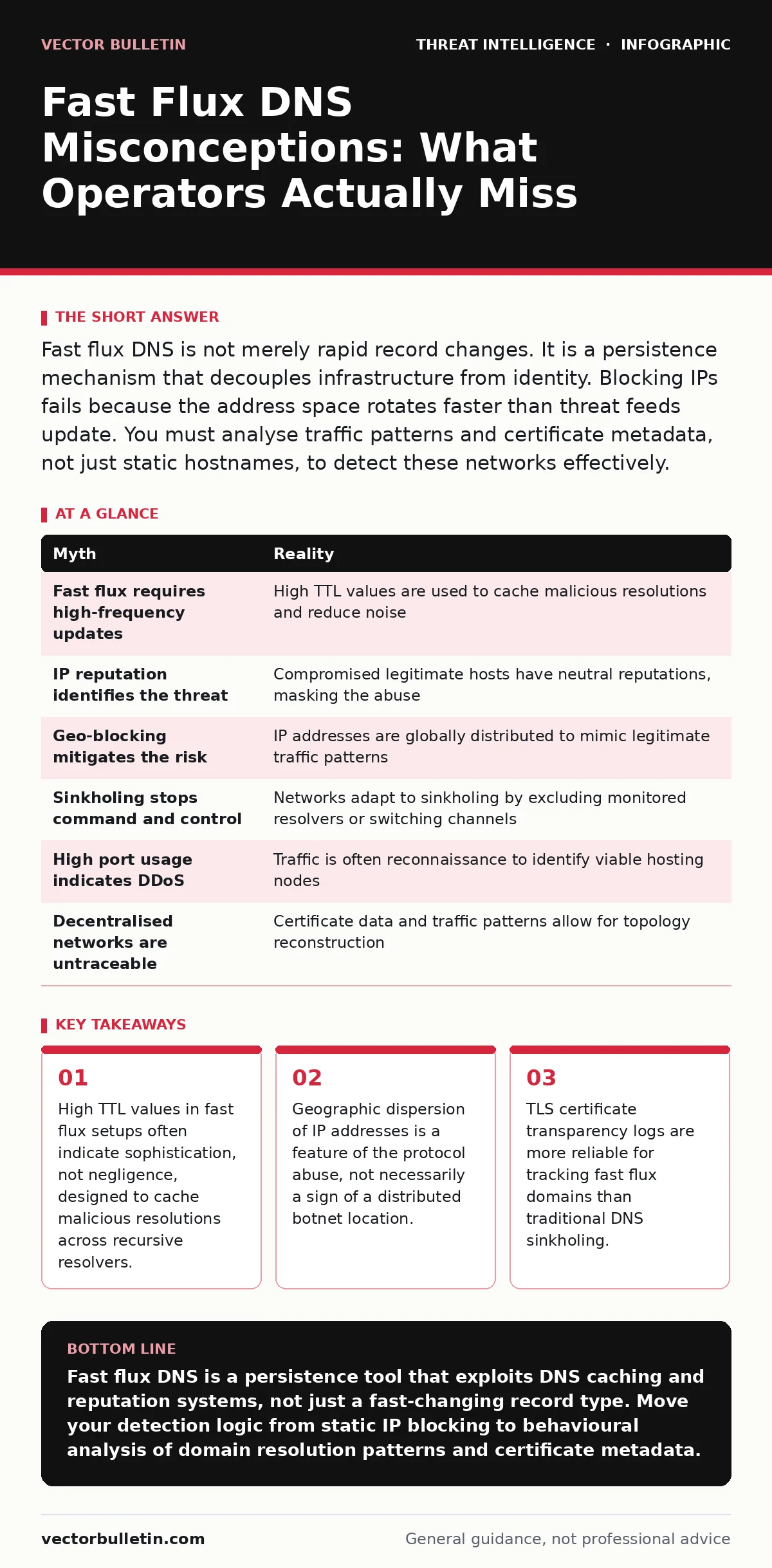
Fast flux DNS is not merely rapid record changes. It is a persistence mechanism that decouples infrastructure from identity. Blocking IPs fails because the address space rotates faster than threat feeds update. You must analyse traffic patterns and certificate metadata, not just static hostnames, to detect these networks effectively.
Myth: Fast Flux Means High Frequency Updates Only
Reality: The term "flux" implies constant motion, leading many to believe that only domains changing their A records every few seconds qualify. This definition is too narrow. Modern fast flux networks often use high Time-To-Live (TTL) values, sometimes several hours, to ensure that once a victim resolves the domain, the result persists in their local or recursive resolver cache.
This reduces the query load on the malicious authoritative nameservers, lowering the noise profile and making detection harder. The defining characteristic is not the speed of change, but the volume of distinct IP addresses returned for a single domain name. A domain returning fifty different IPs for one query is fast flux, regardless of whether those IPs change every minute or every day.
Myth: IP Reputation Alone Identifies the Threat
Reality: Fast flux networks operate by compromising legitimate hosts, often residential or small business internet connections, to serve malicious content. These hosts have neutral or positive reputation scores because they are not dedicated botnet nodes. When you rely solely on IP reputation lists, you miss the signal. The malicious domain appears clean because the infrastructure behind it is borrowed.
The attack vector exploits the trust placed in the underlying network. You cannot block the IPs because they belong to innocent users or small entities that would suffer collateral damage from aggressive blacklisting. The reputation of the IP is irrelevant; the reputation of the domain name is what matters, but even that is often obscured by the sheer number of return addresses.
Myth: Geo-Blocking is an Effective Mitigation Strategy
Reality: It is common to assume that fast flux IPs will originate from specific regions known for lax cybersecurity laws. In practice, fast flux networks deliberately distribute their return addresses globally to mimic legitimate traffic patterns. This geographic dispersion prevents simple geo-blocking rules from working.
If you block an entire country or region, you disrupt legitimate business operations and miss the malicious nodes that are located in unexpected jurisdictions. The distribution is often randomised or weighted to match the geographic distribution of the victim base, making the traffic look like normal user behaviour. Geographic analysis reveals little about the operator’s location or intent.
Myth: Sinkholing Stops the Command and Control
Reality: Sinkholing involves redirecting queries for a known malicious domain to a controlled server to gather intelligence or disrupt operations. Fast flux networks are resilient to this technique. Because the authoritative nameservers are also part of the flux network, they can detect when a specific resolver is being sinkholed.
The network can then exclude that resolver from receiving valid responses or switch to an alternate communication channel. This is a form of adaptive evasion. The attackers monitor the effectiveness of their infrastructure and adjust dynamically. Sinkholing provides only a transient view of the victim base and does not dismantle the network. It may even alert the operators to the presence of defensive monitoring, causing them to accelerate their rotation cycles.
Myth: High Port Usage Indicates a DDoS Reflection Attack
Reality: Observing traffic from a fast flux domain hitting multiple ports on your perimeter can lead to the assumption that the network is attempting a distributed denial-of-service attack. While possible, this is often a side effect of the flux mechanism itself. The compromised hosts in the network may be scanning for open ports to determine which services are available for hosting malicious payloads.
This behaviour is reconnaissance, not necessarily an active attack. The traffic pattern looks similar to a port scan, but the intent is infrastructure management. The operators need to know which nodes are alive and capable of serving web content. Misclassifying this as DDoS leads to wasted resources on rate-limiting rather than investigating the underlying domain abuse.
See also: Open-Source Intelligence (OSINT): 10 FAQs Answered · Lateral Movement Response: Containment, Recovery and Prevention Steps
Myth: Decentralised Networks Are Untraceable
Reality: The belief that fast flux networks are untraceable due to their distributed nature is a significant deterrent for investigation. However, the domain registration details, while often privacy-protected, are tied to specific registrars. More importantly, the communication between the compromised nodes and the control servers leaves traces in network flow data.
By analysing the timing and structure of these communications, analysts can reconstruct the topology. The decentralisation is a logistical challenge, not a cryptographic guarantee of anonymity. Correlating data from open-source intelligence (OSINT) sources with internal log management systems allows for the identification of persistent elements within the flux. The operators make mistakes in certificate generation and naming conventions that reveal their identity over time.
| Myth | Reality |
|---|---|
| Fast flux requires high-frequency updates | High TTL values are used to cache malicious resolutions and reduce noise |
| IP reputation identifies the threat | Compromised legitimate hosts have neutral reputations, masking the abuse |
| Geo-blocking mitigates the risk | IP addresses are globally distributed to mimic legitimate traffic patterns |
| Sinkholing stops command and control | Networks adapt to sinkholing by excluding monitored resolvers or switching channels |
| High port usage indicates DDoS | Traffic is often reconnaissance to identify viable hosting nodes |
| Decentralised networks are untraceable | Certificate data and traffic patterns allow for topology reconstruction |
Key takeaways
- High TTL values in fast flux setups often indicate sophistication, not negligence, designed to cache malicious resolutions across recursive resolvers.
- Geographic dispersion of IP addresses is a feature of the protocol abuse, not necessarily a sign of a distributed botnet location.
- TLS certificate transparency logs are more reliable for tracking fast flux domains than traditional DNS sinkholing.
Fast flux DNS is a persistence tool that exploits DNS caching and reputation systems, not just a fast-changing record type. Move your detection logic from static IP blocking to behavioural analysis of domain resolution patterns and certificate metadata.
Frequently asked questions
How does fast flux differ from domain generation algorithms?
Domain generation algorithms create new, random domain names to evade blocklists, whereas fast flux keeps the same domain name but changes the IP addresses it resolves to, making the domain appear legitimate while hiding the infrastructure.
Can I use MITRE ATT&CK Navigator to map fast flux techniques?
Yes, fast flux is typically mapped to the Command and Control tactic, specifically under techniques related to application layer protocols and multi-stage payloads, helping you standardise your detection rules.
Why do fast flux networks use high TTL values?
High TTL values force recursive resolvers to cache the malicious IP addresses for longer periods, reducing the number of queries the attackers need to handle and making the traffic appear more stable and legitimate.
Is fast flux DNS common in ransomware attacks?
Fast flux is more commonly associated with malware distribution, botnets, and phishing infrastructure, though ransomware groups may use similar techniques to host their payload delivery mechanisms.
How this guide was produced: written by the Vector Bulletin editorial team with AI assistance, checked against the public references listed below, and reviewed when the facts change. See our editorial policy or report an error.