
DNS over HTTPS vs DNS over TLS: The Operational Trade-offs
Choosing between encrypted DNS protocols depends on whether you prioritise firewall evasion through port standardisation or strict protocol separation for cleaner traffic analysis.
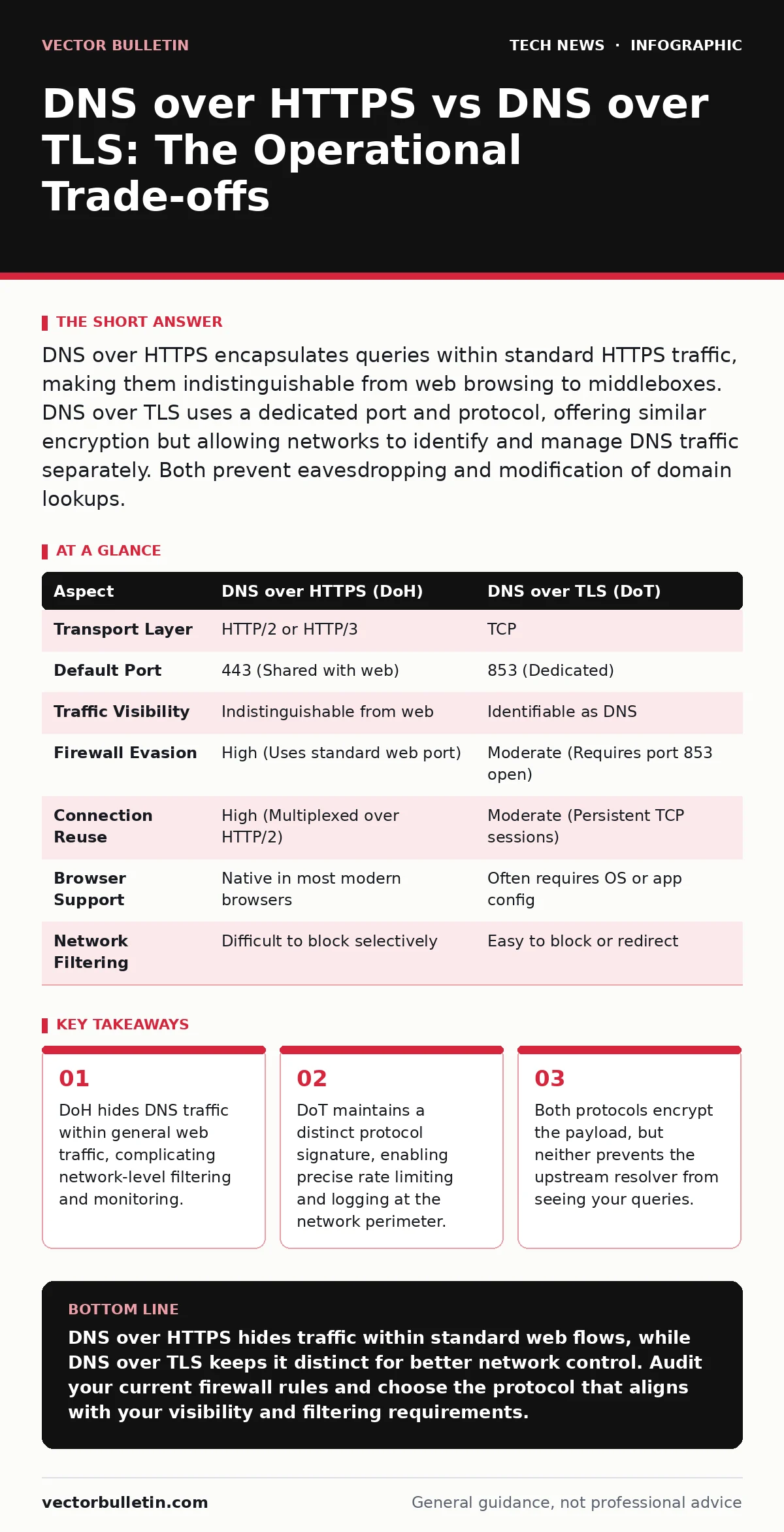
DNS over HTTPS encapsulates queries within standard HTTPS traffic, making them indistinguishable from web browsing to middleboxes. DNS over TLS uses a dedicated port and protocol, offering similar encryption but allowing networks to identify and manage DNS traffic separately. Both prevent eavesdropping and modification of domain lookups.
The Core Distinction
The fundamental difference lies in transport encapsulation. DNS over HTTPS (DoH) wraps standard DNS queries inside the HTTPS protocol, typically using port 443. This makes the traffic appear identical to regular encrypted web browsing. DNS over TLS (DoT) establishes a separate, dedicated connection using TLS encryption over a specific port, usually 853. This separation allows network equipment to recognise the traffic as DNS rather than generic web data.
Understanding DNS over HTTPS
DoH operates by sending DNS queries as HTTP POST or GET requests to a specified endpoint. Because it uses the same port and encryption as standard web traffic, it blends seamlessly with other HTTPS flows. This design choice ensures that firewalls cannot easily block DNS without breaking all web access. However, this blending removes the ability for network administrators to distinguish DNS queries from other encrypted application data.
Understanding DNS over TLS
DoT creates a persistent, encrypted TCP connection dedicated solely to DNS. It uses a separate port, which allows network devices to identify the traffic type immediately. This separation is beneficial for environments that require strict logging of DNS activity or need to apply specific rate limits to domain lookups. The protocol remains distinct from HTTP, ensuring that DNS traffic does not mix with general web browsing data at the network layer.
Protocol Comparison
| Aspect | DNS over HTTPS (DoH) | DNS over TLS (DoT) |
|---|---|---|
| Transport Layer | HTTP/2 or HTTP/3 | TCP |
| Default Port | 443 (Shared with web) | 853 (Dedicated) |
| Traffic Visibility | Indistinguishable from web | Identifiable as DNS |
| Firewall Evasion | High (Uses standard web port) | Moderate (Requires port 853 open) |
| Connection Reuse | High (Multiplexed over HTTP/2) | Moderate (Persistent TCP sessions) |
| Browser Support | Native in most modern browsers | Often requires OS or app config |
| Network Filtering | Difficult to block selectively | Easy to block or redirect |
Operational Trade-offs
When you implement DoH, you gain resilience against network intermediaries that might drop or modify DNS packets. The traffic merges with the general internet flow, reducing the attack surface for port-specific denial-of-service attacks. However, this opacity comes at a cost. Security teams lose visibility into domain resolution patterns, which hampers threat detection. If a host begins communicating with known malicious domains, the encrypted nature of DoH prevents simple network-layer blocking.
DoT offers a middle ground. It provides the encryption benefits of DoH while maintaining protocol distinctness. This allows security operations teams to monitor DNS volume and latency separately from web traffic. You can implement stricter controls, such as forcing all internal devices to use a specific internal DoT resolver. This centralisation aids in compliance auditing and local cache management, reducing external query volume.
See also: Remote Desktop Security: Definition, Architecture and Failure Modes
Overlapping Security Benefits
Both protocols address the primary weakness of traditional DNS: its lack of confidentiality. Standard DNS operates over UDP, transmitting queries in plain text. Any observer on the network path can read the domains you visit. Both DoH and DoT encrypt this payload, preventing passive eavesdropping and man-in-the-middle modifications. They both rely on the same underlying trust model: you must trust the resolver you choose. Encryption hides the query from your ISP, but the resolver sees everything.
This shared trust model intersects with broader data center security strategies. If you operate your own resolvers, you must ensure the infrastructure handling these encrypted queries is secure. The protection extends only to the transport layer; the destination remains visible to the endpoint operator.
Choosing the Right Protocol
The choice depends on your operational priorities. If you need to ensure DNS availability through restrictive firewalls, DoH is often the better choice. It survives network configurations that block non-standard ports. If you require granular control over DNS traffic, DoT is superior. It allows you to apply specific policies to DNS without affecting general web performance.
Implementation Considerations
Deploying either protocol requires updating client configurations. Operating systems and browsers must be directed to use the encrypted endpoints. For DoH, this often involves changing browser settings or system-wide networking preferences. For DoT, you may need to configure the OS resolver to point to a DoT-capable server. Ensure your firewall rules allow outbound traffic on the required ports. Misconfiguration can lead to resolution failures, causing significant operational disruption.
Key takeaways
- DoH hides DNS traffic within general web traffic, complicating network-level filtering and monitoring.
- DoT maintains a distinct protocol signature, enabling precise rate limiting and logging at the network perimeter.
- Both protocols encrypt the payload, but neither prevents the upstream resolver from seeing your queries.
DNS over HTTPS hides traffic within standard web flows, while DNS over TLS keeps it distinct for better network control. Audit your current firewall rules and choose the protocol that aligns with your visibility and filtering requirements.
Frequently asked questions
Can I use both DoH and DoT on the same network?
Yes, but you must configure devices consistently. Mixing protocols can complicate logging and policy enforcement, leading to inconsistent security postures across different user groups.
Does encrypted DNS prevent DDoS attacks?
It mitigates amplification attacks by eliminating UDP, but it does not stop direct volumetric attacks against the resolver endpoints. You still need rate limiting and upstream filtering.
How does this affect my **open port management** strategy?
You must ensure port 443 is open for DoH and port 853 for DoT. Closing these ports will break encrypted resolution, forcing devices to fall back to insecure UDP if not properly restricted.
Is one protocol faster than the other?
DoH can be faster due to HTTP/2 multiplexing and connection reuse, but the difference is negligible for most users. Latency is more affected by the physical distance to the resolver than the protocol choice.
How this guide was produced: written by the Vector Bulletin editorial team with AI assistance, checked against the public references listed below, and reviewed when the facts change. See our editorial policy or report an error.