
Firewall Rules: Concrete Benefits and Hidden Limitations
Static firewall rules create a false sense of security by blocking known threats while remaining blind to application-layer logic flaws and encrypted traffic patterns.
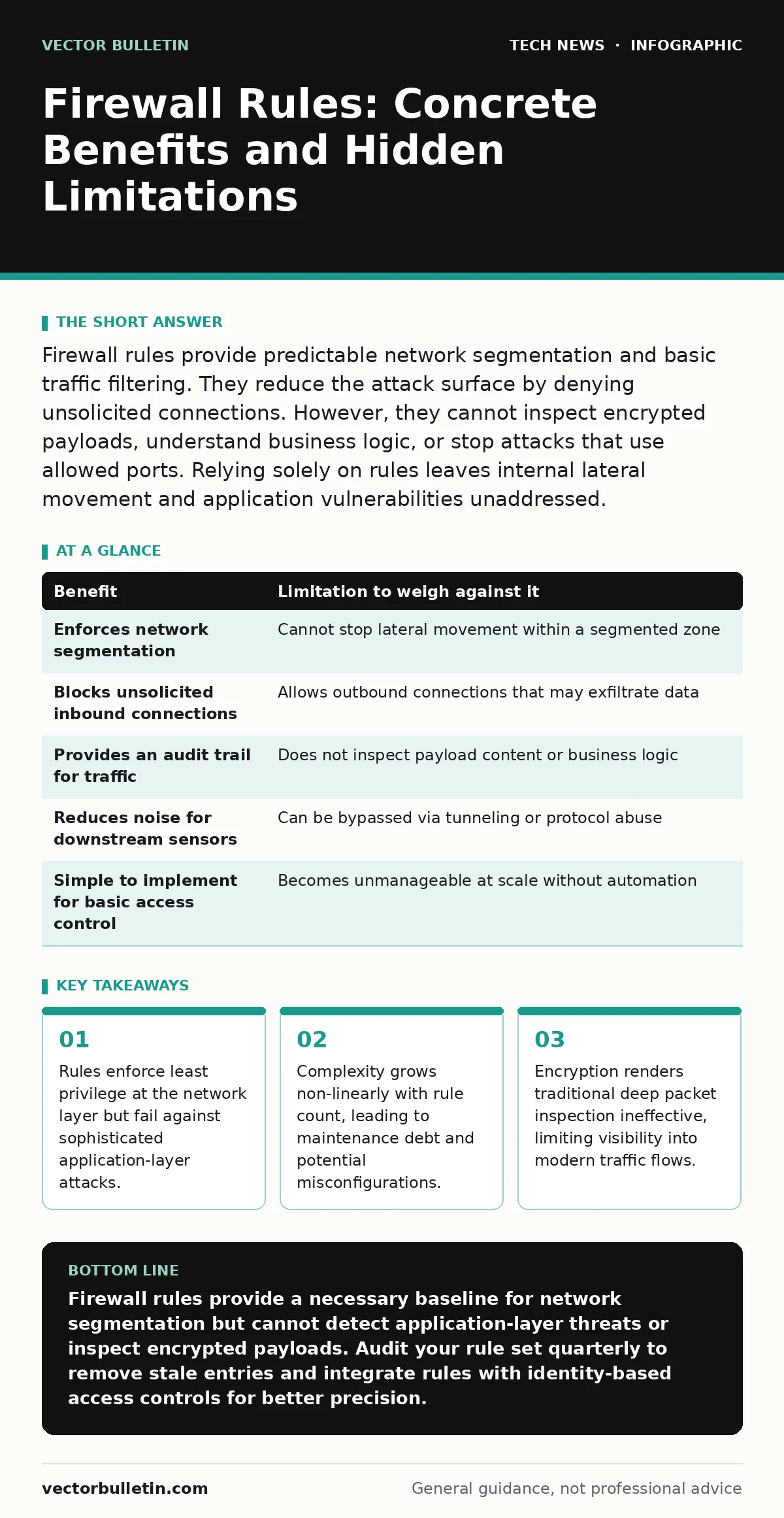
Firewall rules provide predictable network segmentation and basic traffic filtering. They reduce the attack surface by denying unsolicited connections. However, they cannot inspect encrypted payloads, understand business logic, or stop attacks that use allowed ports. Relying solely on rules leaves internal lateral movement and application vulnerabilities unaddressed.
The Mechanics of Network Filtering
Firewall rules operate by comparing packet headers against a predefined set of criteria. When a packet arrives at the firewall interface, the device examines source and destination addresses, port numbers, and protocol types. If the packet matches a permit rule, it passes through. If it matches a deny rule, it is dropped. If it matches no rule, the default policy applies, typically dropping the traffic. This stateless or stateful inspection happens at the network and transport layers of the OSI model.
The primary advantage of this approach is predictability. You define exactly what traffic is allowed. Any deviation from the norm is blocked by default. This creates a hard boundary around your network perimeter. However, this boundary is blind to the content of the traffic once it is encrypted or encapsulated within legitimate protocols.
The Cost of Rule Complexity
As an organisation grows, the number of firewall rules increases. New services require new rules. Temporary exceptions for debugging often become permanent. Over time, the rule set becomes a tangled web of overlapping entries. This complexity introduces a hidden cost: the difficulty of auditing and maintaining the configuration.
When rules conflict or overlap, the firewall processes them in order. A broad permit rule placed before a specific deny rule will allow traffic that should be blocked. This is known as rule shadowing. It is a common configuration error that goes unnoticed until an incident occurs. Regular rule consolidation is necessary to prevent this decay, but it is labour-intensive and prone to human error.
Imagine a scenario where a developer requests access to a database for testing. A temporary rule is added. The test finishes, but the rule remains. Six months later, a vulnerability in the database application is exploited. The attacker uses the forgotten rule to gain access. The firewall did not fail; the rule management process did.
Benefits and Limitations Table
The following table outlines the concrete benefits of firewall rules alongside their inherent limitations. Each benefit must be weighed against its corresponding limitation when designing a security architecture.
| Benefit | Limitation to weigh against it |
|---|---|
| Enforces network segmentation | Cannot stop lateral movement within a segmented zone |
| Blocks unsolicited inbound connections | Allows outbound connections that may exfiltrate data |
| Provides an audit trail for traffic | Does not inspect payload content or business logic |
| Reduces noise for downstream sensors | Can be bypassed via tunneling or protocol abuse |
| Simple to implement for basic access control | Becomes unmanageable at scale without automation |
Blind Spots in Encrypted Traffic
Modern internet traffic is predominantly encrypted using TLS. While this protects user privacy and data integrity, it also hides the content from traditional firewalls. A firewall can see that a connection is to port 443, but it cannot see what application is using that connection. An attacker can tunnel malicious traffic through HTTPS, making it indistinguishable from legitimate web browsing.
This limitation means that firewall rules alone cannot detect command-and-control channels or data exfiltration attempts that use standard web protocols. To address this, organisations often implement TLS inspection, where the firewall decrypts, inspects, and re-encrypts traffic. This adds significant computational overhead and raises privacy concerns. It also requires careful certificate management to avoid breaking legitimate applications.
Application Logic and Business Rules
Firewalls operate at the network and transport layers. They do not understand the application layer. They cannot distinguish between a legitimate login attempt and a brute-force attack if both use valid credentials and standard ports. They cannot detect SQL injection, cross-site scripting, or other application-layer vulnerabilities.
This is why web application firewalls exist. These devices inspect the HTTP headers and payloads for malicious patterns. However, even these can be evaded with obfuscation or by exploiting logic flaws that do not match known signatures. Firewall rules are necessary but insufficient for application security. They must be complemented by application-level controls and secure coding practices.
Suppose an API endpoint allows users to update their profile. A firewall rule permits traffic to the API server. An attacker finds a logic flaw that allows them to change another user's email address by manipulating the request ID. The firewall sees this as valid traffic and allows it. The rule did its job, but the application failed.
See also: Difference Between Computer Viruses Worms and Trojans · Smart Home Security Mistakes That Invite Intrusion and How to Fix Them
The Maintenance Burden
Managing firewall rules is an ongoing operational task. Rules must be reviewed, tested, and updated as the network changes. This requires a disciplined change management process. Without it, the rule set becomes a liability. Stale rules increase the attack surface and make troubleshooting difficult.
Automation can help manage this burden, but it requires robust testing frameworks. Automated rule generation can introduce errors if the input data is incorrect. Human oversight remains necessary to validate that the rules align with business requirements and security policies. This balance between automation and manual review is difficult to achieve and requires dedicated resources.
When It Is Worth It
Firewall rules are worth implementing when you need to enforce basic network hygiene and segment critical assets. They are effective at blocking unsolicited inbound traffic from the internet. They are also useful for isolating different parts of your network, such as separating guest Wi-Fi from corporate resources.
For small to medium-sized networks, a well-configured firewall with a default-deny policy can provide a significant reduction in risk. It prevents casual scanning and automated attacks from reaching internal systems. It also provides a clear boundary for compliance requirements that mandate network segmentation.
In these scenarios, the cost of implementation and maintenance is low relative to the benefit. The rules are simple, easy to audit, and effective at stopping low-sophistication threats. They form the foundation of a defence-in-depth strategy.
When It Is Not Worth It
Firewall rules are not worth relying on when you need to protect against sophisticated, targeted attacks. They cannot stop attackers who have valid credentials or who exploit application-layer vulnerabilities. They are also ineffective against insider threats who have legitimate access to the network.
For complex, dynamic environments such as cloud-native architectures, traditional firewall rules become unmanageable. The ephemeral nature of containers and microservices means that static rules are quickly outdated. In these cases, network policies and service mesh technologies are more appropriate. They provide dynamic, identity-based access control that scales with the environment.
Integrating with Other Controls
Firewall rules must be part of a broader security strategy. They work in conjunction with intrusion detection systems, security information and event management platforms, and endpoint protection. They do not replace these controls; they complement them.
For instance, firewall rules can reduce the volume of traffic that intrusion detection systems need to analyse. This improves the accuracy of detection and reduces false positives. Similarly, firewall rules can help isolate compromised endpoints, limiting the spread of malware.
Consider the principles of open port management. Minimising the number of open ports reduces the complexity of firewall rules and the potential for misconfiguration. Similarly, API key security ensures that even if traffic reaches an API, it cannot be abused without valid credentials.
The goal is to create multiple layers of defence. If one layer fails, the others can still provide protection. Firewall rules are one layer. They are necessary, but they are not sufficient on their own.
The Future of Network Access Control
As networks become more distributed and mobile, the concept of a fixed perimeter is fading. Zero trust architectures emphasise identity and device health over network location. In this model, firewall rules are still used, but they are applied dynamically based on context.
This shift requires more sophisticated policy engines and better integration with identity providers. It also means that firewall rules become more granular and ephemeral. They are created and destroyed as needed, rather than being static configurations.
This evolution reduces the maintenance burden and improves security by enforcing least privilege more strictly. However, it also requires more complex infrastructure and higher operational maturity. Organisations must weigh these factors when deciding how to implement firewall rules in their environment.
Key takeaways
- Rules enforce least privilege at the network layer but fail against sophisticated application-layer attacks.
- Complexity grows non-linearly with rule count, leading to maintenance debt and potential misconfigurations.
- Encryption renders traditional deep packet inspection ineffective, limiting visibility into modern traffic flows.
Firewall rules provide a necessary baseline for network segmentation but cannot detect application-layer threats or inspect encrypted payloads. Audit your rule set quarterly to remove stale entries and integrate rules with identity-based access controls for better precision.
Frequently asked questions
Do firewall rules protect against ransomware?
Firewall rules can block known command-and-control servers and unsolicited inbound connections, but they cannot stop ransomware delivered via legitimate email attachments or exploited vulnerabilities within allowed traffic.
How often should firewall rules be reviewed?
Review firewall rules at least quarterly. Remove unused rules, consolidate overlapping entries, and verify that each rule still aligns with current business requirements and security policies.
Can firewalls stop data exfiltration?
Traditional firewalls cannot detect data exfiltration if it occurs over allowed ports and protocols. Data loss prevention tools and behavioural analytics are required to identify unusual outbound traffic patterns.
What is the difference between a stateful and stateless firewall?
A stateless firewall inspects each packet independently, while a stateful firewall tracks the state of active connections. Stateful firewalls provide better security by ensuring that only packets belonging to established sessions are allowed.
How this guide was produced: written by the Vector Bulletin editorial team with AI assistance, checked against the public references listed below, and reviewed when the facts change. See our editorial policy or report an error.