OSI Model vs TCP Model: The Structural Difference and When to Use Each
The OSI model is a conceptual teaching tool, while the TCP model is the practical blueprint for actual network implementation and troubleshooting.
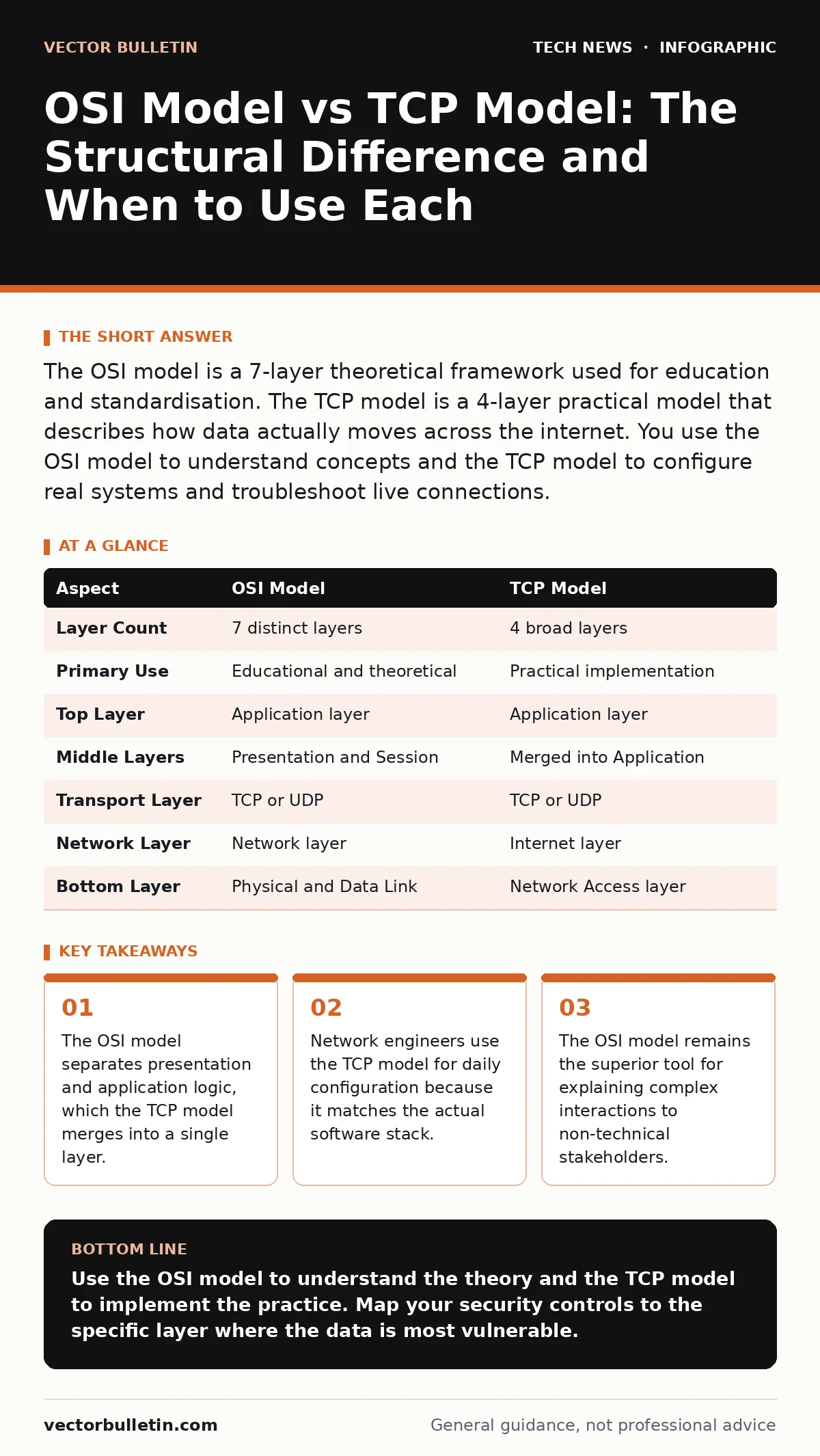
The OSI model is a 7-layer theoretical framework used for education and standardisation. The TCP model is a 4-layer practical model that describes how data actually moves across the internet. You use the OSI model to understand concepts and the TCP model to configure real systems and troubleshoot live connections.
The Core Difference Between OSI and TCP Models
The OSI model is a theoretical reference model that defines 7 distinct layers of network communication. It was designed to help different hardware and software vendors create compatible systems. The TCP model, often called the TCP/IP model, is a practical description of the protocols that actually run the internet. It condenses those 7 layers into 4 broader categories. The OSI model tells you what each layer should do. The TCP model shows you how the current internet stack actually behaves. You choose the OSI model for teaching and conceptual clarity. You choose the TCP model for configuration and troubleshooting real networks.
| Aspect | OSI Model | TCP Model |
|---|---|---|
| Layer Count | 7 distinct layers | 4 broad layers |
| Primary Use | Educational and theoretical | Practical implementation |
| Top Layer | Application layer | Application layer |
| Middle Layers | Presentation and Session | Merged into Application |
| Transport Layer | TCP or UDP | TCP or UDP |
| Network Layer | Network layer | Internet layer |
| Bottom Layer | Physical and Data Link | Network Access layer |
What Is the OSI Model
The OSI model stands for Open Systems Interconnection. It breaks network communication into 7 specific stages. The Physical layer handles electrical signals and cables. The Data Link layer manages MAC addresses and error detection on a local segment. The Network layer handles routing and IP addresses. The Transport layer ensures reliable data transfer between hosts.
The Session layer manages connections and dialogues. The Presentation layer translates data formats and handles encryption. The Application layer interacts directly with software applications. This separation of duties makes it easier to isolate problems. If your data is corrupted, you know to check the Presentation layer, not the Physical layer.
What Is the TCP Model
The TCP model, or TCP/IP model, is the architecture that powers the modern internet. It reduces the complexity of the OSI model into 4 layers. The Network Access layer combines the Physical and Data Link functions. It deals with hardware addresses and physical transmission. The Internet layer corresponds to the OSI Network layer.
It handles IP addressing and routing across different networks. The Transport layer is identical to the OSI Transport layer. It uses TCP for reliable delivery or UDP for speed. The Application layer merges the OSI Session, Presentation, and Application layers. It handles high-level protocols like HTTP, SMTP, and FTP. This model reflects how software is actually written and deployed.
Point-by-Point Comparison of Layers
The OSI model separates concerns more strictly than the TCP model. In the OSI model, encryption happens in the Presentation layer. In the TCP model, encryption is often handled by the application itself, such as HTTPS. The OSI model has a dedicated Session layer to manage connection states. The TCP model pushes this responsibility to the application or the Transport layer. This difference matters when you are debugging a connection timeout. The OSI model suggests checking the Session layer. The TCP model suggests checking the application code or the TCP handshake. The TCP model is less granular but more accurate for real-world stacks.
When to Choose the OSI Model
Choose the OSI model when you need to explain network concepts to a broad audience. It provides a clear vocabulary for discussing network issues. Use it when designing new protocols that need to interact with existing systems. It helps you identify where a specific function belongs in the stack. For example, if you are building a new encryption standard, the OSI model tells you it belongs in the Presentation layer. This prevents confusion with lower-level routing or transport mechanisms. It is also useful for vendor-neutral discussions. Different vendors may implement the TCP model differently, but the OSI concepts remain constant.
When to Choose the TCP Model
Choose the TCP model when you are configuring firewalls or routers. Your firewall rules are based on IP addresses and ports, which map directly to the TCP model. You use this model when troubleshooting connectivity issues. If a packet is not reaching its destination, you check the Internet layer. If data is corrupted, you check the Transport layer. The TCP model aligns with the commands you run on your systems. It matches the output of network diagnostic tools. It is the language of network engineers and system administrators. You will rarely see the term "Session layer" in a real-world configuration file.
Where the Models Overlap
The Transport and Network layers are nearly identical in both models. TCP and UDP operate the same way in both frameworks. IP addressing and routing are also consistent. This overlap means you can switch between models without losing much information at the core. The main divergence is at the top and bottom. The OSI model splits the bottom into two layers. The TCP model combines them. The OSI model splits the top into three layers. The TCP model combines them. Understanding this overlap helps you translate between theoretical diagrams and practical configurations.
Practical Application in Security
Security measures often map to specific layers. Understanding which model you are using helps you place your controls correctly. For instance, firewall rules typically operate at the Network and Transport layers. They filter based on IP addresses and ports. Application-level firewalls operate at the Application layer. API key security is an Application layer concern in the TCP model.
It is often ignored in the OSI model, which treats application logic as a black box. Password policies relate to the Application layer, but the transmission of passwords involves the Transport layer. Hashing is used in the Data Link layer for integrity checks and in the Application layer for password storage. Digital signatures operate at the Presentation layer in the OSI model, but are often implemented in the Application layer in practice. Open port management is a Transport layer activity. Smart home security often fails because devices ignore the separation of layers, exposing application logic directly to the network. Remote desktop security relies on the Transport layer for connection stability and the Application layer for user authentication.
Key takeaways
- The OSI model separates presentation and application logic, which the TCP model merges into a single layer.
- Network engineers use the TCP model for daily configuration because it matches the actual software stack.
- The OSI model remains the superior tool for explaining complex interactions to non-technical stakeholders.
Use the OSI model to understand the theory and the TCP model to implement the practice. Map your security controls to the specific layer where the data is most vulnerable.
Frequently asked questions
Which model is used in university courses?
Universities typically teach the OSI model first because it provides a clearer conceptual foundation for understanding network layers.
Can I use both models at the same time?
Yes, many engineers use the OSI model for high-level design and the TCP model for detailed implementation and troubleshooting.
Does the TCP model replace the OSI model?
No, the TCP model does not replace the OSI model. They serve different purposes. The OSI model remains a valuable reference for standardisation.
How this guide was produced: written by the Vector Bulletin editorial team with AI assistance, checked against the public references listed below, and reviewed when the facts change. See our editorial policy or report an error.