
Open Port Management: Benefits, Limits and Decision Criteria
Closing ports reduces attack surface but introduces latency and complexity that often outweigh the security gains for low-risk services.
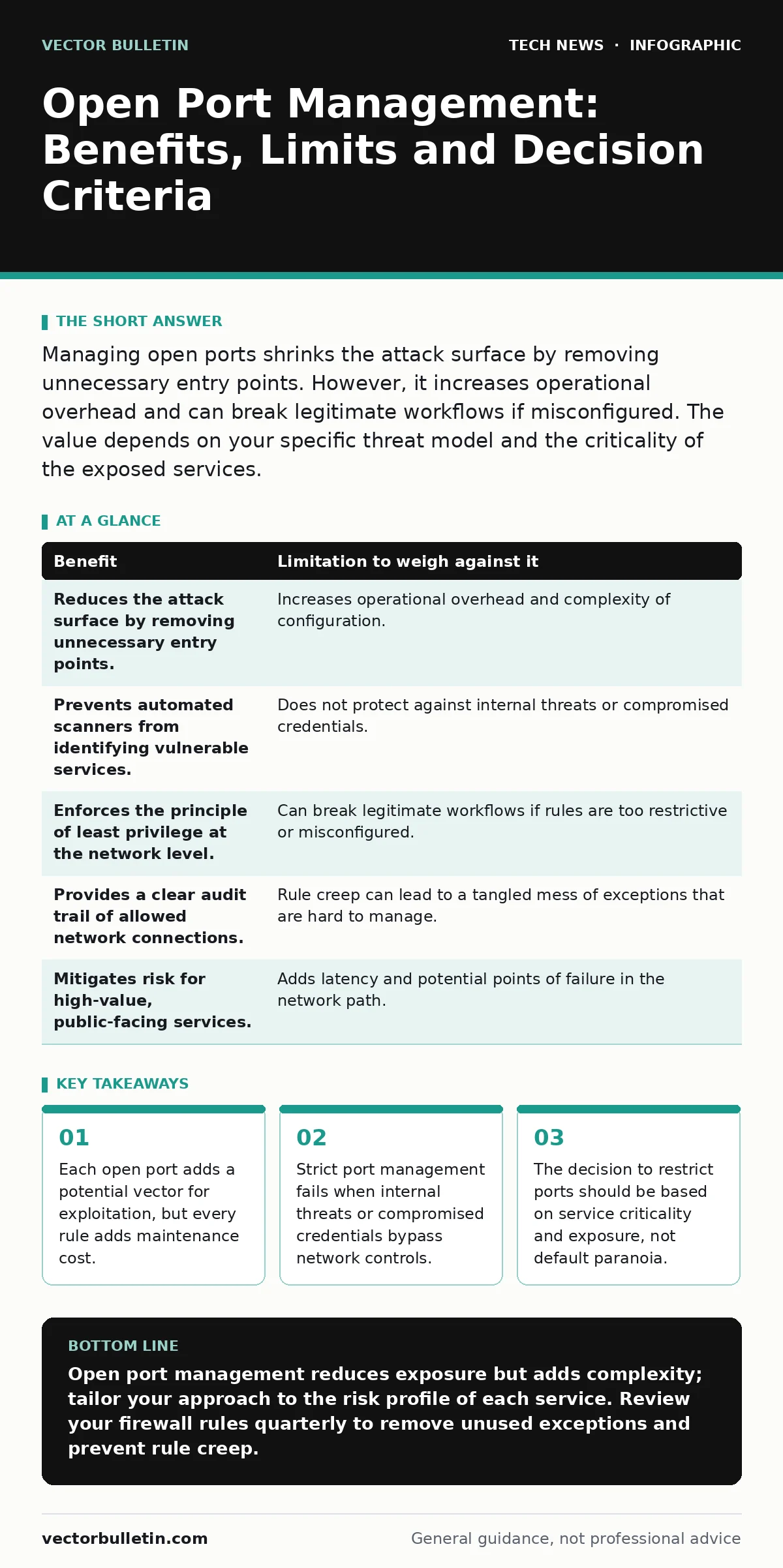
Managing open ports shrinks the attack surface by removing unnecessary entry points. However, it increases operational overhead and can break legitimate workflows if misconfigured. The value depends on your specific threat model and the criticality of the exposed services.
The Mechanics of Exposure
An open port is a network endpoint where a service listens for incoming connections. Every port you leave open represents a potential entry point for an attacker. This is not a theoretical risk. Attackers use automated scanners to identify open ports across the internet. Once identified, they probe for known vulnerabilities in the service listening on that port.
You might assume that closing a port eliminates the risk entirely. This is only true if the service is completely unreachable. If you use a firewall to block external access but the service remains active internally, the risk shifts rather than disappears. The service can still be compromised via lateral movement from another infected machine.
The structure of network communication follows the OSI model, a conceptual framework that standardises the functions of a telecommunication or computing system into seven different abstraction layers. Port management operates primarily at the transport layer, which handles end-to-end communication. Understanding this layer helps you distinguish between blocking a port and blocking an application protocol.
The Hidden Cost of Restriction
There is a trade-off between security and usability. Every rule you add to a firewall or host-based filter increases the complexity of your configuration. Complex configurations are prone to human error. A single misconfigured rule can block legitimate traffic, causing service outages.
Imagine a development team needs to access a testing server. You close all ports except the standard web ports. The developers then request an exception for a custom debugging port. You grant it. Now you have an exception that may never be removed. This is known as rule creep. Over time, your firewall rules become a tangled mess of legacy exceptions, making it difficult to audit who has access to what.
The cost of managing these rules is not just technical. It is operational. Your security team spends time reviewing requests, testing changes and documenting exceptions. This time could be spent on more impactful security measures. If the service exposed is low-risk, the return on investment for strict port management is negligible.
The Illusion of Complete Protection
Closing ports does not protect against all threats. It only reduces the surface area available for initial access. If an attacker already has access to your network, closed ports offer little resistance. They can move laterally using open internal channels.
Suppose an employee clicks a phishing link and installs malware on their workstation. The malware does not need an open port to communicate with a command and control server. It can use established outbound connections. Inbound port management does not stop data exfiltration or command execution via outbound channels.
This is why firewall rules alone are insufficient. You need a defence-in-depth strategy. This includes endpoint detection, network segmentation and strict access controls. Port management is one layer of this strategy. It is not a silver bullet. Relying on it exclusively creates a false sense of security.
When Restriction Adds Value
Strict port management is worth the effort when the exposed service is high-value. This includes systems that hold sensitive data, such as databases or authentication servers. These systems are prime targets for attackers. Reducing their exposure minimises the chance of a successful breach.
It is also worth it when the service is exposed to the public internet. Public-facing services are constantly scanned and attacked. Every open port is a beacon. Closing unnecessary ports on public-facing systems reduces the noise and the risk.
Consider remote desktop security. Remote Desktop Protocol (RDP) is a common target for brute-force attacks. Exposing RDP directly to the internet is dangerous. Placing it behind a VPN or restricting access to specific IP addresses via port rules is a standard mitigation. In this case, the benefit of reduced exposure outweighs the operational cost.
When Restriction Fails
Port management is not worth the effort for low-risk internal services. These are systems that do not handle sensitive data and are not exposed to the internet. The cost of managing rules for these services often exceeds the risk they pose.
Imagine a small internal tool used by a few employees. It does not store sensitive data. It is only accessible within the local network. Closing all ports except the minimum required adds complexity without significantly reducing risk. The effort is better spent on securing more critical assets.
Another case where port management fails is when the service requires dynamic ports. Some applications, such as certain database clients or file transfer protocols, use multiple ports for a single session. Blocking dynamic ports can break functionality. In these cases, you must either allow the dynamic range or use a proxy to manage the connections.
See also: Firewall Rules: Concrete Benefits and Hidden Limitations · Smart Home Security Mistakes That Invite Intrusion and How to Fix Them
The Balance of Risk and Reward
The decision to manage ports strictly should be based on a clear understanding of risk. Not all ports are created equal. Some services are inherently more vulnerable than others. Understanding the vulnerabilities associated with each service helps you prioritise your efforts.
For example, older protocols may have known weaknesses that are difficult to patch. Exposing these services, even on a restricted port, is risky. You should consider decommissioning these services or replacing them with more secure alternatives.
This approach aligns with the principles of data center security, which focuses on protecting the most critical assets. By focusing your efforts on high-value targets, you maximise the impact of your security investments. You avoid the trap of trying to secure everything equally, which is neither feasible nor effective.
Weighing the Trade-offs
The following table summarises the key benefits and limitations of open port management. Use it to evaluate your specific situation.
| Benefit | Limitation to weigh against it |
|---|---|
| Reduces the attack surface by removing unnecessary entry points. | Increases operational overhead and complexity of configuration. |
| Prevents automated scanners from identifying vulnerable services. | Does not protect against internal threats or compromised credentials. |
| Enforces the principle of least privilege at the network level. | Can break legitimate workflows if rules are too restrictive or misconfigured. |
| Provides a clear audit trail of allowed network connections. | Rule creep can lead to a tangled mess of exceptions that are hard to manage. |
| Mitigates risk for high-value, public-facing services. | Adds latency and potential points of failure in the network path. |
Final Considerations
Open port management is a tool, not a strategy. It is effective when used as part of a broader security posture. It is ineffective when used in isolation or applied indiscriminately.
You must consider the context of each service. Is it exposed to the internet? Does it handle sensitive data? What is the cost of a breach versus the cost of management? These questions will guide your decision.
Remember that API key security often becomes the new frontier when network controls are tightened. Attackers may shift from exploiting open ports to stealing credentials. Ensure your authentication mechanisms are strong. Port management buys you time, but it does not stop a determined attacker with valid credentials.
Key takeaways
- Each open port adds a potential vector for exploitation, but every rule adds maintenance cost.
- Strict port management fails when internal threats or compromised credentials bypass network controls.
- The decision to restrict ports should be based on service criticality and exposure, not default paranoia.
Open port management reduces exposure but adds complexity; tailor your approach to the risk profile of each service. Review your firewall rules quarterly to remove unused exceptions and prevent rule creep.
Frequently asked questions
How often should I review my open ports?
Review your open ports at least quarterly. More frequent reviews are advisable for high-risk systems or after significant changes to your infrastructure.
Can I automate port management?
Yes, automation tools can help manage firewall rules and detect unauthorized changes. However, automation requires careful configuration to avoid breaking legitimate services.
What is the difference between a firewall and a port filter?
A firewall is a broader security device that can filter traffic based on various criteria, including ports. A port filter is a specific mechanism that blocks or allows traffic based on port numbers.
Does closing ports protect against ransomware?
Closing ports can reduce the initial attack surface, but ransomware often enters via phishing or other means. It spreads internally, bypassing inbound port restrictions.
How this guide was produced: written by the Vector Bulletin editorial team with AI assistance, checked against the public references listed below, and reviewed when the facts change. See our editorial policy or report an error.