Lateral Movement Response: Containment, Recovery and Prevention Steps
Network segmentation often fails because internal trust is implicit, allowing attackers to pivot freely once they breach the perimeter defences.
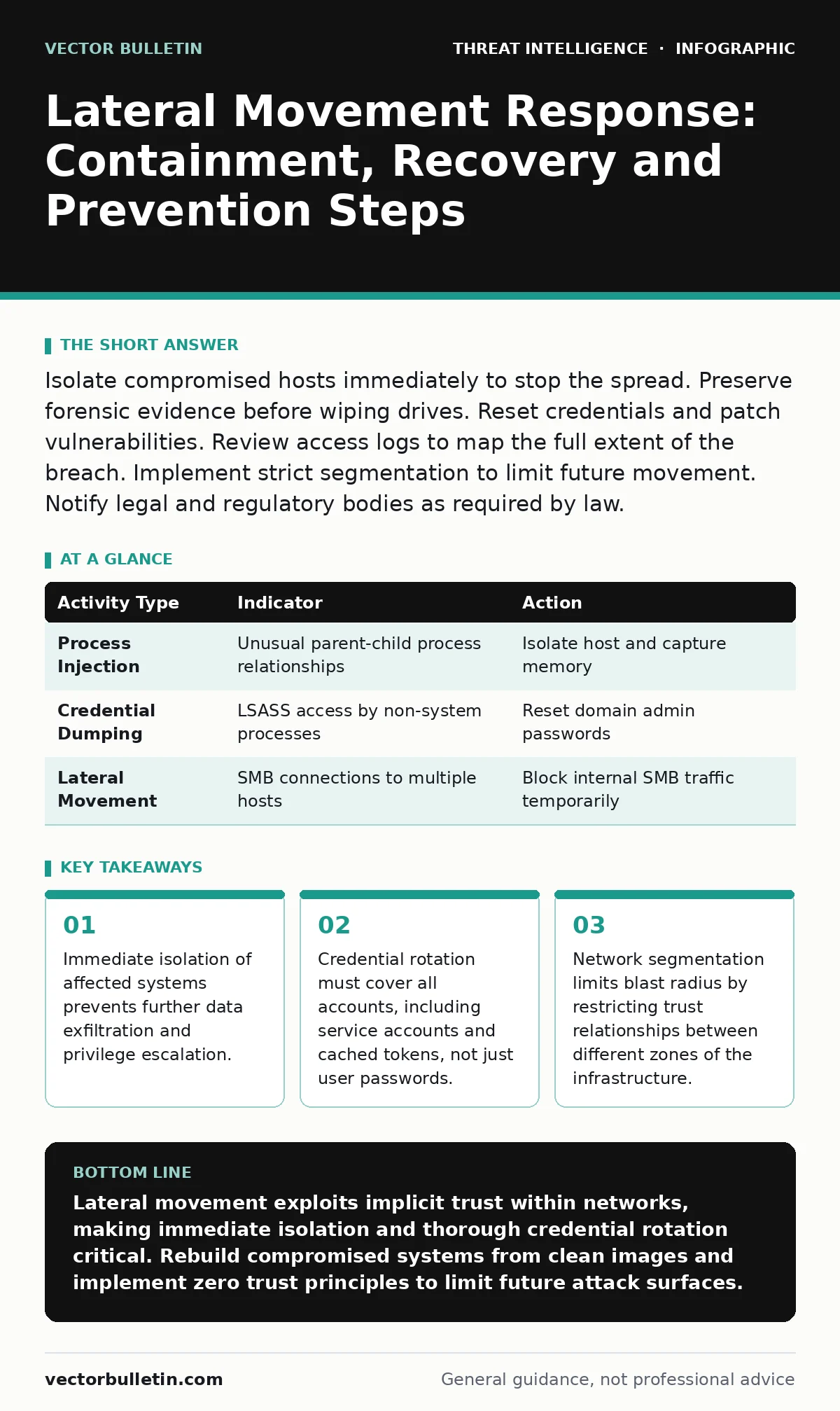
Isolate compromised hosts immediately to stop the spread. Preserve forensic evidence before wiping drives. Reset credentials and patch vulnerabilities. Review access logs to map the full extent of the breach. Implement strict segmentation to limit future movement. Notify legal and regulatory bodies as required by law.
First hour
Lateral movement occurs when an attacker moves through a network after gaining initial access, seeking higher privileges or sensitive data. Your first priority is to stop the spread without alerting the adversary to your awareness, which might cause them to destroy evidence or accelerate their actions.
- Identify the initial point of compromise using endpoint detection alerts or unusual login patterns.
- Isolate affected hosts from the network by disabling network interfaces or applying firewall rules that block all traffic.
- Preserve memory dumps and disk images from critical systems before any remediation steps begin.
- Disable compromised user accounts and service accounts to prevent further authentication attempts.
- Check for new administrative accounts or modified group policies that indicate privilege escalation.
Imagine an attacker has compromised a workstation via phishing. They use legitimate administrative tools to query Active Directory for other high-value targets. If you simply disconnect the internet, the attacker may still move laterally within the internal network. You must isolate the specific host from the entire network, including internal segments, to halt this movement.
First day
Containment requires a methodical approach to understand the scope of the breach. You must determine which systems the attacker accessed and what data they may have exfiltrated. This phase involves correlating logs from multiple sources to build a timeline of events.
Review your log management systems to identify anomalous behaviour. Look for unusual process executions, such as PowerShell scripts running from unexpected locations, or connections to internal servers from workstations that should not have access. Cross-reference these findings with identity and access management logs to spot impossible travel or concurrent logins from different locations.
| Activity Type | Indicator | Action |
|---|---|---|
| Process Injection | Unusual parent-child process relationships | Isolate host and capture memory |
| Credential Dumping | LSASS access by non-system processes | Reset domain admin passwords |
| Lateral Movement | SMB connections to multiple hosts | Block internal SMB traffic temporarily |
Threat actors often use living-off-the-land binaries, which are legitimate system tools abused for malicious purposes. These tools leave minimal traces, making detection difficult. You must look for behavioural anomalies rather than specific file hashes. For example, a web server process initiating a database connection is suspicious if the web server has no legitimate reason to access the database directly.
First week
Recovery involves restoring systems to a trusted state and verifying that the attacker has been fully removed. This is not a simple reboot. You must assume that any system touched by the attacker is compromised. Rebuild affected hosts from known-good images and restore data from backups that predate the breach.
Reset all credentials, including those for service accounts, API keys and database connections. Many organisations forget to rotate cached tokens or refresh OAuth tokens, allowing attackers to maintain access even after password changes. Verify that no backdoors, such as new user accounts or scheduled tasks, remain on the system.
Implement stricter access controls and network segmentation. Limit the ability of users and services to communicate with systems outside their immediate functional requirements. This reduces the attack surface and limits the impact of future breaches. Monitor for any signs of residual activity or attempts to re-establish access.
Who to tell
Notification obligations vary by jurisdiction and industry. You must inform internal stakeholders, including legal, human resources and executive leadership, to coordinate the response and manage reputational risk. External notifications may be required for regulators, customers and partners, depending on the type of data compromised.
Legal counsel should guide the notification process to ensure compliance with relevant laws and regulations. Delaying notifications can lead to significant fines and loss of trust. Be transparent about what happened, what data was affected and what steps you are taking to mitigate the impact.
How to stop a repeat
Preventing lateral movement requires a shift from perimeter defence to internal trust verification. Implement zero trust architecture, where every request for access is authenticated and authorised, regardless of its origin. This means verifying the identity of users, devices and applications before granting access to resources.
Use conditional access policies to enforce multi-factor authentication and device compliance checks. Restrict administrative privileges to dedicated accounts that are used only for specific tasks and are heavily monitored. Regularly review and audit access rights to ensure they align with job responsibilities.
Consider the cyber kill chain model to understand the stages of an attack and identify where your defences are weakest. Lateral movement occurs in the exploitation and installation stages. Strengthening your defences at these points can disrupt the attacker's progress and limit their ability to move through the network.
See also: Privileged Access Management: Answers to Your Hardest Questions · Prompt injection recovery in AI desktop apps: containment steps
Long-term resilience
Building long-term resilience involves continuous monitoring and improvement of your security posture. Conduct regular red team exercises to test your defences against realistic attack scenarios. These exercises help you identify vulnerabilities and improve your detection and response capabilities.
Invest in security awareness training for employees to reduce the risk of initial compromise via phishing or social engineering. Educate staff on recognising suspicious emails, links and attachments. A well-informed workforce is your first line of defence against many attacks.
Review and update your incident response plan regularly. Ensure that it reflects the current technology landscape and threat environment. Test the plan through tabletop exercises to identify gaps and improve coordination among teams.
Final verification
Before declaring the incident resolved, conduct a thorough review of all systems and processes. Verify that all compromised accounts have been disabled or reset. Ensure that all backdoors and malicious artifacts have been removed. Confirm that all affected systems have been rebuilt or patched.
Document the incident thoroughly, including the timeline of events, the actions taken and the lessons learned. Use this documentation to improve your security posture and prevent similar incidents in the future. Share insights with the broader security community to contribute to collective defence.
Imagine a scenario where an attacker uses a compromised service account to access a database. Even after resetting the password, if the attacker has cached credentials or tokens, they can regain access. You must invalidate all active sessions and tokens associated with the compromised account to ensure complete remediation.
Key takeaways
- Immediate isolation of affected systems prevents further data exfiltration and privilege escalation.
- Credential rotation must cover all accounts, including service accounts and cached tokens, not just user passwords.
- Network segmentation limits blast radius by restricting trust relationships between different zones of the infrastructure.
Lateral movement exploits implicit trust within networks, making immediate isolation and thorough credential rotation critical. Rebuild compromised systems from clean images and implement zero trust principles to limit future attack surfaces.
Frequently asked questions
How do I know if lateral movement has occurred?
Look for unusual network connections, such as workstations communicating with servers they do not normally access, or multiple logins from a single account in different locations.
Should I disconnect the entire network?
No, isolate only the affected hosts. Disconnecting the entire network can cause significant business disruption and may alert the attacker, causing them to destroy evidence.
What is the difference between lateral movement and privilege escalation?
Lateral movement is moving from one system to another, while privilege escalation is gaining higher access rights on the same system. Attackers often use both techniques.
Can honeypots help detect lateral movement?
Yes, honeypots can attract attackers and reveal their techniques. However, they are not a substitute for proper network segmentation and monitoring.
How this guide was produced: written by the Vector Bulletin editorial team with AI assistance, checked against the public references listed below, and reviewed when the facts change. See our editorial policy or report an error.