The Attack Lifecycle: Answers to Eight Common Questions
Defences fail because they assume linear progression, whereas modern adversaries move laterally through trusted internal paths before exfiltrating data.
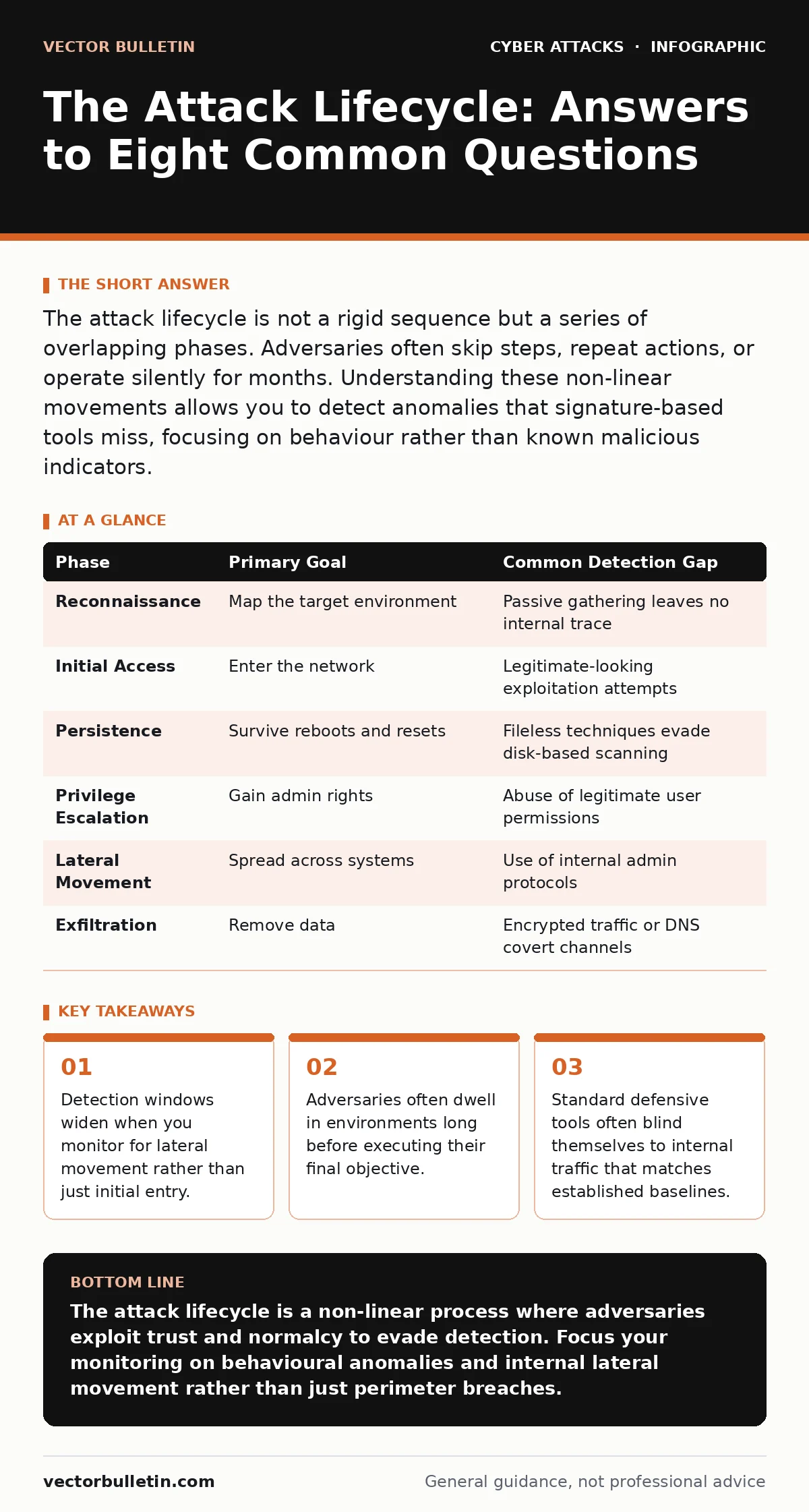
The attack lifecycle is not a rigid sequence but a series of overlapping phases. Adversaries often skip steps, repeat actions, or operate silently for months. Understanding these non-linear movements allows you to detect anomalies that signature-based tools miss, focusing on behaviour rather than known malicious indicators.
Does the attack lifecycle always follow a strict sequence?
No, the attack lifecycle is rarely a linear progression from start to finish. Adversaries frequently jump between phases, revisit earlier steps to maintain access, or operate in parallel threads. For example, an attacker may establish command and control while simultaneously performing reconnaissance on adjacent systems. Rigid models suggest a neat order, but real-world intrusions resemble a tangled web of activities. This non-linearity means that focusing solely on the "initial compromise" phase leaves the broader environment vulnerable to ongoing manipulation.
Can defenders detect activity during the reconnaissance phase?
Detection during reconnaissance is difficult because the traffic often resembles legitimate scanning or health checks. Adversaries use passive techniques, such as analysing public metadata or DNS records, which generate no network noise inside your perimeter. When active scanning occurs, they often throttle requests to stay below threshold limits set by intrusion detection systems. You can improve visibility by logging failed connection attempts and monitoring for unusual queries against directory services. However, much of this activity happens outside your direct control, making prevention reliant on limiting public exposure.
Why do initial access attacks often succeed against patch management?
Initial access succeeds because patch management addresses known vulnerabilities, not logic flaws or misconfigurations. Adversaries exploit weaknesses in how software is used, rather than bugs in the code itself. For instance, a correctly configured firewall may still allow malicious traffic if the application logic trusts input too readily. Furthermore, the time between a vulnerability disclosure and widespread patching creates a window of opportunity that automated exploits can traverse. This gap highlights the need for defensive depth, where a single failure point does not grant full system access.
How do adversaries maintain persistence after initial entry?
Persistence mechanisms rely on altering system configurations to survive reboots and credential changes. Common methods include creating scheduled tasks, modifying startup scripts, or injecting code into legitimate processes. These techniques are effective because they blend with normal administrative activity, evading basic integrity checks. Fileless malware is particularly dangerous here, as it resides in memory rather than on disk, leaving no static artefact for traditional antivirus scanners to find. Detecting this requires monitoring for behavioural anomalies, such as a web server process initiating outbound network connections.
Is lateral movement always noticeable in network logs?
Lateral movement often goes unnoticed because it uses legitimate administrative protocols and credentials. Adversaries adopt stolen identities to move between servers, making their traffic indistinguishable from routine management tasks. They may use remote desktop protocols or secure shell connections to execute commands on new hosts. Without strict baseline monitoring, this internal traffic appears benign. The hidden cost of permissive internal networking is that it provides a highway for attackers once the perimeter is breached.
See also: Lateral Movement: Risks and Protection for Small Businesses · Privileged Access Management: Answers to Your Hardest Questions
What is the purpose of privilege escalation in the lifecycle?
Privilege escalation allows an attacker to gain higher-level access rights than initially granted. This step is necessary because initial access usually provides limited user permissions, which are insufficient for data exfiltration or deeper system manipulation. Techniques range from exploiting kernel vulnerabilities to abusing misconfigured group policies. The trade-off for defenders is that restricting privileges can hinder operational efficiency, leading some teams to over-allocate rights for convenience. This convenience directly fuels the attacker's ability to climb the hierarchy.
How do adversaries exfiltrate data without triggering alerts?
Data exfiltration often succeeds by using encrypted channels or low-bandwidth techniques that mimic normal web traffic. Adversaries may compress and encrypt data before sending it to external servers, hiding the payload within standard HTTPS streams. Alternatively, they might use DNS tunneling, encoding data in domain name queries, which many security tools ignore. This method exploits the necessity of DNS for network function, turning a critical service into a covert channel. Without deep packet inspection or anomaly detection on DNS traffic, this exfiltration remains invisible.
Does the lifecycle end when data is stolen?
The lifecycle does not end with data theft; adversaries often maintain access for future operations. They may install backdoors or create dormant accounts to ensure re-entry if their current paths are discovered. This long-term presence turns a single incident into a persistent threat. Defending against this requires assuming breach and regularly auditing user accounts and service permissions. Refer to our guide on privileged access management for strategies on restricting these high-value targets. Ignoring the post-exfiltration phase allows attackers to use your infrastructure as a launching pad for further campaigns.
| Phase | Primary Goal | Common Detection Gap |
|---|---|---|
| Reconnaissance | Map the target environment | Passive gathering leaves no internal trace |
| Initial Access | Enter the network | Legitimate-looking exploitation attempts |
| Persistence | Survive reboots and resets | Fileless techniques evade disk-based scanning |
| Privilege Escalation | Gain admin rights | Abuse of legitimate user permissions |
| Lateral Movement | Spread across systems | Use of internal admin protocols |
| Exfiltration | Remove data | Encrypted traffic or DNS covert channels |
Why do traditional signature-based tools fail here?
Signature-based tools fail because they rely on known patterns of malicious code. Modern adversaries use polymorphic code, which changes its appearance with each execution, or completely custom scripts. These methods bypass static analysis, which looks for specific byte sequences or hashes. The hidden cost of relying on signatures is a false sense of security, where clean scans mask ongoing compromise. You must shift towards behavioural analysis, which looks for actions that violate expected system norms.
How does supply chain compromise alter this model?
Supply chain attacks bypass perimeter defenses entirely by trusting a third-party vendor. The adversary compromises a software update or a service provider, delivering malicious code directly to your systems. This alters the lifecycle by merging initial access with persistence, as the malicious component is often signed and trusted. Your guide on supply chain attacks details how to verify vendor integrity. In this scenario, the attack vector is not a vulnerability in your code, but a weakness in your trust model.
Key takeaways
- Detection windows widen when you monitor for lateral movement rather than just initial entry.
- Adversaries often dwell in environments long before executing their final objective.
- Standard defensive tools often blind themselves to internal traffic that matches established baselines.
The attack lifecycle is a non-linear process where adversaries exploit trust and normalcy to evade detection. Focus your monitoring on behavioural anomalies and internal lateral movement rather than just perimeter breaches.
Frequently asked questions
How is the attack lifecycle different from the kill chain?
The kill chain is a linear model used primarily by offensive operators, while the attack lifecycle describes the observed behaviour of defenders and attackers in a dynamic environment. The lifecycle accounts for loops, delays, and skipped steps that the rigid kill chain often ignores.
Can automation stop all phases of the attack lifecycle?
Automation can respond to known indicators quickly, but it struggles with novel techniques or subtle behavioural changes. Human analysis is still required to interpret context and determine if an anomaly is malicious or benign. Automation should augment, not replace, skilled investigation.
What is the most overlooked phase in the attack lifecycle?
Reconnaissance is often overlooked because it generates little noise inside the network. Adversaries gather public data and map networks passively before ever touching your systems. Failing to monitor for this early activity allows them to plan their entry with precision.
Does zero-trust architecture eliminate the attack lifecycle?
Zero-trust reduces the impact of lateral movement and privilege escalation by enforcing strict verification at every step. However, it does not prevent initial access or reconnaissance. It merely limits the damage an attacker can do once they breach a single point.
How this guide was produced: written by the Vector Bulletin editorial team with AI assistance, checked against the public references listed below, and reviewed when the facts change. See our editorial policy or report an error.