
Vulnerability Disclosure Policies for Small Teams
A structured disclosure process prevents minor technical flaws from becoming costly legal disputes by setting clear expectations for security researchers.
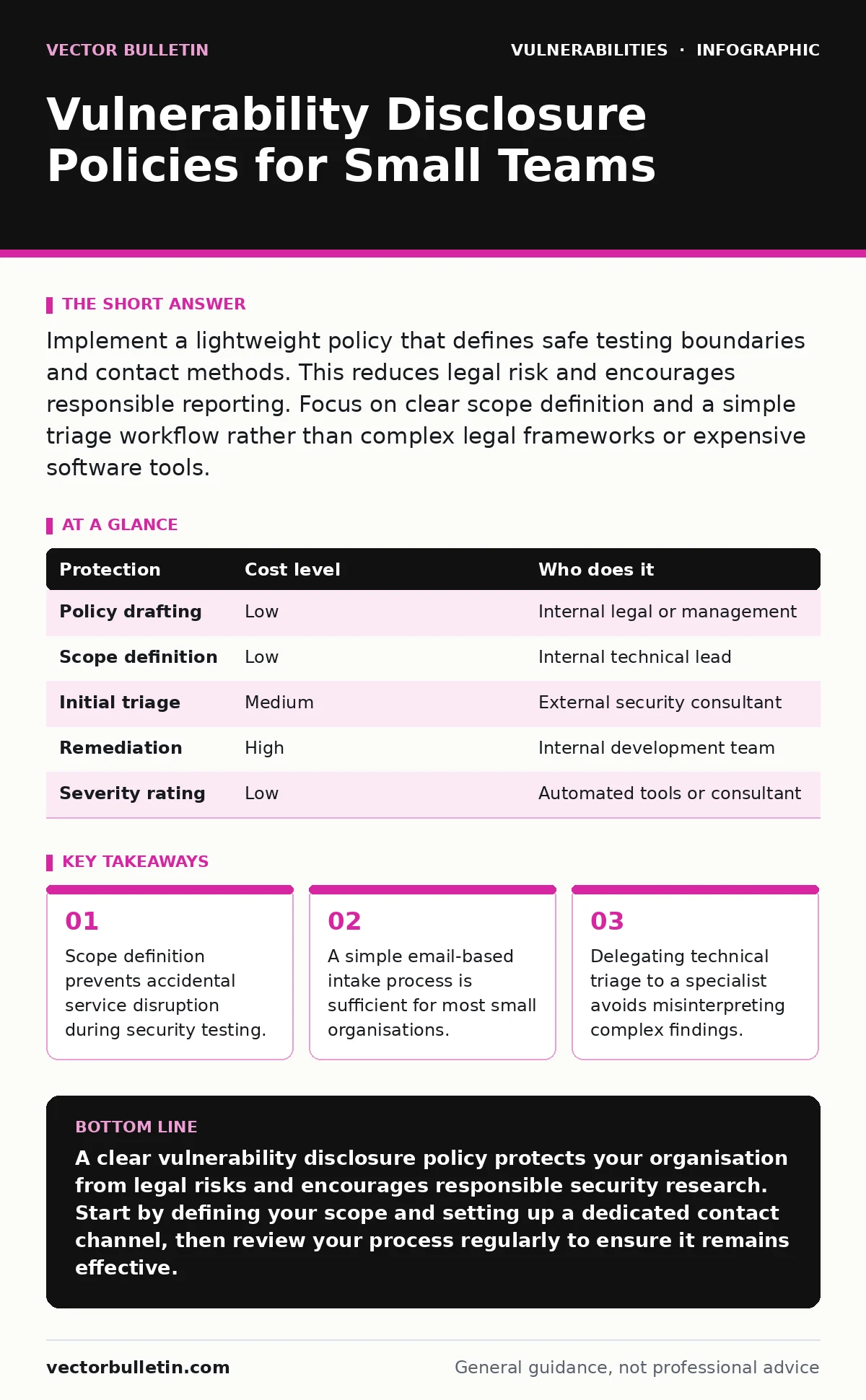
Implement a lightweight policy that defines safe testing boundaries and contact methods. This reduces legal risk and encourages responsible reporting. Focus on clear scope definition and a simple triage workflow rather than complex legal frameworks or expensive software tools.
The Hidden Liability of Silence
Many small organisations believe that vulnerability disclosure is only necessary for large enterprises with significant attack surfaces. This view overlooks the legal and operational risks inherent in ignoring unsolicited security reports. When a researcher discovers a flaw, such as insecure direct object references (IDOR), they face a dilemma. They can report it and risk being sued for unauthorised access, or they can remain silent and potentially disclose the issue publicly.
A written policy resolves this ambiguity. It grants implied permission for testing within defined boundaries. This transforms a potential legal confrontation into a cooperative security improvement. For a small team, the cost of drafting a simple policy is negligible compared to the cost of defending against an accusation of negligence or unauthorised access.
Defining the Technical Scope
The most critical component of your policy is the scope. You must specify which systems are in-scope for testing and which are out-of-scope. In-scope systems are those you explicitly allow researchers to test. Out-of-scope systems are those that must not be touched, often because they are third-party services or critical infrastructure that could cause widespread damage if disrupted.
Be precise about what is allowed. Prohibit techniques that cause denial of service, as these can crash your servers and disrupt legitimate users. Specify that social engineering or physical security testing is not permitted unless explicitly agreed upon in advance. Clarity here prevents accidental service disruption. If you are unsure how to classify a specific service, consult a specialist to ensure your definitions are technically accurate and legally sound.
The Intake Mechanism
You need a single, reliable channel for receiving reports. An email address dedicated to this purpose is sufficient for most small teams. Avoid using general support inboxes, as reports may be lost or delayed. Publish this contact method on your website, preferably in the footer or a dedicated security page.
When a report arrives, acknowledge receipt immediately. You do not need to confirm the validity of the finding in the first response. A simple message stating that you have received the report and will investigate is enough. This reassures the researcher that their effort is recognised. Delayed responses can lead to frustration and may encourage the researcher to publish the details themselves, which damages your reputation.
Triage and Validation
Receiving a report is only the first step. You must determine whether the reported issue is a genuine vulnerability or a false positive. A false positive is a finding that appears to be a vulnerability but is actually benign or already mitigated. This requires technical expertise. If your internal team lacks the skills to assess complex issues, such as cross-site scripting (XSS) variants or logic flaws, you risk misjudging the severity.
Misjudgement can lead to either ignoring a critical flaw or wasting resources on a non-issue. Consider delegating the initial technical assessment to a trusted third party. This ensures that your internal team only deals with confirmed issues that require remediation. It also provides an objective perspective on the severity of the finding, which helps in prioritising fixes.
Managing the Response
Once a vulnerability is confirmed, you must decide on the timeline for remediation. There is no universal standard, but a reasonable expectation is to provide a patch or mitigation within a few weeks for critical issues. Communicate this timeline to the researcher. Transparency builds trust.
If you cannot fix the issue immediately, explain why. Perhaps the fix requires a significant code refactor or a dependency update. Provide a temporary mitigation if possible. For example, if you cannot patch a web application firewall rule immediately, you might restrict access to the affected endpoint. This demonstrates that you are taking the issue seriously, even if the full solution is delayed.
See also: Edge Computing Security: Protecting Small Sites Without Heavy Infrastructure
What to Delegate
Small teams often struggle with the technical depth required to evaluate advanced vulnerabilities. You do not need to be an expert in every area of security. Instead, delegate specific tasks to specialists. This approach is more efficient and reduces the risk of oversight.
| Protection | Cost level | Who does it |
|---|---|---|
| Policy drafting | Low | Internal legal or management |
| Scope definition | Low | Internal technical lead |
| Initial triage | Medium | External security consultant |
| Remediation | High | Internal development team |
| Severity rating | Low | Automated tools or consultant |
Using vulnerability severity ratings helps prioritise work. These ratings provide a standardised way to assess the impact and likelihood of exploitation. By delegating the initial triage and severity assessment, you ensure that your development team focuses on the most critical issues first. This optimises resource allocation and improves overall security posture.
Questions for Your IT Provider
If you rely on an IT provider for your infrastructure, you must clarify their role in vulnerability management. Do not assume they handle disclosure. Ask specific questions to ensure there are no gaps in responsibility.
- Who is responsible for receiving and acknowledging vulnerability reports?
- What is the process for validating reported issues?
- How are severity levels determined and communicated?
- What is the expected timeline for remediation?
- How is the researcher notified of the outcome?
These questions ensure that your provider has a clear process in place. It also helps you understand how their services integrate with your own security operations. If their answers are vague, consider seeking a more specialised provider or handling these tasks internally.
Integrating with Development
Vulnerability disclosure is not just a reactive process. It should inform your development practices. If you frequently receive reports about the same type of vulnerability, such as leaked cloud access keys or file metadata exposure, it indicates a systemic issue.
Address these root causes through secure code review and improved development training. This proactive approach reduces the number of vulnerabilities entering your systems. It also demonstrates to researchers that you are committed to continuous improvement. This can encourage more responsible disclosure and foster a stronger security community around your organisation.
Key takeaways
- Scope definition prevents accidental service disruption during security testing.
- A simple email-based intake process is sufficient for most small organisations.
- Delegating technical triage to a specialist avoids misinterpreting complex findings.
A clear vulnerability disclosure policy protects your organisation from legal risks and encourages responsible security research. Start by defining your scope and setting up a dedicated contact channel, then review your process regularly to ensure it remains effective.
Frequently asked questions
Do I need a legal team to write a vulnerability disclosure policy?
No, a simple policy can be drafted by technical and management staff. Legal review is helpful but not strictly necessary for basic policies.
How long should I keep vulnerability reports?
Keep reports for the lifetime of the affected system plus a reasonable period for legal protection. This ensures you have a record of the issue and its resolution.
Can I offer rewards for vulnerability reports?
Rewards are optional. They can encourage reporting but may also attract low-quality submissions. Consider your resources and goals before implementing a reward programme.
What if a researcher publishes a vulnerability before I can fix it?
Respond professionally. Acknowledge the report and explain the steps you are taking. Avoid blame or threats. This maintains your reputation and encourages future cooperation.
How this guide was produced: written by the Vector Bulletin editorial team with AI assistance, checked against the public references listed below, and reviewed when the facts change. See our editorial policy or report an error.