
Personal data for small businesses: how to collect less and survive
Small organisations hold more sensitive records than they realise, creating legal exposure without proportional business value.
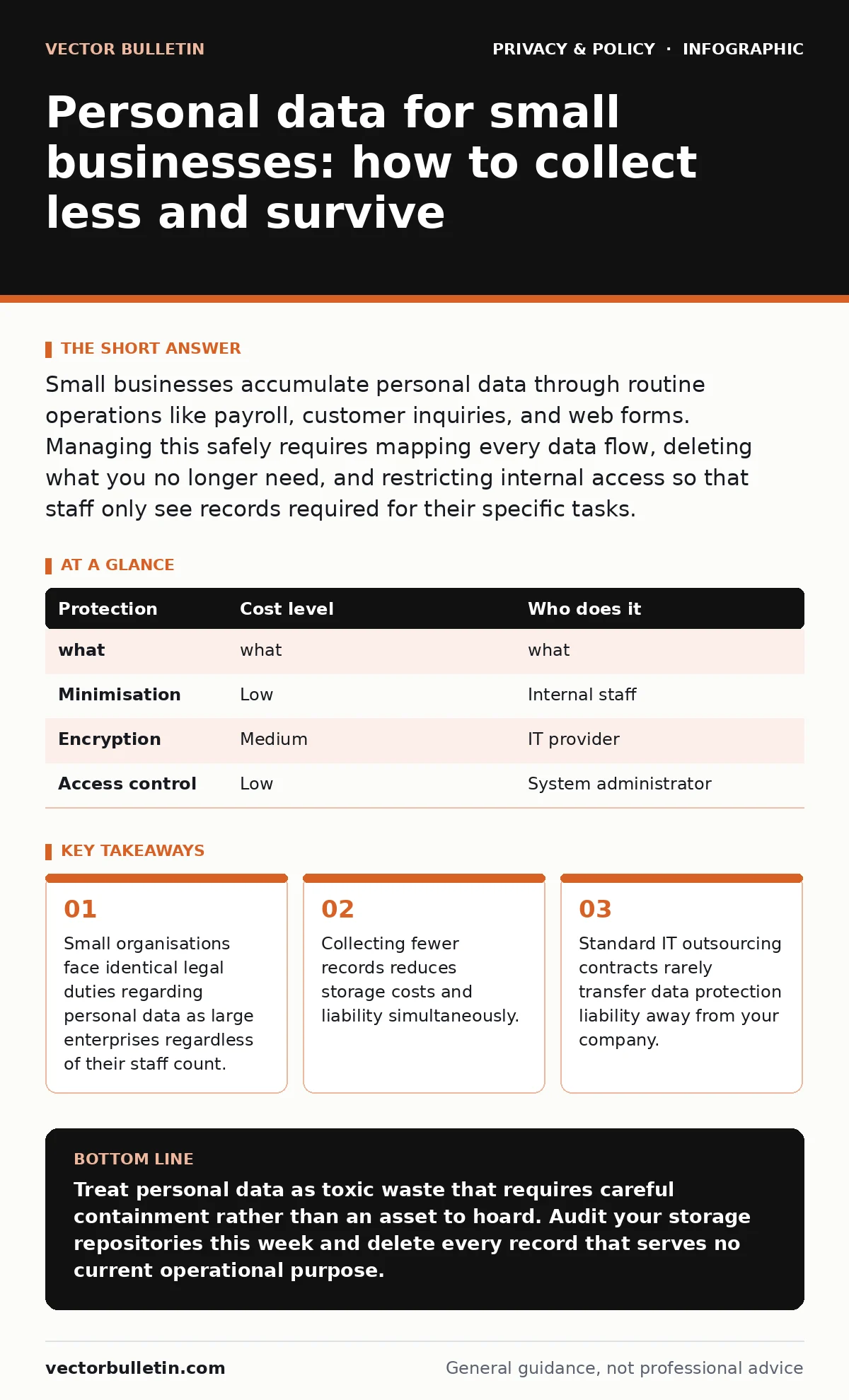
Small businesses accumulate personal data through routine operations like payroll, customer inquiries, and web forms. Managing this safely requires mapping every data flow, deleting what you no longer need, and restricting internal access so that staff only see records required for their specific tasks.
Why personal data matters at small scale
Personal data creates liability that scales with retention time rather than company size. Regulators and civil claimants do not offer exemptions for firms with fewer employees when records leak. Small businesses often assume that their obscurity protects them from scrutiny. Automated scanning tools and disgruntled former employees invalidate that assumption quickly.
Holding unnecessary information increases your blast radius during a security incident. Every customer birthdate or employee tax identifier stored on a local desktop is another vector for identity theft. Minimising collection means you have less to lose when systems fail. You cannot leak what you never stored in your servers.
The hidden cost of holding everything
Storage is cheap, but liability is expensive. Keeping customer correspondence indefinitely feels prudent until a discovery request forces you to search ten years of archived email boxes. Legal counsel fees dwarf the perceived value of historical customer records.
Data accumulation also degrades operational efficiency. Staff spend valuable hours wading through duplicate files and outdated contact lists. Sorting through clutter obscures the genuine records that require careful handling. Treating data as an asset rather than waste leads to perpetual hoarding.
| Protection | Cost level | Who does it |
|---|---|---|
| what | what | what |
| Minimisation | Low | Internal staff |
| Encryption | Medium | IT provider |
| Access control | Low | System administrator |
How to map your data flows
Data mapping reveals where information enters your systems, where it travels, and where it rests. You must trace a customer record from the initial web form submission through to accounting software and long-term archives. Most firms discover data residing in shadow IT tools adopted by individual departments without management approval.
Unauthorised spreadsheets on personal laptops represent the greatest point of failure in small organisations. Staff copy database exports to local machines for offline work and forget them there. Centralising storage allows you to apply uniform retention rules and access controls.
Practical handling techniques for daily operations
Data minimisation requires strict discipline regarding web forms and customer intake procedures. Ask only for the minimum details necessary to complete a transaction. Deleting information automatically after a defined retention period prevents archives from swelling indefinitely.
Access control limits internal exposure to sensitive records. A receptionist needs names and phone numbers, but rarely requires access to bank routing numbers or staff performance reviews. Principle of least privilege ensures that a compromised user account only exposes a fraction of your total holdings.
What to ask your IT provider
Outsourced technology vendors manage infrastructure, but your organisation retains legal accountability for the data. You must interrogate their operational practices before handing over administrative keys. Clear contractual boundaries prevent disastrous misunderstandings during an incident.
- Where do backups reside geographically, and are those backup archives encrypted at rest?
- What is your standard procedure and timeline for returning or destroying our data if we terminate this contract?
- Which specific personnel have administrative access to our primary tenant environment?
- Do you monitor for unauthorised data exfiltration or anomalous file downloads from our storage repositories?
- How do you handle software updates for custom databases built specifically for our operations?
See also: Data Subject Access Requests: How to Handle Them Correctly
Managing third-party risk and vendors
Payroll processors, customer support platforms, and email marketing tools hold your most sensitive assets. Each vendor represents a potential backdoor into your business network. You must review their security posture with the same rigour you apply to your own workstations.
Data sovereignty laws dictate where records may travel physically across national borders. Storing customer records in foreign jurisdictions can violate regulations instantly. Ensure your vendors guarantee regional data residency if your industry demands strict geographical boundaries.
Preparing for the inevitable deletion request
Individuals possess the legal right to demand the complete erasure of their personal records from your systems. Complying with such requests manually is notoriously difficult when data is scattered across disparate folders and physical filing cabinets. You need a predictable workflow to locate and purge records upon demand.
Backup archives complicate deletion requests because historical snapshots preserve data long after live records are scrubbed. IT providers must explain how their backup rotation handles permanent erasure. Sometimes, implementing privacy by design from the outset is the only way to ensure downstream compliance without catastrophic engineering overhead.
Key takeaways
- Small organisations face identical legal duties regarding personal data as large enterprises regardless of their staff count.
- Collecting fewer records reduces storage costs and liability simultaneously.
- Standard IT outsourcing contracts rarely transfer data protection liability away from your company.
Treat personal data as toxic waste that requires careful containment rather than an asset to hoard. Audit your storage repositories this week and delete every record that serves no current operational purpose.
Frequently asked questions
Do sole traders need to worry about personal data protection laws?
Sole traders handling client records face the same regulatory expectations as larger corporations, as laws focus on the sensitivity of the data rather than the size of the entity.
How long should a small business keep customer invoices?
Retention periods are dictated by local tax authorities and financial regulations, which typically require records for several years before lawful deletion.
Can we use standard consumer cloud storage for client files?
Consumer cloud accounts lack the administrative controls, audit logs, and security features required to demonstrate appropriate handling of sensitive personal data.
What happens if an employee stores customer data on a personal device?
Unmanaged personal devices bypass corporate security controls, creating regulatory liabilities and making data deletion requests nearly impossible to fulfil.
How this guide was produced: written by the Vector Bulletin editorial team with AI assistance, checked against the public references listed below, and reviewed when the facts change. See our editorial policy or report an error.