
Privacy by Design: Seven Technical Practices for Secure Data
Embedding privacy controls into system architecture reduces liability more effectively than retroactive policy updates or user consent forms.
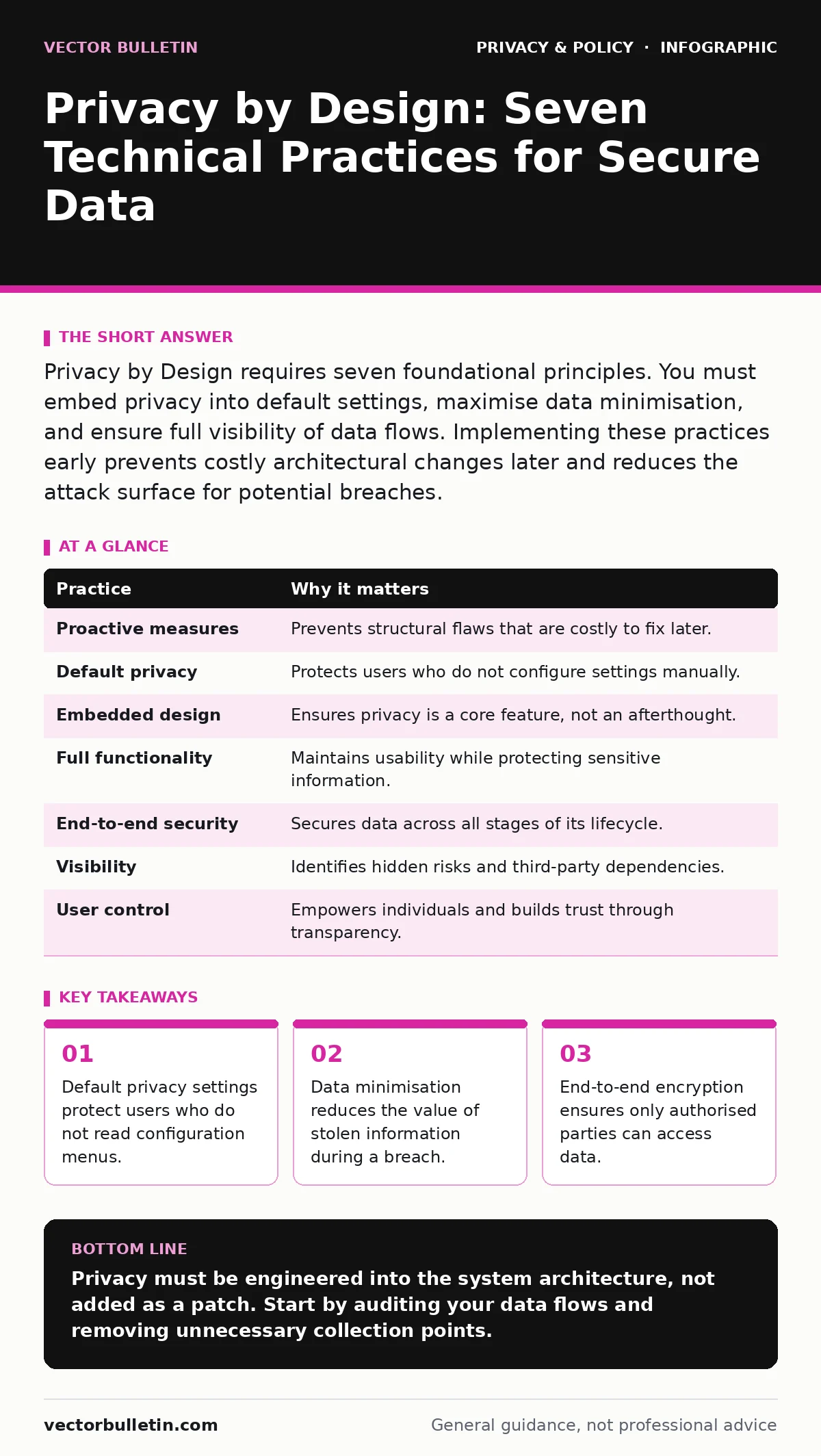
Privacy by Design requires seven foundational principles. You must embed privacy into default settings, maximise data minimisation, and ensure full visibility of data flows. Implementing these practices early prevents costly architectural changes later and reduces the attack surface for potential breaches.
1. Proactive Not Reactive
Security teams often treat privacy as a compliance checklist completed after development. This approach fails because privacy issues are structural. If a system is designed to collect excessive data, removing that capability later requires rewriting core logic. You must identify privacy risks before code is written.
Imagine a social platform that collects location data by default to sell ads. Changing this later angers users and requires complex data purging. Instead, design the system to collect only what is strictly necessary for the primary function. This aligns with the concept of privacy by design, where protection is built in from the start.
2. Privacy as the Default
Users rarely change default settings. If a system defaults to public profiles or data sharing, most users will remain exposed. You must configure systems so the most privacy-preserving option is the automatic choice. This shifts the burden from the user to the designer.
This practice relies on nudge theory. By making privacy the path of least resistance, you reduce human error. For example, a camera application should default to blurring faces unless the user explicitly disables it. This ensures protection even for those who lack technical knowledge or time to configure settings.
3. Embed Privacy into Design
Privacy cannot be an add-on. It must be integrated into the architecture itself. This means selecting technologies that support privacy goals natively. Using end-to-end encryption is a structural choice, not just a feature toggle. It ensures that even if storage is compromised, data remains unreadable.
Consider the difference between encrypting data at rest versus in transit. Both are necessary, but they serve different purposes. If your architecture relies on a centralised data lake without encryption, you have created a high-value target. Designing for privacy means choosing distributed storage or encrypted databases from the outset.
4. Full Functionality
Privacy and security must not compromise utility. If a privacy control makes a system unusable, users will bypass it. You must ensure that positive sum outcomes are achieved. Both parties—the user and the service provider—should benefit from the design.
Suppose a health app requires face recognition to unlock, but the feature is slow and unreliable. Users will disable it to access their data quickly. This creates a vulnerability. Instead, offer alternative authentication methods that are both secure and convenient. Balance is key; privacy should enhance, not hinder, the user experience.
5. End-to-End Security
Data travels through multiple stages: collection, processing, storage, and deletion. Each stage presents a risk. You must secure data at every point. End-to-end encryption protects data in transit, while strong access controls protect it at rest.
Deletion is often the weakest link. If data is not securely erased, it can be recovered. Use cryptographic erasure, where deleting the key renders the data unreadable. This is more reliable than overwriting files, which can be bypassed by forensic tools. Ensure that third-party processors also adhere to these standards.
See also: Breach Notification Laws: What You Must Report and When
6. Visibility and Transparency
Hidden data flows are a major risk. You must map every data asset and its journey. This includes third-party services, analytics tools, and backup systems. Lack of visibility leads to unexpected data exposure.
Imagine a web application that sends user data to an analytics provider. If that provider breaches, your users are affected. By maintaining a data flow diagram, you can identify these dependencies. Regular privacy audits help verify that these flows remain secure and compliant over time. Transparency builds trust and enables better risk management.
7. Respect for User Privacy
Users must have control over their data. This includes the right to access, correct, and delete their information. Design systems that make these actions easy. Complex opt-out processes or buried settings violate this principle.
Provide clear mechanisms for users to manage their preferences. For instance, allow users to download their data in a standard format. This empowers them and reduces friction. Additionally, consider using email aliases to protect user identities in public forums. These small features demonstrate respect for user autonomy.
| Practice | Why it matters |
|---|---|
| Proactive measures | Prevents structural flaws that are costly to fix later. |
| Default privacy | Protects users who do not configure settings manually. |
| Embedded design | Ensures privacy is a core feature, not an afterthought. |
| Full functionality | Maintains usability while protecting sensitive information. |
| End-to-end security | Secures data across all stages of its lifecycle. |
| Visibility | Identifies hidden risks and third-party dependencies. |
| User control | Empowers individuals and builds trust through transparency. |
Implementation Challenges
Implementing these practices requires cross-functional collaboration. Engineers, legal teams, and product managers must work together. Silos lead to gaps in coverage. For example, engineers may not understand legal requirements, while legal teams may lack technical insight.
Regular training helps bridge this gap. Include privacy considerations in code reviews and sprint planning. This ensures that privacy is continuously evaluated. Additionally, monitor for workplace monitoring tools that may inadvertently collect excessive data. Ensure these tools are configured to respect privacy boundaries.
Data Minimisation in Practice
Collecting less data is one of the most effective privacy measures. Every data point you collect is a liability. Reduce the scope of collection to only what is necessary. This principle, known as data minimisation, reduces the impact of potential breaches.
For instance, if you need to verify a user's age, you do not need their full birth date. A simple yes/no question suffices. This reduces the risk of identity theft. Additionally, consider file metadata which often contains hidden information. Strip metadata from uploaded files to prevent accidental leakage.
Continuous Improvement
Privacy is not a one-time task. Technologies and threats evolve. You must continuously review and update your privacy measures. Regular privacy audits help identify new risks. Engage with users to understand their concerns and adapt accordingly.
Stay informed about emerging standards and best practices. Participate in industry groups and share knowledge. This collective effort strengthens the overall security posture. Remember, privacy by design is a journey, not a destination.
Key takeaways
- Default privacy settings protect users who do not read configuration menus.
- Data minimisation reduces the value of stolen information during a breach.
- End-to-end encryption ensures only authorised parties can access data.
Privacy must be engineered into the system architecture, not added as a patch. Start by auditing your data flows and removing unnecessary collection points.
Frequently asked questions
How does privacy by design differ from data protection?
Data protection focuses on securing existing data, while privacy by design integrates privacy controls into the system architecture from the initial planning stages.
Is privacy by design only for large enterprises?
No, small organisations benefit significantly by reducing liability and building trust. The principles are scalable and can be applied to projects of any size.
Does privacy by design increase development costs?
Initial costs may be higher, but it reduces long-term expenses by avoiding costly retrofits, legal penalties, and reputation damage from data breaches.
How do we measure the success of privacy by design?
Success is measured by reduced data exposure, fewer privacy incidents, and positive user feedback regarding control and transparency.
How this guide was produced: written by the Vector Bulletin editorial team with AI assistance, checked against the public references listed below, and reviewed when the facts change. See our editorial policy or report an error.