
AI governance meaning: controls for model risk and data integrity
AI governance is not a policy document but a technical control plane that enforces data boundaries and validates model outputs before they reach production systems.
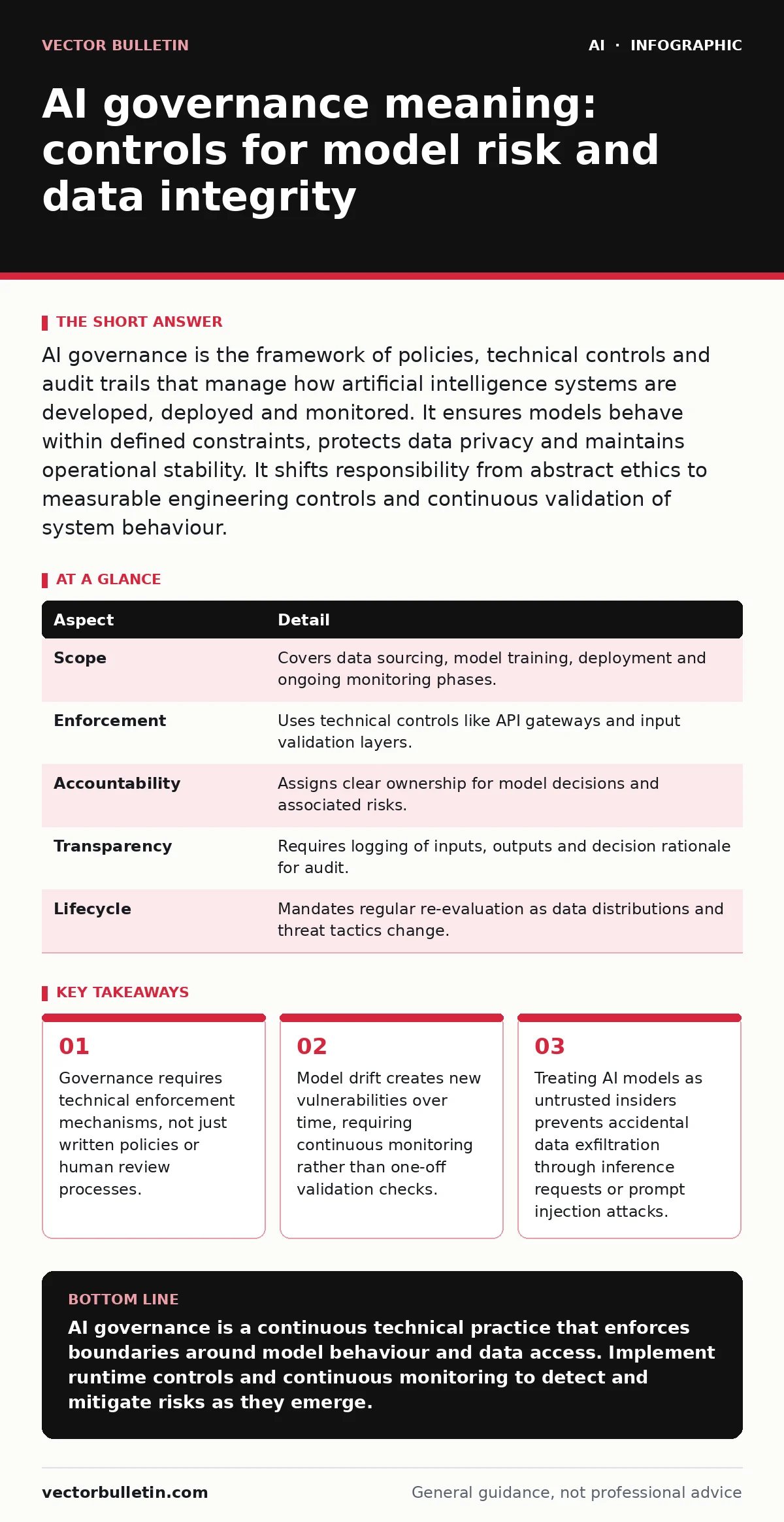
AI governance is the framework of policies, technical controls and audit trails that manage how artificial intelligence systems are developed, deployed and monitored. It ensures models behave within defined constraints, protects data privacy and maintains operational stability. It shifts responsibility from abstract ethics to measurable engineering controls and continuous validation of system behaviour.
The mechanics of control
Imagine a traditional software deployment pipeline where every code change undergoes static analysis, dynamic testing and version control. AI governance applies this same rigour to probabilistic systems. Unlike deterministic code, an AI model does not follow explicit instructions but predicts outcomes based on patterns in training data. This fundamental difference means traditional security controls often fail. You cannot simply scan a neural network for known vulnerabilities because the risk lies in its behaviour, not its structure.
Governance works by establishing boundaries around input data, model parameters and output actions. It defines what the system is permitted to access and what decisions it is authorised to make. This creates a containment strategy that limits the blast radius of any unexpected behaviour. The mechanism relies on continuous verification rather than static compliance checks.
| Aspect | Detail |
|---|---|
| Scope | Covers data sourcing, model training, deployment and ongoing monitoring phases. |
| Enforcement | Uses technical controls like API gateways and input validation layers. |
| Accountability | Assigns clear ownership for model decisions and associated risks. |
| Transparency | Requires logging of inputs, outputs and decision rationale for audit. |
| Lifecycle | Mandates regular re-evaluation as data distributions and threat tactics change. |
Who bears the responsibility
AI governance affects every role in the technology stack, from data engineers to executive leadership. Developers must implement secure-by-design practices during model creation. This includes data sanitisation and adversarial testing. Operations teams are responsible for monitoring model performance and detecting anomalies in production. Legal and compliance officers define the regulatory boundaries and ensure alignment with standards.
The burden extends to third-party vendors. Many organisations integrate external AI services without understanding the underlying data handling practices. This introduces significant supply chain risks. If a vendor updates their model without notice, your governance controls may no longer apply. You must treat external AI providers as untrusted insiders. Verify their security posture and maintain the ability to disconnect their services instantly if anomalies occur.
What to do about implementation
Start by mapping your data flows. Identify where sensitive information enters the AI lifecycle and where it might exit. Implement strict data classification and access controls. Encrypt data at rest and in transit. Use tokenisation or differential privacy where appropriate to reduce exposure. Document every data transformation step. This lineage is critical for auditing and troubleshooting.
Next, define operational boundaries. Determine which decisions the AI can make autonomously and which require human oversight. Implement circuit breakers that halt automatic actions if confidence scores drop below a threshold. Log all interactions. These logs serve as evidence for audits and help identify patterns of abuse or error. Regularly review these logs to detect subtle shifts in behaviour.
Common misconceptions about governance
Many organisations mistake AI governance for a one-time compliance exercise. They create a policy document, obtain sign-off and consider the matter resolved. This approach fails because AI systems are dynamic. Models degrade over time as real-world data diverges from training data. This phenomenon, known as model drift, can introduce new biases or vulnerabilities. Governance must be continuous and adaptive.
Another error is assuming that open-source models are inherently safer because the code is visible. Transparency does not equal security. You still need to verify the provenance of the training data and the integrity of the model weights. Without proper verification, you may inadvertently deploy a model that contains backdoors or leaked sensitive data. Understanding AI transparency helps clarify what is actually visible and what remains hidden in the weights.
Technical controls for enforcement
Policy statements alone do not stop a compromised model from exfiltrating data. You need technical controls that enforce boundaries at runtime. Implement input sanitisation to strip structured data that could trigger prompt injection. Use output filtering to block responses containing sensitive information or malicious instructions. Rate limiting prevents abuse and reduces the cost of denial-of-service attacks.
Isolate AI workloads from core infrastructure. Run models in containerised environments with minimal privileges. Monitor network traffic for unusual data transfers. If a model attempts to access external services or internal databases it should not reach, block the connection. These controls reduce the attack surface and limit the impact of any breach. Consider the risks of sensitive data leaks through AI chatbots when designing these boundaries.
Monitoring and continuous improvement
Deployment is not the end of governance. It is the beginning of monitoring. Track key metrics such as error rates, latency and confidence scores. Set alerts for significant deviations from baseline performance. Investigate every alert thoroughly. A drop in accuracy might indicate data poisoning or adversarial attacks. Regularly retrain models with fresh, verified data to counteract drift.
Conduct periodic red teaming exercises. Simulate attacks to test the resilience of your controls. Identify gaps in input validation and output filtering. Update your governance framework based on these findings. This iterative process ensures that your defences evolve alongside emerging threats. Integrating machine learning in cybersecurity can help automate some of these monitoring tasks, but human oversight remains necessary for complex decisions.
Addressing synthetic media risks
Governance must also account for the creation and use of synthetic content. AI models can generate realistic audio, video and text. This capability raises concerns about misinformation and fraud. Implement watermarks or metadata standards to distinguish AI-generated content from real content. Verify the authenticity of media before publishing or using it in critical processes.
Establish clear guidelines for the use of synthetic media in marketing and communications. Ensure that users are aware when they are interacting with AI-generated content. This builds trust and reduces the risk of reputational damage. Regularly review these guidelines to keep pace with advancing generation techniques. The ability to fine-tune models for specific tasks must be balanced against the risk of creating highly persuasive deceptive content.
Key takeaways
- Governance requires technical enforcement mechanisms, not just written policies or human review processes.
- Model drift creates new vulnerabilities over time, requiring continuous monitoring rather than one-off validation checks.
- Treating AI models as untrusted insiders prevents accidental data exfiltration through inference requests or prompt injection attacks.
- Effective governance isolates high-risk decision-making paths and enforces strict data lineage tracking throughout the lifecycle.
AI governance is a continuous technical practice that enforces boundaries around model behaviour and data access. Implement runtime controls and continuous monitoring to detect and mitigate risks as they emerge.
Frequently asked questions
Is AI governance only for large enterprises?
No, any organisation using AI systems faces risks that require governance. Small teams can implement basic controls like input validation and output filtering to protect their data and reputation. The scale of governance should match the risk profile of the use case.
How does AI governance differ from data governance?
Data governance focuses on the quality, availability and security of data assets. AI governance extends this to include the behaviour of models that process that data. It addresses unique risks like model drift, adversarial attacks and decision transparency that traditional data governance does not cover.
Can automation replace human oversight in AI governance?
Automation can handle routine monitoring and enforcement tasks, but human oversight is necessary for complex decisions. Automated systems may miss novel attack patterns or ethical nuances. A hybrid approach combines automated controls with regular human review and audit.
What is the first step in building an AI governance framework?
Start by identifying all AI systems in use and mapping their data flows. Understand what data each model accesses and what decisions it influences. This inventory provides the foundation for defining controls and assigning responsibilities.
How this guide was produced: written by the Vector Bulletin editorial team with AI assistance, checked against the public references listed below, and reviewed when the facts change. See our editorial policy or report an error.