
Neural Networks: Frequently Asked Questions Answered
Neural networks do not understand meaning; they map statistical correlations between inputs and outputs, which creates specific blind spots for adversarial manipulation.
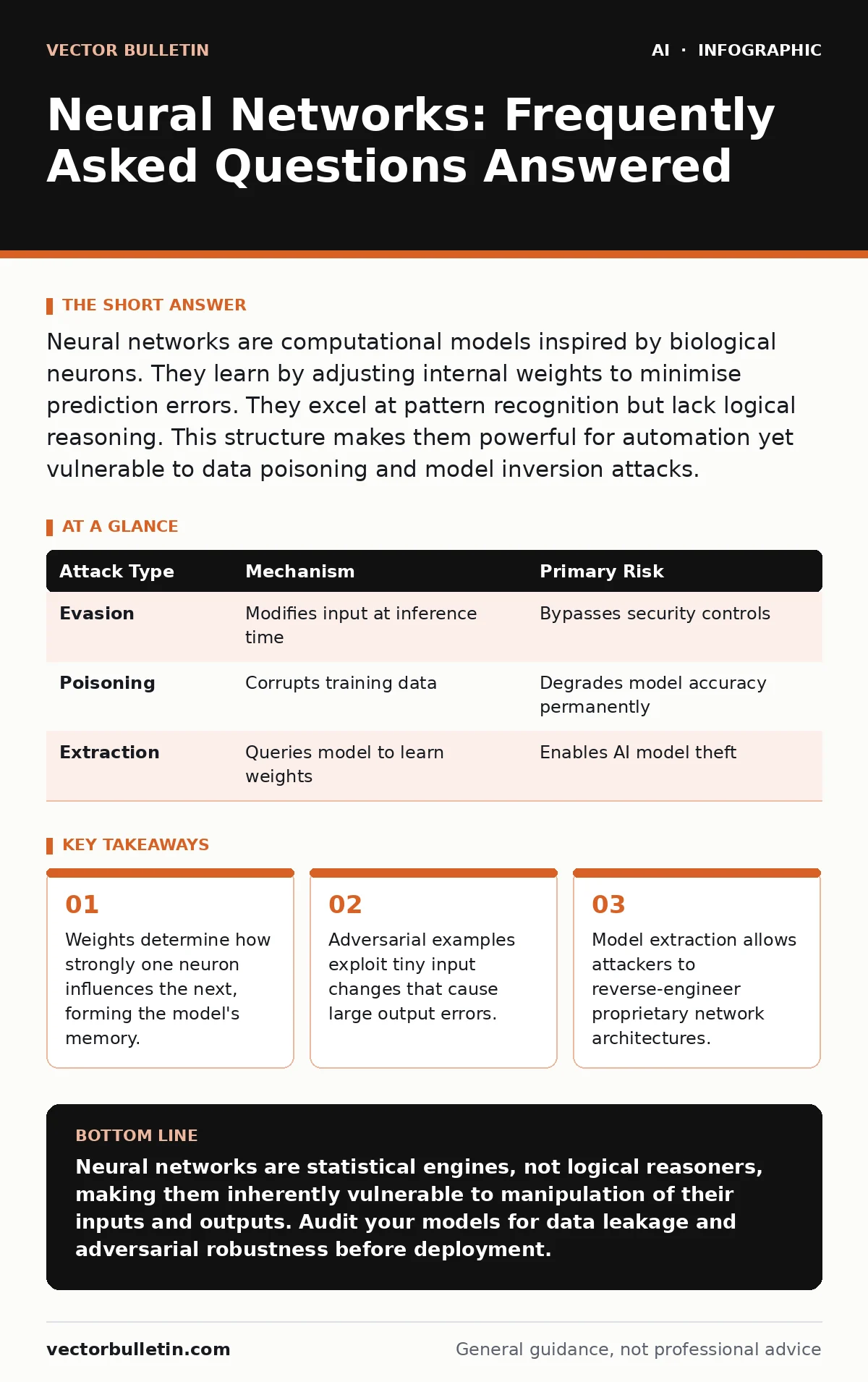
Neural networks are computational models inspired by biological neurons. They learn by adjusting internal weights to minimise prediction errors. They excel at pattern recognition but lack logical reasoning. This structure makes them powerful for automation yet vulnerable to data poisoning and model inversion attacks.
What is a neural network?
A neural network is a computational system composed of interconnected layers of nodes, known as neurons. Each connection has a weight that adjusts during training to minimise the difference between predicted and actual outputs. This structure allows the system to approximate complex functions without explicit programming for every rule.
How do neural networks learn?
Learning occurs through a process called backpropagation, which calculates how much each weight contributed to the final error. The system then updates these weights in small increments to reduce future mistakes. This iterative adjustment continues until the model achieves an acceptable level of accuracy on unseen data.
Why do neural networks fail unexpectedly?
Neural networks optimise for statistical correlation, not causal understanding. They may rely on spurious features, such as the presence of snow in images of wolves, rather than the animal’s shape. This fragility means that minor, imperceptible changes to input data can cause the model to produce wildly incorrect outputs.
Imagine a system trained to detect spam emails. If it learns that emails containing the word "urgent" are always spam, an attacker can bypass it by using synonyms. The model fails because it memorised a shortcut rather than understanding intent. This behaviour is a core concern when reviewing machine learning in cybersecurity.
What is an adversarial attack?
An adversarial attack involves adding carefully calculated noise to input data to deceive the network. This noise is often invisible to humans but shifts the input across the model’s decision boundary. The result is a high-confidence prediction that is completely wrong.
| Attack Type | Mechanism | Primary Risk |
|---|---|---|
| Evasion | Modifies input at inference time | Bypasses security controls |
| Poisoning | Corrupts training data | Degrades model accuracy permanently |
| Extraction | Queries model to learn weights | Enables AI model theft |
These attacks highlight that security cannot rely solely on data accuracy. You must assume the input stream can be manipulated. Refer to MITRE ATLAS for a structured view of these adversarial techniques.
Can neural networks leak data?
Yes, through techniques like model inversion or membership inference. An attacker queries the model repeatedly to reconstruct training data or determine if a specific record was used. This is particularly risky when models are trained on sensitive personal or financial information.
This risk extends beyond the model itself. If you integrate third-party APIs, you face AI supply chain risks where the provider’s security posture affects your data exposure.
What is overfitting and why is it dangerous?
Overfitting occurs when a network memorises the training data rather than learning generalisable patterns. The model performs perfectly on known examples but fails on new, real-world inputs. This creates a false sense of security during testing phases.
To detect overfitting, compare performance on training data versus a held-out validation set. A large gap indicates the model is too complex for the available data. Simplifying the architecture or adding more diverse data usually resolves this issue.
How do you secure a neural network?
Security requires defence-in-depth, starting with rigorous data validation and ending with continuous monitoring. You must assume that the model will be probed for weaknesses. Implementing input sanitisation prevents malformed data from triggering internal errors or revealing architecture details.
Consider the broader context of AI transparency when deploying models. If you cannot explain a decision, you cannot effectively defend it against challenge or audit.
What are the limits of neural networks?
Neural networks struggle with tasks requiring long-term reasoning, logical consistency, or factual grounding. They generate plausible-sounding text or images but do not verify truth. This limitation makes them prone to hallucinations, where they invent facts with high confidence.
This limitation is particularly relevant when deploying securing AI agents that act autonomously. An agent that hallucinates a command can cause significant operational damage.
How does fine-tuning affect security?
Fine-tuning adapts a pre-trained model to a specific task using a smaller dataset. This process can introduce new vulnerabilities if the fine-tuning data is biased or poisoned. It may also reduce the model’s general robustness, making it more susceptible to domain-specific attacks.
You must validate the fine-tuned model against the same adversarial benchmarks as the original. The security posture can degrade significantly during this phase. For deeper technical details, see our guide on fine-tuning.
Can neural networks be stolen?
Yes, through model extraction or query-based attacks. An attacker sends many inputs to a model and records the outputs to build a surrogate model that mimics its behaviour. This surrogate can then be used to bypass security controls or generate adversarial examples.
This form of AI model theft does not require access to the underlying code or weights. It only requires the ability to query the API. Rate limiting and output perturbation can mitigate this risk, but they may impact legitimate user experience.
Key takeaways
- Weights determine how strongly one neuron influences the next, forming the model's memory.
- Adversarial examples exploit tiny input changes that cause large output errors.
- Model extraction allows attackers to reverse-engineer proprietary network architectures.
Neural networks are statistical engines, not logical reasoners, making them inherently vulnerable to manipulation of their inputs and outputs. Audit your models for data leakage and adversarial robustness before deployment.
Frequently asked questions
Do neural networks need internet access to function?
No, once trained, they run locally on hardware. However, many modern applications query cloud-hosted models, which introduces network-based attack surfaces.
Can encryption protect neural network models?
Encryption protects models at rest, but not during inference. Homomorphic encryption allows computation on encrypted data but is currently too slow for most real-time applications.
How do I detect if my model is being attacked?
Monitor for unusual input distributions, high-frequency queries, and sudden drops in confidence scores. Anomalies in these metrics often indicate adversarial probing.
Are open-source neural networks less secure?
Not necessarily. Open-source models allow for community auditing, which can uncover vulnerabilities faster. However, they are also more easily accessible to attackers for reverse engineering.
How this guide was produced: written by the Vector Bulletin editorial team with AI assistance, checked against the public references listed below, and reviewed when the facts change. See our editorial policy or report an error.