
Fine-Tuning AI Models: The Mechanics and Security Implications
Fine-tuning adapts a general model to specific tasks, but it permanently alters the model’s behaviour in ways that are difficult to reverse or audit.
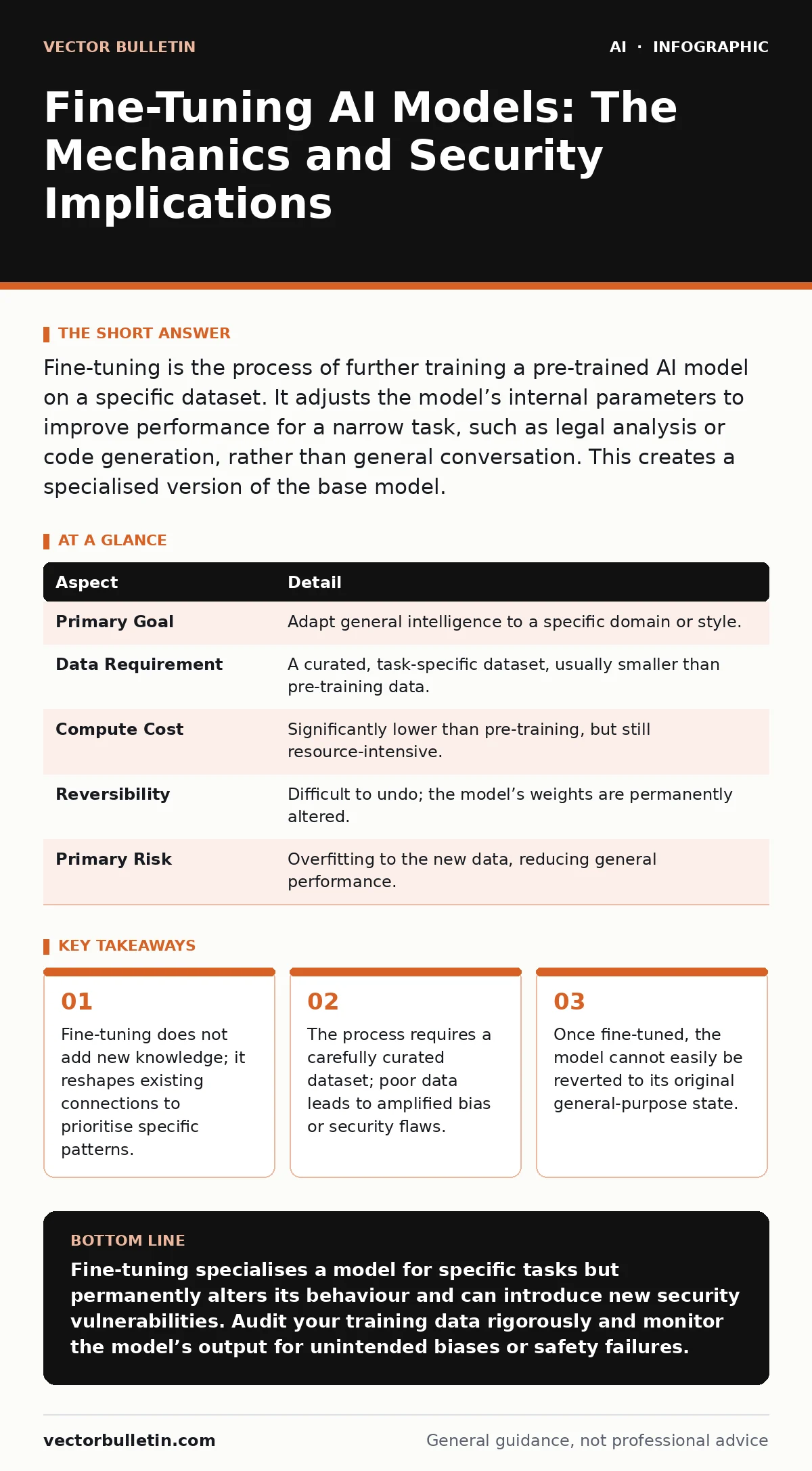
Fine-tuning is the process of further training a pre-trained AI model on a specific dataset. It adjusts the model’s internal parameters to improve performance for a narrow task, such as legal analysis or code generation, rather than general conversation. This creates a specialised version of the base model.
The Mechanic’s Bench
Imagine you have purchased a high-quality kitchen knife. It is sharp and balanced, ready for general chopping. However, you need to carve intricate fruit designs. You do not buy a new knife. You take the existing blade to a whetstone and sharpen it to a specific angle. The knife is now excellent for carving but less useful for heavy chopping.
Fine-tuning works in the same way. You start with a large, pre-trained language model. This model has read vast amounts of text and knows how grammar and logic generally work. It is the unsharpened knife. Fine-tuning involves feeding this model a smaller, specific dataset. The model adjusts its internal weights to align with this new information. The result is a system that performs well on your specific task but may lose some of its general flexibility.
This process is distinct from pre-training. Pre-training builds the foundation. It teaches the model the structure of language and basic facts about the world. Fine-tuning refines that foundation for a particular job. It is a cheaper and faster alternative to training a model from scratch, which requires immense computing power and data.
| Aspect | Detail |
|---|---|
| Primary Goal | Adapt general intelligence to a specific domain or style. |
| Data Requirement | A curated, task-specific dataset, usually smaller than pre-training data. |
| Compute Cost | Significantly lower than pre-training, but still resource-intensive. |
| Reversibility | Difficult to undo; the model’s weights are permanently altered. |
| Primary Risk | Overfitting to the new data, reducing general performance. |
How Fine-Tuning Works in Practice
The process begins with a base model. This is often an open-weight model or an API-accessible model provided by a vendor. You then prepare your dataset. This data must be structured correctly. For example, if you are training a model to answer customer support tickets, your data should consist of pairs: the question and the correct answer.
The model reads these pairs. It makes a prediction. If the prediction is wrong, the system calculates the error. It then adjusts its internal parameters to reduce that error in the future. This happens thousands of times. Each adjustment is small, but the cumulative effect shifts the model’s behaviour.
This shift is not just about memorisation. The model learns the patterns in your data. It learns which words are likely to follow others in your specific context. It learns the tone and style of your organisation. This is why fine-tuning can make a model sound more professional or more technical. It is adapting its probability distribution to match your desired output.
The Hidden Cost of Specialisation
There is a trade-off when you specialise a model. As it becomes better at your specific task, it often becomes worse at others. This is known as catastrophic forgetting. The model overwrites the general knowledge it acquired during pre-training. It forgets how to handle general conversation because it is now optimised for legal summaries or code generation.
This has security implications. If you fine-tune a model on internal documents, it may become more susceptible to prompt injection attacks. The model is now biased towards the structure and content of your documents. An attacker can craft inputs that exploit this bias. The model may reveal sensitive information because it is trained to prioritise the patterns in your data over safety guidelines.
Common Misconceptions About Capacity
Many users believe fine-tuning teaches the model new facts. It does not. The model already has a vast amount of knowledge from pre-training. Fine-tuning changes how that knowledge is accessed and presented. It is a steering mechanism, not a teaching mechanism.
If your dataset contains facts the model does not know, the model will not learn them. It may hallucinate answers to fit the pattern of your data. This leads to AI hallucinations, where the model generates plausible but false information. Users often blame the data, but the root cause is the model’s inability to learn new facts from small datasets.
Another misconception is that fine-tuning makes a model secure. It does not. In fact, it can reduce security. If you fine-tune a model without including safety examples, you may override its built-in refusal mechanisms. The model may become more willing to answer dangerous questions because it is optimised for compliance with your specific prompts, not general safety.
Data Quality and Supply Chain
The quality of your fine-tuning data determines the quality of the model. This is a classic case of garbage in, garbage out. If your data contains biases, the model will amplify them. If your data contains errors, the model will learn those errors.
This creates AI supply chain risks. You are relying on the integrity of your data pipeline. If an attacker compromises your data source, they can inject malicious examples. These examples can train the model to behave in a harmful way. This is a form of AI model theft or poisoning, where the attacker does not steal the model but corrupts it.
You must audit your data before fine-tuning. Check for inconsistencies, biases, and potential security vulnerabilities. This is not a one-time task. As your data evolves, you must re-audit it. Failure to do so can lead to sensitive data leaks through AI chatbots, where the model inadvertently reveals private information it was trained on.
Operationalising the Process
Fine-tuning is not a one-off event. It is an ongoing process. As your organisation changes, your data changes. The model must be re-fine-tuned to stay relevant. This requires a structured workflow.
You need to track the version of the model and the data used to train it. This is part of AI transparency. Without clear records, you cannot understand why the model is behaving a certain way. You cannot debug errors or investigate security incidents.
Consider the lifecycle of the model. When is it time to retire a fine-tuned model? How do you ensure that old models are not still accessible? These are operational questions that often get overlooked. The focus is usually on the initial training, not the long-term management.
The Role of Neural Networks
To understand fine-tuning, you must understand the underlying architecture. Most large language models are based on neural networks. These are computational structures inspired by the human brain. They consist of layers of interconnected nodes.
Each node performs a simple calculation. The layers combine these calculations to produce a result. Fine-tuning adjusts the weights of these connections. It strengthens some connections and weakens others. This changes the path the data takes through the network.
This is why fine-tuning is computationally cheaper than pre-training. You are not building the network from scratch. You are adjusting the existing structure. However, this also means that the changes are permanent. You cannot simply "unlearn" a fine-tuned behaviour. You must re-train the model to reverse it.
Managing Security Risks
Fine-tuning introduces new attack vectors. The model is now tailored to your organisation. Attackers can use this to their advantage. They can craft prompts that exploit the model’s specific biases. This is a form of adversarial attack.
You must implement safeguards. These include input filtering, output monitoring, and regular audits. You should also consider synthetic media risks. A fine-tuned model can generate highly realistic content that mimics your organisation’s style. This can be used for phishing or fraud.
Security is not just about the model. It is about the data and the process. Ensure that your fine-tuning pipeline is secure. Protect your training data from unauthorised access. Monitor the model’s behaviour in production. Detect anomalies early.
Key takeaways
- Fine-tuning does not add new knowledge; it reshapes existing connections to prioritise specific patterns.
- The process requires a carefully curated dataset; poor data leads to amplified bias or security flaws.
- Once fine-tuned, the model cannot easily be reverted to its original general-purpose state.
Fine-tuning specialises a model for specific tasks but permanently alters its behaviour and can introduce new security vulnerabilities. Audit your training data rigorously and monitor the model’s output for unintended biases or safety failures.
Frequently asked questions
Can fine-tuning teach a model new facts?
No, fine-tuning adjusts how existing knowledge is accessed and presented. It does not add new factual information to the model’s base knowledge.
How does fine-tuning differ from pre-training?
Pre-training builds the model’s foundational understanding of language and world knowledge. Fine-tuning adapts that foundation to perform specific tasks or mimic a specific style.
Is fine-tuning secure?
Fine-tuning itself is not a security feature. It can introduce risks if the training data is compromised or if the process overrides existing safety mechanisms.
Can you reverse fine-tuning?
No, the changes to the model’s weights are permanent. To reverse them, you must re-train the model from the original pre-trained state.
How this guide was produced: written by the Vector Bulletin editorial team with AI assistance, checked against the public references listed below, and reviewed when the facts change. See our editorial policy or report an error.