
How AI Chatbots Leak Sensitive Data: The Mechanics and Fixes
Your private inputs often train public models, meaning your secrets become part of the system’s permanent knowledge base for all future users.
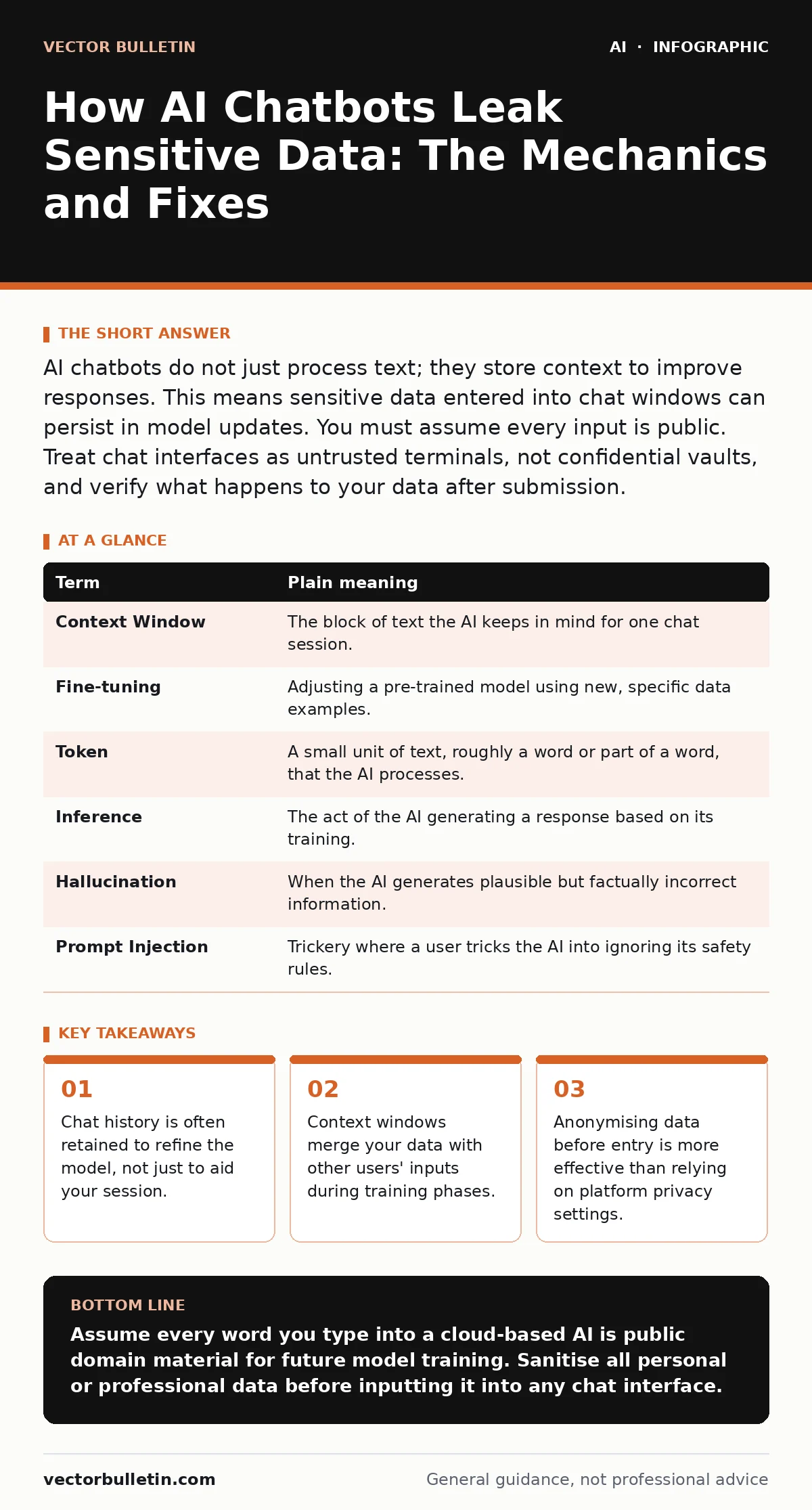
AI chatbots do not just process text; they store context to improve responses. This means sensitive data entered into chat windows can persist in model updates. You must assume every input is public. Treat chat interfaces as untrusted terminals, not confidential vaults, and verify what happens to your data after submission.
The Open Notebook Analogy
Imagine you hire a diligent tutor to help you study. You write your answers in a shared notebook. The tutor reads your work to understand your style. Next week, a new student sits down. The tutor glances at your previous answers to answer the new student’s question. Your private thoughts are now part of the tutor’s reference material.
This is how many AI systems operate. They do not forget your input to protect you. They remember it to become smarter for everyone else. The notebook is not yours alone. It belongs to the institution.
How Context Windows Retain Secrets
An AI chatbot uses a context window, which is the limit of text it can hold in short-term memory for a single conversation. You might think this memory clears when you close the tab. It often does not. The provider may save this exchange to a database.
This saved data feeds into fine-tuning, a process where developers adjust the model’s weights using real user examples. If you pasted a code snippet or a patient record, it is no longer just your text. It is a training sample. The model learns the patterns in your data. It can reproduce similar structures later.
The Hidden Cost of Convenience
The trade-off for a smooth conversational experience is data persistence. Developers need massive amounts of high-quality text to make the model coherent. Your inputs are free, high-quality data. You are not just a user; you are a data source.
This creates a blind spot. You assume the interface is ephemeral. The architecture is cumulative. A single prompt containing an internal policy or a draft email can alter how the model behaves for thousands of others. The leak is not a breach of security walls. It is a feature of the learning mechanism.
What "Private Mode" Really Means
Many platforms offer a "private" or "anonymous" mode. This usually means your account ID is not attached to the text. It does not always mean the text is deleted. It often means the data is stored without a user key.
For an ordinary user, this distinction is vital. If the text remains in the training set, it can still be extracted or influenced. Privacy settings often govern access control, not data retention. You must check the retention policy, not just the login settings. Understanding the difference between AI transparency reports and actual data handling is key.
Glossary of Core Terms
| Term | Plain meaning |
|---|---|
| Context Window | The block of text the AI keeps in mind for one chat session. |
| Fine-tuning | Adjusting a pre-trained model using new, specific data examples. |
| Token | A small unit of text, roughly a word or part of a word, that the AI processes. |
| Inference | The act of the AI generating a response based on its training. |
| Hallucination | When the AI generates plausible but factually incorrect information. |
| Prompt Injection | Trickery where a user tricks the AI into ignoring its safety rules. |
Simple Safety Habits
You cannot stop the model from learning. You can control what it learns from you. The goal is to reduce the sensitivity of your inputs. Do not paste raw data. Transform it first.
- Sanitise inputs: Remove names, dates, and identifiers before pasting. Replace "John Smith, patient ID 459" with "Patient A, ID X".
- Use local models: For highly sensitive work, run open-source models on your own hardware. This keeps the data off external servers.
- Verify outputs: Never trust the AI for factual accuracy. It predicts the next likely word, not the truth. Cross-check every claim.
The Edge Case of Synthetic Media
Be aware that AI can generate synthetic media, which is fake audio, video, or text created to look real. This is not just about leaks. It is about fabrication. If your data leaks, it can be used to create convincing forgeries of your voice or writing style.
This connects to AI supply chain risks, where vulnerabilities in one part of the software stack compromise the whole. If a third-party plugin accesses your chat history, your data is exposed regardless of the main platform’s rules. Always review what permissions tools have.
Final Considerations
The risk is not malicious hackers breaking in. It is the system working as designed. The model improves by absorbing your inputs. This is a fundamental tension in AI utility.
You must decide how much convenience is worth the loss of data exclusivity. For most daily tasks, the risk is low. For professional or personal secrets, the risk is absolute. Adjust your behaviour accordingly. Do not assume the technology knows what is secret. It only knows what is useful for prediction.
Key takeaways
- Chat history is often retained to refine the model, not just to aid your session.
- Context windows merge your data with other users' inputs during training phases.
- Anonymising data before entry is more effective than relying on platform privacy settings.
Assume every word you type into a cloud-based AI is public domain material for future model training. Sanitise all personal or professional data before inputting it into any chat interface.
Frequently asked questions
Does logging out delete my chat history?
Logging out ends your session but does not delete the data from the provider’s servers or training sets. Check the specific retention policy.
Can I use AI for confidential work?
Only if you use a local, offline model that does not connect to the internet. Cloud-based models will likely store your inputs.
What is prompt injection?
It is a technique where a user tricks the AI into ignoring its instructions, potentially causing it to reveal system details or process data it should not.
Are open-source models safer?
They can be if hosted locally, as you control the data flow. If hosted by a third party, they carry the same risks as proprietary models.
How this guide was produced: written by the Vector Bulletin editorial team with AI assistance, checked against the public references listed below, and reviewed when the facts change. See our editorial policy or report an error.