
Stop Sensitive Data Leaks in AI Chatbots: Priority Controls
Most teams assume output filtering prevents leaks, but the real exposure occurs when context windows ingest unredacted source material before processing begins.
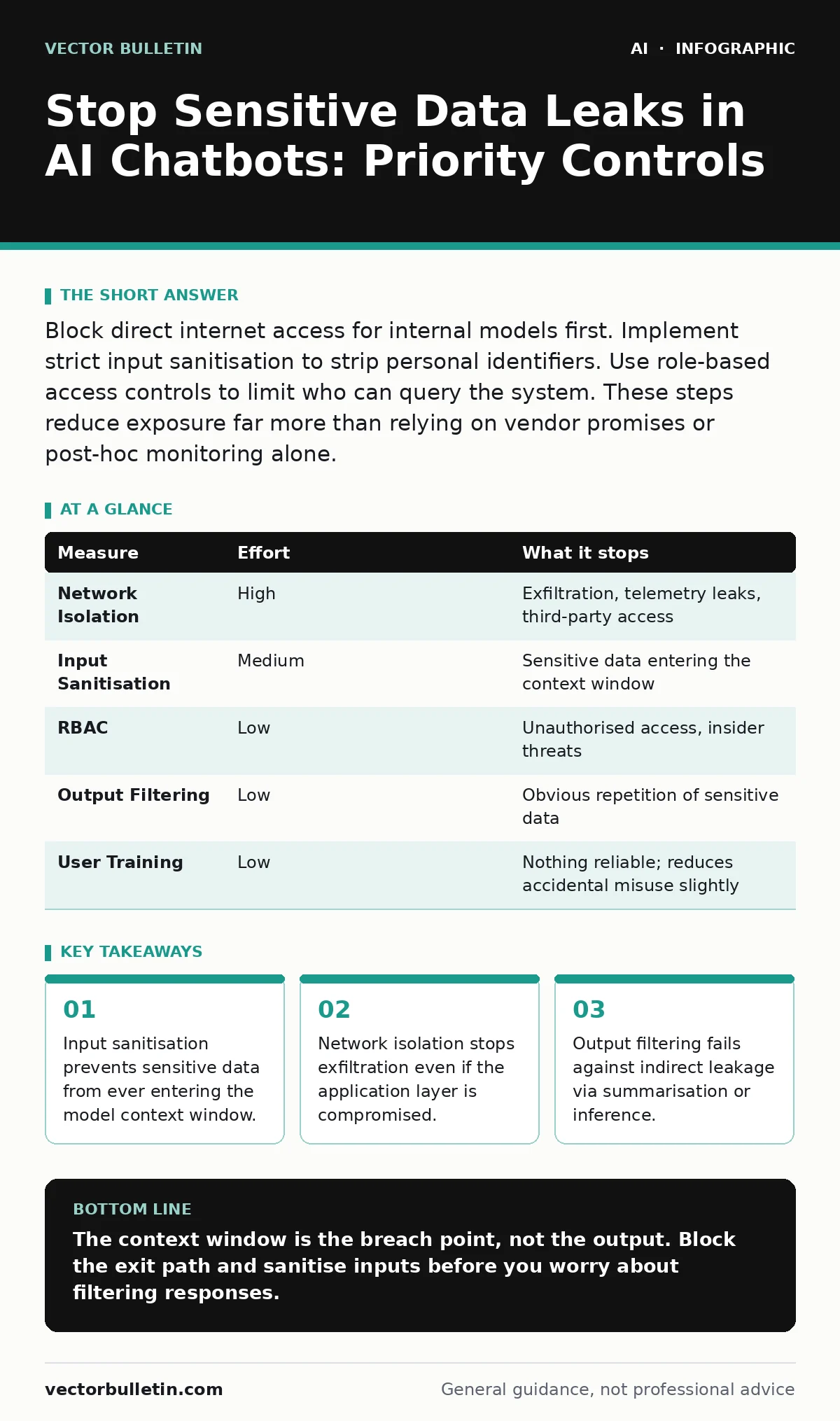
Block direct internet access for internal models first. Implement strict input sanitisation to strip personal identifiers. Use role-based access controls to limit who can query the system. These steps reduce exposure far more than relying on vendor promises or post-hoc monitoring alone.
The Context Window Is the Breach Point
When you paste a document into a chat interface, you are not just sending text. You are expanding the context window, which is the limited amount of information the model can hold in memory during a single interaction. This window acts as a temporary database. If that database contains sensitive data, the model processes it as fact. The risk is not merely that the model repeats the data. It is that the model internalises the relationships between data points, creating a shadow record that persists until the session ends or the cache clears.
Most security teams focus on what comes out of the model. This is backward. The breach happens at ingestion. Once sensitive data enters the context window, it is processed by the neural networks that power the system. These networks are designed to find patterns, not to respect data classification boundaries. You cannot trust the model to distinguish between public training data and your private customer records once both exist in the same session.
Network Isolation Removes the Exit Path
The first priority is to ensure the AI service cannot talk to the open internet. Imagine a scenario where an employee uploads a confidential contract to a cloud-hosted chatbot. If that chatbot has outbound access, the provider may use that interaction to improve their base model. Even if the provider claims they do not store user inputs, the data traverses their infrastructure. It exists in memory on servers you do not control.
By placing the AI service behind a strict firewall, you remove the ability for data to leave your perimeter. This is a binary control. Either the traffic is blocked, or it is not. There is no middle ground where "most" traffic is safe. For internal tools, this means hosting the model locally or using a managed service that guarantees no egress to public endpoints. This single measure stops exfiltration via API calls, telemetry leaks, and accidental forwarding to third-party services. It does not prevent an insider from taking a screenshot, but it removes the digital trail.
Input Sanitisation Before Processing
You must strip sensitive data before it reaches the model. This is known as input sanitisation. It involves scanning the user’s prompt for patterns that match known sensitive data types, such as credit card numbers, national insurance numbers, or email addresses. When a match is found, the system replaces the value with a placeholder, such as [REDACTED]. The model then processes the sanitised text.
This approach shifts the burden from the model to a deterministic rule engine. Rule engines do not hallucinate. They do not make mistakes about what constitutes a phone number. The trade-off is context loss. If you redact too aggressively, the model may fail to answer the question. You must balance privacy with utility. However, losing some context is preferable to leaking PII. This measure works best when combined with a dictionary of your specific data formats, ensuring you catch internal identifiers that generic scanners might miss.
The Fallacy of Output Filtering
Many organisations rely on output filtering as their primary defence. This involves scanning the model’s response for sensitive data and blocking it if found. This method is fundamentally flawed. A model does not need to repeat sensitive data to leak it. It can paraphrase, summarise, or infer relationships that reveal private information. For example, if you ask a model to summarise a list of employee salaries, it might output the average and the range. That range could identify a specific individual if the dataset is small.
Output filters also suffer from high latency. They add processing time to every response, degrading the user experience. More importantly, they are reactive. They act after the damage is done. The data has already been processed by the model. It may have been logged in debug files, sent to monitoring systems, or cached in the application layer. Relying on output filtering is like locking the door after the thief has already taken the goods.
Access Controls Define the Boundary
Who can talk to the AI matters as much as what they say. Implement role-based access controls (RBAC) to restrict who can query the system. Not every employee needs access to a chatbot that has visibility into sensitive databases. Limit access to those who have a specific business need. This reduces the attack surface. It also limits the blast radius if an account is compromised.
You should also log who queried what. These logs are not for monitoring individual productivity. They are for forensic analysis. If a leak occurs, you need to know which user session contained the sensitive data. Without logs, you are blind to the scope of the breach. Ensure these logs are stored securely and are immutable. They are your only record of what entered the context window.
What Does Not Work
Do not rely on user training to prevent leaks. Employees will make mistakes. They will copy and paste sensitive data into chat windows because it is convenient. Human error is inevitable. Do not rely on the AI provider’s privacy policy. Policies are legal documents, not technical controls. They can change, be misinterpreted, or be violated by bugs in the provider’s infrastructure.
Do not assume that disabling chat history prevents leaks. History is often stored locally in the browser or on the device. It can be extracted by malware or forensic tools. Disabling it only removes the convenience of recalling past conversations. It does not stop the data from being processed in real-time.
Measure Comparison
| Measure | Effort | What it stops |
|---|---|---|
| Network Isolation | High | Exfiltration, telemetry leaks, third-party access |
| Input Sanitisation | Medium | Sensitive data entering the context window |
| RBAC | Low | Unauthorised access, insider threats |
| Output Filtering | Low | Obvious repetition of sensitive data |
| User Training | Low | Nothing reliable; reduces accidental misuse slightly |
Checklist for Today
- Verify that your AI service has no outbound internet access.
- Implement input sanitisation to strip PII before it reaches the model.
- Review access logs to ensure only authorised users can query the system.
These steps are foundational. They address the technical reality of how AI systems process data. They do not rely on trust, promises, or human perfection. They rely on controls that you can verify and enforce.
Key takeaways
- Input sanitisation prevents sensitive data from ever entering the model context window.
- Network isolation stops exfiltration even if the application layer is compromised.
- Output filtering fails against indirect leakage via summarisation or inference.
The context window is the breach point, not the output. Block the exit path and sanitise inputs before you worry about filtering responses.
Frequently asked questions
Can I use a commercial AI service for sensitive data?
Only if you can verify that it operates in a private, isolated environment with no data retention or training on user inputs. Most standard commercial services do not meet this criterion.
Does encryption protect data in the context window?
No. The model must decrypt the data to process it. Encryption protects data at rest and in transit, not data in use.
How do I know if my input sanitisation is working?
Test it with known sensitive data patterns. Verify that the placeholders appear in the logs and that the original data does not reach the model API.
What about AI hallucinations causing leaks?
Hallucinations are fabricated data, not leaks. However, they can confuse users into trusting false information. This is a separate risk from sensitive data exposure.
How this guide was produced: written by the Vector Bulletin editorial team with AI assistance, checked against the public references listed below, and reviewed when the facts change. See our editorial policy or report an error.