
AI coding assistant supply-chain risks: spotting poisoned code generation
Detecting malicious code injected via software development utilities requires monitoring build outputs rather than examining user prompts.
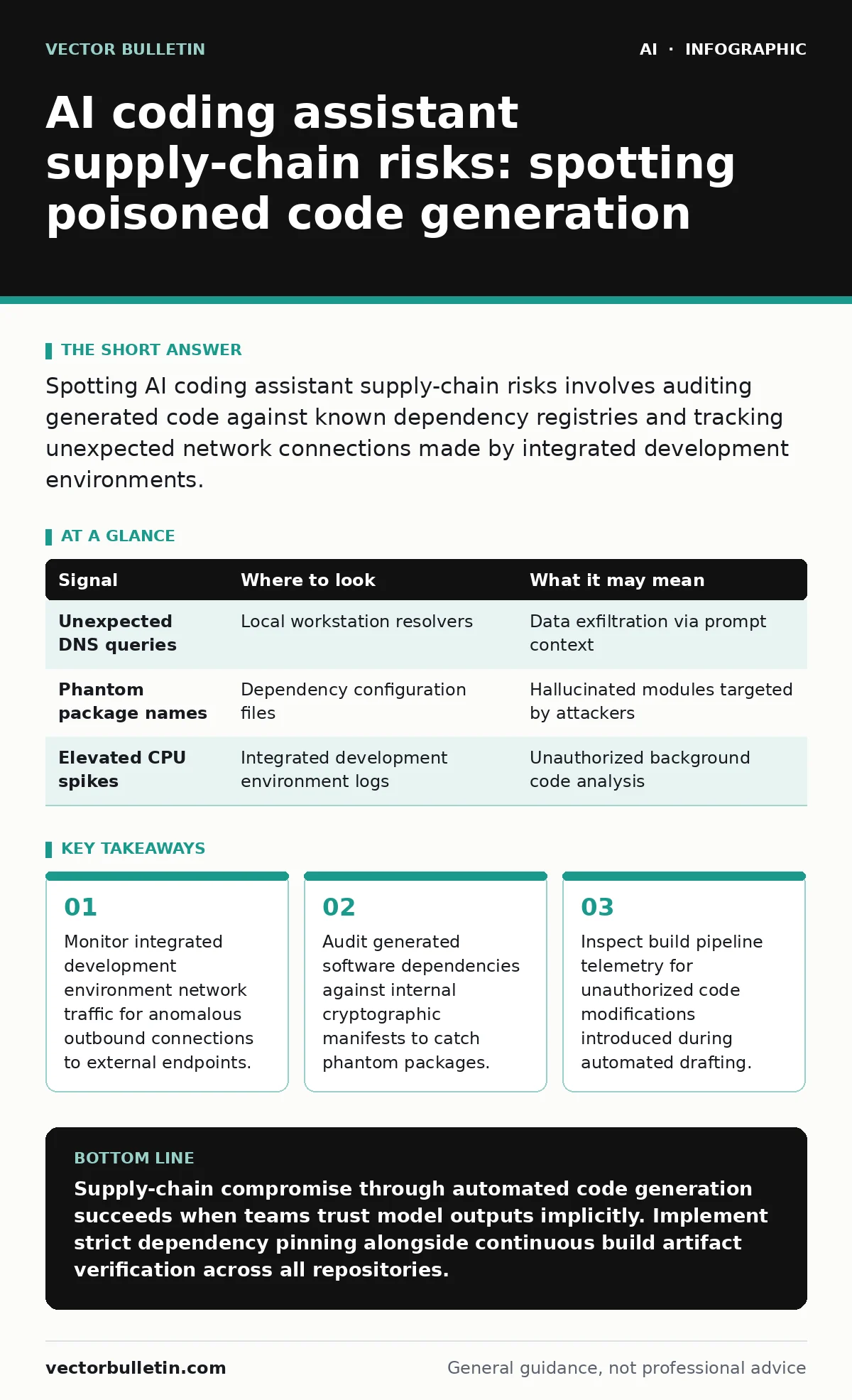
Spotting AI coding assistant supply-chain risks involves auditing generated code against known dependency registries and tracking unexpected network connections made by integrated development environments.
Where developer workstations leak telemetry
Developer workstations running large language models exhibit distinct network and process behaviors that signal potential supply-chain interference. Integrated development environments execute background processes to fetch context, creating opportunities for third-party utilities to exfiltrate local source code. You must monitor these local processes for persistent connections to unverified external addresses during idle states.
Unusual background synchronization often points to hidden credential harvesting rather than normal telemetry collection. Treating AI models as untrusted insiders helps security teams frame how local assistant plugins interact with sensitive repositories. Background indexing routines can read environment variables stored in local memory, transmitting sensitive configuration data alongside routine code completion requests without explicit developer consent.
How dependency manifests reveal poisoned suggestions
Automated coding tools frequently invent nonexistent software packages when asked to solve complex programming tasks. Malicious actors register these non-existent package names on public repositories to deliver malicious payloads when developers accept the suggestion. You should parse every new dependency introduced by automated generation tools against a curated internal allowlist before merging code.
Generative AI models prioritize statistical likelihood over semantic correctness, making them susceptible to recommending vulnerable or hijacked open-source libraries. Phantom dependencies created by this phenomenon bypass standard code reviews because the syntax appears legitimate at first glance. Developers rarely verify whether a suggested library actually exists in the official repository index before running local installation commands.
| Signal | Where to look | What it may mean |
|---|---|---|
| Unexpected DNS queries | Local workstation resolvers | Data exfiltration via prompt context |
| Phantom package names | Dependency configuration files | Hallucinated modules targeted by attackers |
| Elevated CPU spikes | Integrated development environment logs | Unauthorized background code analysis |
What network logs show during unauthorized code exfiltration
Network perimeters surrounding engineering networks frequently miss malicious traffic originating from local development tools. Code assistants require continuous internet access to function, masking outbound data transfers inside normal operational noise. Inspecting Transport Layer Security inspection logs reveals whether code snippets leave the corporate boundary during offline tasks.
Prompt injection in AI desktop apps allows attackers to smuggle instructions past local sanitisation filters by hiding commands inside seemingly benign documentation files. Malicious instructions executed this way force the local assistant to append hidden backdoors to routine functions. Network monitoring systems catch these anomalies only when outbound payload sizes deviate significantly from standard code completion responses.
Why traditional static analysis fails on generated code
Static analysis tools rely on signature matching and known vulnerability patterns that struggle with novel code structures produced by machine learning models. Automated assistants synthesize code snippets by combining disparate programming patterns, creating hybrid constructs that evade conventional rulesets. You need behavioural monitoring during runtime execution rather than relying solely on post-commit code scanning.
Obfuscated logic generated by automated tools often employs unusual variable naming conventions that bypass basic linting checks while maintaining malicious functionality. Security teams must evaluate the semantic intent of generated functions rather than checking purely for syntax errors or memory safety violations. Manual code review remains necessary for critical security components precisely because automated generation masks logical flaws behind convincing syntax.
Blind spots in modern development pipelines
Automated build pipelines rarely inspect the intermediate steps occurring inside developer plugins during the active coding phase. Visibility typically begins only after a commit reaches the central version control system, leaving a dangerous monitoring gap during local code drafting. Securing this phase requires treating the local authoring environment as an untrusted zone where code integrity cannot be assumed.
Another overlooked vector involves cached context files stored locally by coding assistants, which accumulate sensitive project details over months of use. If an external service compromise occurs, these cached training vectors expose intellectual property well beyond the current repository scope. Monitoring local disk Input/Output operations helps identify unauthorized reading of sensitive configuration files by background assistant threads.
Key takeaways
- Monitor integrated development environment network traffic for anomalous outbound connections to external endpoints.
- Audit generated software dependencies against internal cryptographic manifests to catch phantom packages.
- Inspect build pipeline telemetry for unauthorized code modifications introduced during automated drafting.
Supply-chain compromise through automated code generation succeeds when teams trust model outputs implicitly. Implement strict dependency pinning alongside continuous build artifact verification across all repositories.
Frequently asked questions
How do AI coding assistants introduce supply-chain risks?
Automated assistants introduce supply-chain risks by hallucinating non-existent software packages that attackers can register, or by incorporating vulnerable dependencies directly into codebases without developer awareness.
What network anomalies indicate a compromised coding assistant?
Anomalous outbound DNS queries, unexpected data transfers during idle periods, and persistent connections to unverified external endpoints point to potential compromise within the development environment.
Why do conventional security scanners miss AI-generated vulnerabilities?
Conventional scanners miss these flaws because machine learning models synthesize novel code structures and unusual logic patterns that do not match existing signature databases or static analysis rulesets.
How can security teams protect local development workstations?
Security teams can protect workstations by auditing all newly introduced dependencies against internal allowlists, monitoring local process telemetry, and maintaining offline caches for approved package registries.
How this guide was produced: written by the Vector Bulletin editorial team with AI assistance, checked against the public references listed below, and reviewed when the facts change. See our editorial policy or report an error.