
Generative AI vs Traditional AI: Operational Differences and Risk Profiles
Generative systems create novel outputs from patterns, while traditional systems classify existing data, creating distinct attack surfaces for each.
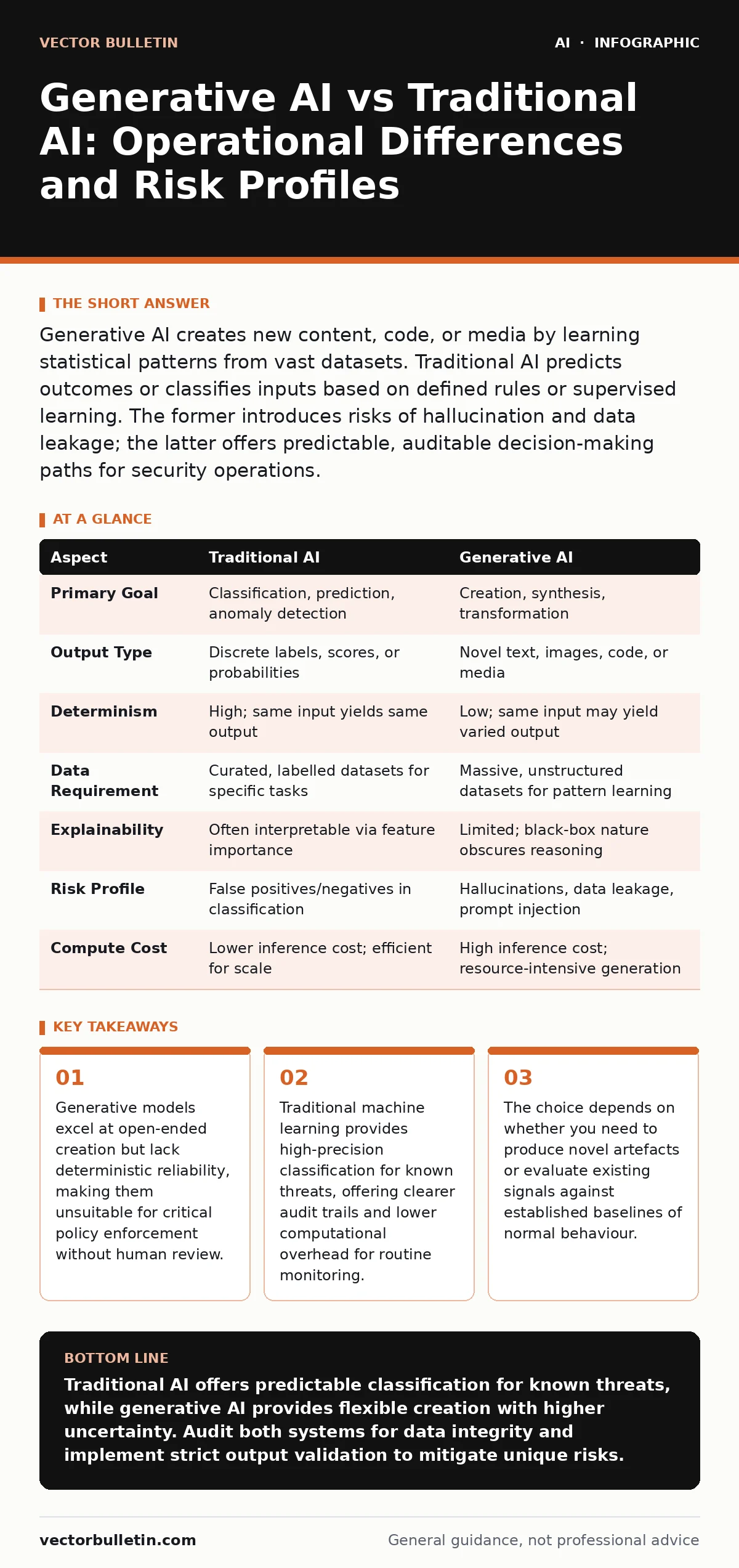
Generative AI creates new content, code, or media by learning statistical patterns from vast datasets. Traditional AI predicts outcomes or classifies inputs based on defined rules or supervised learning. The former introduces risks of hallucination and data leakage; the latter offers predictable, auditable decision-making paths for security operations.
Generative AI vs Traditional AI: The Core Distinction
Generative AI vs traditional AI represents a fundamental shift in how systems process information. Traditional artificial intelligence, often referred to as discriminative or predictive AI, focuses on mapping inputs to specific outputs. It classifies data, detects anomalies, or predicts discrete outcomes based on historical patterns. Generative artificial intelligence, by contrast, learns the underlying distribution of data to create new, original content. It does not merely recognise a pattern; it synthesises new instances that fit that pattern. This difference dictates how you deploy, secure, and monitor these systems within your infrastructure.
What Is Traditional AI?
Traditional AI systems rely on supervised or unsupervised learning to identify boundaries between classes. These models are trained on labelled datasets where the correct answer is known. The system learns to draw a line between "malicious" and "benign" traffic, for instance. The output is deterministic or probabilistic within a narrow range.
You use these systems for tasks requiring precision and consistency. They excel at regression analysis, clustering, and classification. Because the model parameters are fixed after training, the behaviour is stable. This stability allows for thorough validation before deployment. The system does not invent new data; it evaluates existing data against learned criteria.
What Is Generative AI?
Generative AI models, such as large language models or diffusion models, learn to replicate the structure of their training data. They do not memorise specific examples but internalise the statistical likelihood of token sequences or pixel arrangements. When prompted, they generate novel text, images, or code that mimics the training distribution.
This capability enables creative tasks, summarisation, and code generation. However, the output is non-deterministic. The same prompt can yield different results. This stochastic nature means the system can produce plausible but incorrect information, known as hallucinations. It can also inadvertently reproduce sensitive data present in its training set if not properly filtered.
Point-by-Point Comparison
| Aspect | Traditional AI | Generative AI |
|---|---|---|
| Primary Goal | Classification, prediction, anomaly detection | Creation, synthesis, transformation |
| Output Type | Discrete labels, scores, or probabilities | Novel text, images, code, or media |
| Determinism | High; same input yields same output | Low; same input may yield varied output |
| Data Requirement | Curated, labelled datasets for specific tasks | Massive, unstructured datasets for pattern learning |
| Explainability | Often interpretable via feature importance | Limited; black-box nature obscures reasoning |
| Risk Profile | False positives/negatives in classification | Hallucinations, data leakage, prompt injection |
| Compute Cost | Lower inference cost; efficient for scale | High inference cost; resource-intensive generation |
When to Choose Traditional AI
Choose traditional AI when your objective is to evaluate existing data against known criteria. These systems are superior for tasks requiring high reliability and low variance. You should deploy traditional models for network intrusion detection, where the distinction between normal and malicious traffic is well-defined. They are also appropriate for fraud detection, where historical patterns of fraudulent behaviour provide a clear baseline. Traditional AI offers better control over false positive rates, which is critical when automated actions have immediate consequences. The predictability of these systems simplifies compliance and auditing processes.
- Define clear success metrics and acceptable error rates.
- Ensure training data is representative of current operational environments.
- Implement continuous monitoring for concept drift, where data patterns change over time.
When to Choose Generative AI
Choose generative AI when you need to produce novel content or transform unstructured data into structured insights. These systems are valuable for summarising large volumes of logs, generating synthetic data for testing, or drafting incident response playbooks. They can assist in code review by suggesting improvements or identifying potential vulnerabilities in source code. However, you must treat their output as a draft, not a final decision. Always implement human-in-the-loop verification for any action derived from generative output. The flexibility of these models comes at the cost of precision and reliability.
Overlap and Hybrid Approaches
The boundary between these technologies is blurring. Many security operations now use hybrid approaches. For example, a traditional model might flag an anomaly in network traffic, and a generative model could then draft a detailed incident report based on those findings. This combination leverages the precision of traditional AI and the versatility of generative AI. However, this integration increases complexity. You must manage the risks of both systems simultaneously. The traditional component must be accurate to avoid feeding false premises to the generative component. The generative component must be constrained to prevent the creation of misleading or harmful content.
Imagine a scenario where a security analyst uses a generative tool to write detection rules. The tool suggests a rule based on a recent threat pattern. A traditional machine learning model then tests this rule against historical data to verify its efficacy. This workflow reduces manual effort while maintaining a layer of validation. It addresses the limitations of each system individually. The key is to define clear boundaries for what each system is allowed to do.
Security Implications and Governance
Deploying these systems requires distinct security strategies. Traditional AI risks are primarily related to model poisoning and data bias. Attackers may manipulate training data to alter classification boundaries. Generative AI introduces new vectors, such as prompt injection, where malicious inputs manipulate the model's behaviour. It also raises concerns about intellectual property and data privacy. You must assess the sensitivity of the data used for training and inference. Implementing AI governance frameworks helps manage these risks. Regular audits of model performance and data handling practices are necessary.
Consider the risk of sensitive data leaks through AI chatbots. If a generative model is trained on internal documents, it may reproduce confidential information in its responses. Mitigation strategies include using private instances, restricting training data, and implementing output monitoring. For traditional systems, focus on securing the data pipeline and ensuring model integrity. Machine learning in cybersecurity relies on the assumption that the training environment is secure. Compromising this assumption undermines the entire system.
Operational Best Practices
Regardless of the type, both systems require rigorous operational controls. You must establish clear ownership and accountability for AI-driven decisions. Document the intended use cases and limitations of each model. Regularly update training data to reflect current threats and operational changes. Monitor for performance degradation and unexpected behaviour. Engage with AI transparency standards to ensure stakeholders understand how decisions are made. This transparency builds trust and facilitates quicker response to issues.
Address AI supply chain risks by vetting third-party models and data sources. Ensure that any external components meet your security requirements. Consider emergency stop for AI systems mechanisms that allow immediate halting of automated actions if anomalous behaviour is detected. Finally, explore securing AI agents that interact with external systems, ensuring they operate within defined permissions and constraints.
Key takeaways
- Generative models excel at open-ended creation but lack deterministic reliability, making them unsuitable for critical policy enforcement without human review.
- Traditional machine learning provides high-precision classification for known threats, offering clearer audit trails and lower computational overhead for routine monitoring.
- The choice depends on whether you need to produce novel artefacts or evaluate existing signals against established baselines of normal behaviour.
Traditional AI offers predictable classification for known threats, while generative AI provides flexible creation with higher uncertainty. Audit both systems for data integrity and implement strict output validation to mitigate unique risks.
Frequently asked questions
Can traditional AI be used to detect generative AI content?
Yes, traditional machine learning models can be trained to identify statistical artifacts or patterns unique to generative outputs, such as specific token distributions or image noise.
Is generative AI more secure than traditional AI?
No, generative AI introduces additional attack vectors like prompt injection and data leakage, making it generally more complex to secure than traditional classification models.
How do I prevent data leakage in generative models?
Use private instances, restrict training data to non-sensitive information, and implement real-time output filtering to block the reproduction of confidential data.
What is the main cost difference between the two?
Generative AI typically requires significantly more computational resources for both training and inference due to the complexity of generating novel content compared to classifying existing data.
How this guide was produced: written by the Vector Bulletin editorial team with AI assistance, checked against the public references listed below, and reviewed when the facts change. See our editorial policy or report an error.