
Machine Learning in Cybersecurity: Meaning, Definition and Daily Use
Machine learning in security automates pattern recognition but introduces new attack surfaces that traditional controls cannot address.
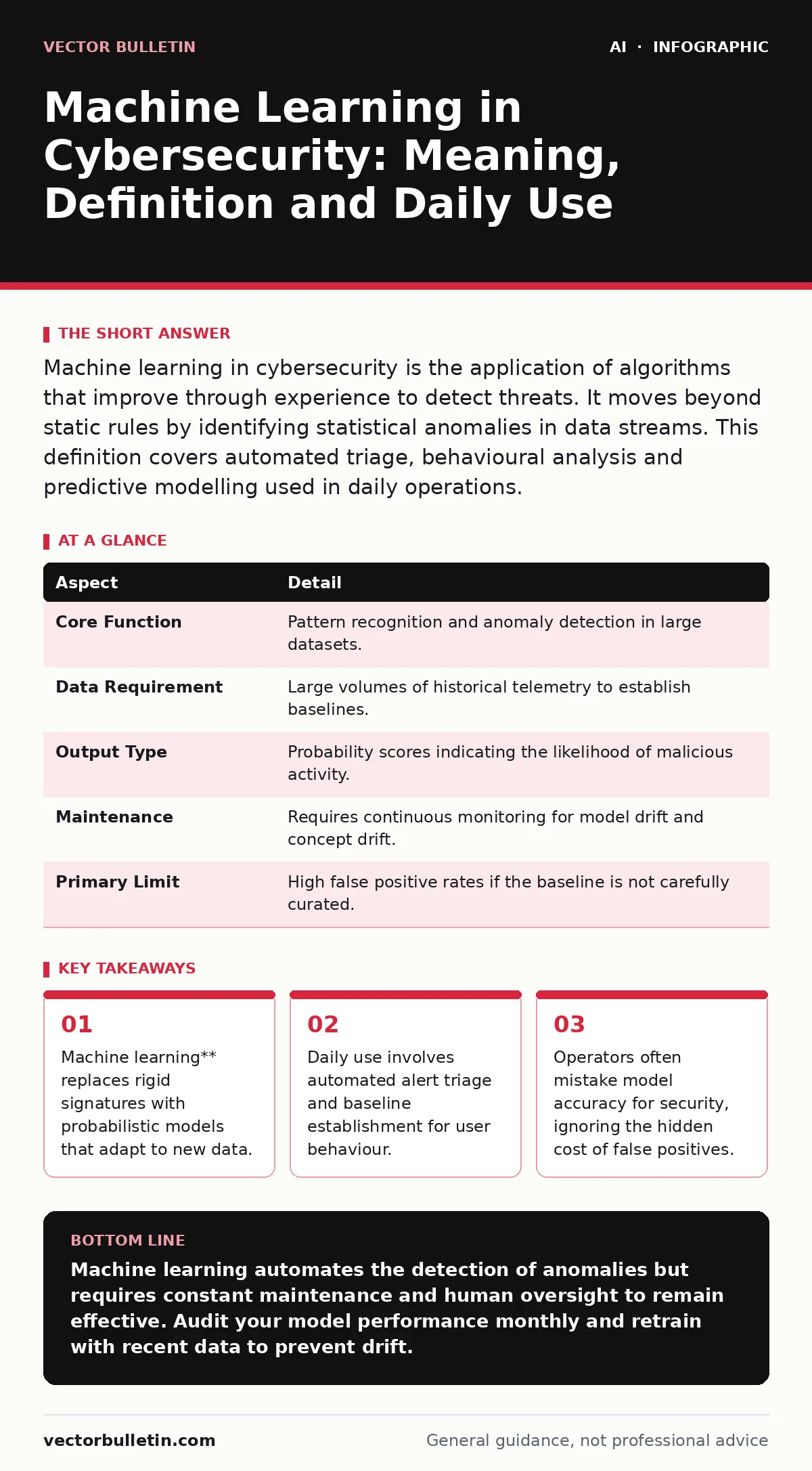
Machine learning in cybersecurity is the application of algorithms that improve through experience to detect threats. It moves beyond static rules by identifying statistical anomalies in data streams. This definition covers automated triage, behavioural analysis and predictive modelling used in daily operations.
The Analogy of the Experienced Guard
Imagine a security guard who has watched the same office entrance for ten years. He knows exactly how the floor vibrates when the manager arrives and which footsteps belong to the cleaning crew. He does not check an ID badge for every visitor. He simply notices when the rhythm of the morning arrival is wrong.
Machine learning in cybersecurity operates on this same principle. It does not rely on a fixed list of known bad actors. Instead, it learns what normal activity looks like by observing vast quantities of historical data. When the current activity deviates from that learned baseline, the system flags it for review.
This approach shifts the focus from matching known patterns to detecting unknown anomalies. The guard does not need to know who the intruder is. He only needs to know that the person walking in does not fit the established pattern of the building.
Defining the Mechanism
At its core, machine learning is a subset of artificial intelligence where systems learn from data without being explicitly programmed for every rule. In a cybersecurity context, this means the software builds a mathematical model of expected behaviour. It then compares live data against this model to find outliers.
The term comes from the academic field of computational learning theory. It describes algorithms that improve their performance on a specific task as they are exposed to more examples. Unlike traditional software, which follows a static set of instructions, these models update their internal parameters continuously or periodically.
This definition distinguishes it from simple automation. Automation executes a predefined script. Machine learning determines the script dynamically based on observed trends. It is the difference between a camera that records everything and a camera that tells you when someone has entered a restricted zone.
| Aspect | Detail |
|---|---|
| Core Function | Pattern recognition and anomaly detection in large datasets. |
| Data Requirement | Large volumes of historical telemetry to establish baselines. |
| Output Type | Probability scores indicating the likelihood of malicious activity. |
| Maintenance | Requires continuous monitoring for model drift and concept drift. |
| Primary Limit | High false positive rates if the baseline is not carefully curated. |
Where the Term Comes From in Practice
The phrase gained traction when organisations realised that signature-based detection was insufficient against novel threats. Signatures are specific byte sequences or code snippets associated with known malware. When an attacker changes the code slightly, the signature fails.
Machine learning offers a way to detect the intent rather than the specific implementation. It looks for the behavioural footprint of an attack, such as rapid file encryption or unusual network connections. This allows security teams to catch threats that have never been seen before, provided they behave differently from normal operations.
This practical origin is why the term is now ubiquitous. It represents a shift from reactive defence to proactive monitoring. The goal is to identify the early stages of an attack chain before significant damage occurs. This aligns with frameworks like MITRE ATLAS, which maps tactics for AI-specific attacks, showing how adversaries exploit these very models.
Daily Operational Usage
In day-to-day operations, you will encounter machine learning in automated triage systems. Security information and event management platforms use these models to score alerts. High-risk alerts are prioritised for human review, while low-risk noise is suppressed. This reduces alert fatigue and allows analysts to focus on genuine threats.
Another common use is user and entity behaviour analytics. The system learns the typical login times, data access patterns and device usage for each employee. If an account suddenly downloads large volumes of data at an unusual hour, the model flags it. This helps detect compromised credentials or insider threats.
These systems also assist in phishing detection. Instead of just checking for known malicious URLs, the model analyses the text structure, sender reputation and request patterns. It can identify sophisticated social engineering attempts that bypass traditional filters. This is critical given the risks of sensitive data leaks through AI chatbots, where users might inadvertently share credentials in conversational interfaces.
What People Usually Get Wrong
A common misconception is that machine learning replaces human analysts. This is incorrect. These systems are tools for augmentation, not replacement. They excel at processing volume and identifying statistical outliers, but they lack context. A human analyst understands the business impact of a flagged action and can determine if it is a benign anomaly or a genuine threat.
Another error is assuming that more data always leads to better security. While data is necessary, quality matters more than quantity. If the training data contains biases or is not representative of the current environment, the model will produce inaccurate results. This is known as model drift. Regular retraining and validation are required to maintain accuracy.
Finally, many organisations treat these models as black boxes. They deploy them without understanding the underlying logic. This lack of transparency can lead to trust issues and missed insights. Understanding how the model makes decisions is part of AI transparency efforts. You must be able to explain why an alert was triggered, especially when it affects critical business operations.
The Hidden Costs of Adoption
Implementing these systems introduces new complexities. The first is the computational cost. Training and running models requires significant processing power and storage. This infrastructure must be secured separately, adding to the overall attack surface. Adversaries may target the model itself, attempting to poison the training data or confuse the inference engine.
This relates directly to AI supply chain risks. If you rely on third-party models or data sources, a compromise in that chain can affect your security posture. You must verify the integrity of the models and the data used to train them. This is similar to verifying software updates, but with higher stakes due to the adaptive nature of the technology.
Another hidden cost is the skill gap. Operating these systems requires data science expertise alongside security knowledge. Finding personnel who understand both fields is difficult. This often leads to over-reliance on vendor support or misconfiguration. You must invest in training your team to understand the limitations and capabilities of the technology.
Integration with Existing Controls
Machine learning does not operate in isolation. It must be integrated with your existing security controls. This includes firewalls, endpoint protection and identity management systems. The models provide context and prioritisation, but the enforcement often relies on traditional mechanisms.
For example, a model might detect anomalous behaviour in an AI agent. However, blocking that agent requires integration with securing AI agents protocols. You need to ensure that the detection output can trigger the appropriate response in your security orchestration platform. Without this integration, the detection is merely informational.
This integration also applies to data handling. You must ensure that the data used for training and inference is properly classified and protected. This prevents sensitive data leaks through AI chatbots or other interfaces. The model should not expose private information in its outputs or logs. Data privacy and security must be designed into the architecture from the start.
Maintaining Model Integrity
Over time, the behaviour of your environment will change. New applications are deployed, employees change roles and network traffic patterns shift. If the model is not updated, it will become less accurate. This is known as concept drift. The baseline of normal behaviour no longer reflects reality.
You must establish a process for continuous monitoring and retraining. This involves regularly reviewing the model’s performance metrics and comparing them against ground truth. If the performance degrades, you must retrain the model with recent data. This ensures that the model stays relevant and accurate.
This process also involves checking for AI hallucinations in generative models used for reporting or analysis. These models may generate incorrect information that appears plausible. You must validate the outputs, especially when they are used for decision-making. Trust but verify is a critical principle in this domain.
Key takeaways
- Machine learning** replaces rigid signatures with probabilistic models that adapt to new data.
- Daily use involves automated alert triage and baseline establishment for user behaviour.
- Operators often mistake model accuracy for security, ignoring the hidden cost of false positives.
Machine learning automates the detection of anomalies but requires constant maintenance and human oversight to remain effective. Audit your model performance monthly and retrain with recent data to prevent drift.
Frequently asked questions
How does machine learning differ from traditional signature-based detection?
Signature-based detection matches known patterns of malicious code. Machine learning identifies deviations from normal behaviour, allowing it to detect novel threats that do not have a known signature.
What is model drift and why does it matter?
Model drift occurs when the data distribution changes over time, making the model’s predictions less accurate. It matters because an outdated model will generate more false positives or miss genuine threats.
Can machine learning models be hacked?
Yes, through techniques like data poisoning or adversarial attacks. These methods manipulate the training data or input to cause the model to behave incorrectly.
How this guide was produced: written by the Vector Bulletin editorial team with AI assistance, checked against the public references listed below, and reviewed when the facts change. See our editorial policy or report an error.