
AI transparency definition and how it works in practice
AI transparency reveals how software models make decisions, yet complete visibility often exposes proprietary secrets to competitors.
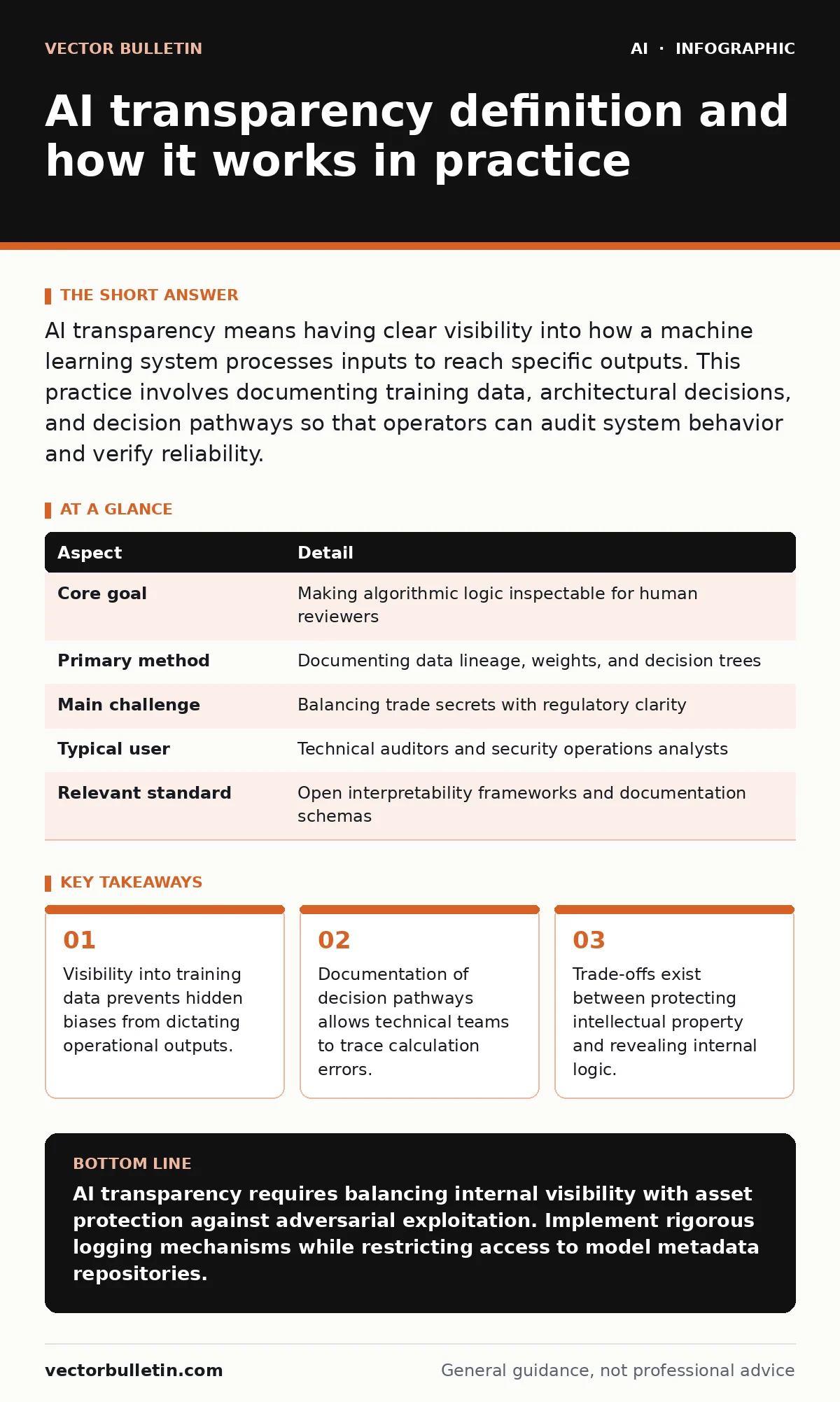
AI transparency means having clear visibility into how a machine learning system processes inputs to reach specific outputs. This practice involves documenting training data, architectural decisions, and decision pathways so that operators can audit system behavior and verify reliability.
Defining the core principles
AI transparency means the degree to which an algorithm's internal workings remain understandable to human operators. Machine learning systems, particularly complex neural networks, often operate as black boxes where inputs transform into outputs through weighted calculations without leaving a legible trail. Achieving visibility requires deliberate architectural choices that record how specific data features influence final conclusions, allowing technical staff to inspect the mathematical foundation behind every automated verdict.
Organizations deploy interpretability tools to map feature weights and training inputs against operational outcomes across dynamic environments. Verifying these relationships prevents hidden biases from dictating production outputs without detection by security monitors.
Historical roots in engineering
Engineering teams originally adopted visibility practices to debug malfunctioning software rather than to satisfy regulatory demands or external compliance frameworks. Early researchers needed methods to isolate why classification models produced false positives during rigorous testing phases. Building internal logging mechanisms allowed developers to trace calculation errors back to specific code segments before deploying applications.
Software maintenance workflows gradually incorporated these diagnostic steps into standard development cycles over subsequent decades of technological advancement. Modern systems inherited these tracing requirements as computational complexity expanded exponentially across enterprise networks. Tracking dataset lineage became essential for maintaining system reliability under heavy production loads and continuous update cycles.
Operational use in security
Security operations personnel apply visibility frameworks to evaluate whether automated triage tools make consistent determinations during high-speed incident response scenarios. Operators inspect feature importance scores to determine if an alert triggered on legitimate user behaviour or superficial artifact anomalies. Regular audits of these decision pathways ensure that downstream generative AI tools do not hallucinate risk assessments during stressful investigations.
Incident responders rely on transparent model outputs to explain anomalous network traffic patterns during high-pressure threat hunting investigations. Analysts cross-reference algorithmic recommendations against raw packet captures before initiating containment procedures or isolating affected hosts. Maintaining clear visibility keeps human operators firmly in control of critical remediation steps across enterprise boundaries.
| Aspect | Detail |
|---|---|
| Core goal | Making algorithmic logic inspectable for human reviewers |
| Primary method | Documenting data lineage, weights, and decision trees |
| Main challenge | Balancing trade secrets with regulatory clarity |
| Typical user | Technical auditors and security operations analysts |
| Relevant standard | Open interpretability frameworks and documentation schemas |
Hidden costs of full disclosure
Publishing complete internal weights creates severe risks regarding intellectual property theft and targeted evasion attacks against proprietary systems. Malicious actors examine detailed model internals to construct adversarial inputs that bypass security filters with mathematical precision. Organizations frequently discover that maximum visibility reduces competitive differentiation while arming adversaries with exploitation blueprints.
Defenders face difficult choices when balancing the demand for public accountability against proprietary asset protection and trade secret preservation. Exposing too much architectural detail hands attackers the exact parameters needed to craft evasion payloads that slip past perimeter defenses. Security architects must implement granular access controls around model metadata repositories to prevent unauthorized inspection.
Managing compliance and oversight
Regulatory bodies demand clear explanations for automated decisions affecting individuals, forcing organizations to balance legal compliance with technical reality. Establishing effective AI governance requires balancing auditability requirements against the inherent opacity of advanced statistical models that defy simple human intuition. Compliance frameworks mandate documentation trails that survive personnel turnover and system upgrades.
Auditing complex systems demands continuous monitoring protocols that capture drift across dynamic production environments over extended operational periods. Regulatory compliance teams collaborate with engineers to construct repeatable validation procedures for every deployed model iteration. Maintaining documentation continuity prevents untraced biases from creeping into decision pipelines during routine maintenance windows.
See also: Machine Learning in Cybersecurity: Meaning, Definition and Daily Use
Common analytical misconceptions
Many practitioners believe that open-source algorithms automatically guarantee complete transparency regarding operational risks and internal vulnerabilities. Software openness provides access to source code, yet compiled weights and massive datasets remain notoriously difficult for human analysts to interpret intuitively. True understanding demands active tooling rather than passive reliance on accessible code repositories or vendor marketing claims.
Assuming that readable code equals explainable model decisions ignores complex mathematical transformations occurring inside multi-layered algorithms during inference execution. Analysts must deploy specialized visualization utilities to bridge the gap between raw source code and final behavioral outputs. Effective oversight requires dedicated effort beyond simple code inspection routines.
Supply-chain dependencies introduce hidden opacity when third-party libraries alter foundational model behaviours without explicit notification from upstream vendors. Enterprise procurement teams must scrutinize vendor transparency reports to identify undocumented pre-trained components embedded within commercial packages. Evaluating component provenance prevents unexpected vulnerabilities from entering internal machine learning pipelines.
Dataset poisoning represents another severe threat where adversaries inject malicious samples into public training corpuses before model compilation occurs. Transparent documentation practices help security analysts trace corrupted data points back to their ingestion origin within complex pipelines. Isolating compromised training inputs protects downstream applications from silent behavioral degradation.
Model drift occurs when real-world data distributions diverge from original training conditions over extended operational timeframes in production environments. Continuous evaluation metrics provide visibility into performance degradation before catastrophic classification failures materialize unexpectedly. Automated monitoring scripts alert engineers when predictive accuracy drops below acceptable statistical thresholds.
Stakeholder communication requires translating complex mathematical weights into understandable risk metrics for non-technical executives and board members. Translators bridge the gap between rigorous algorithmic auditing and business-level decision-making processes across enterprise hierarchies. Clear reporting ensures leadership understands operational limitations without drowning in technical jargon.
Key takeaways
- Visibility into training data prevents hidden biases from dictating operational outputs.
- Documentation of decision pathways allows technical teams to trace calculation errors.
- Trade-offs exist between protecting intellectual property and revealing internal logic.
AI transparency requires balancing internal visibility with asset protection against adversarial exploitation. Implement rigorous logging mechanisms while restricting access to model metadata repositories.
Frequently asked questions
What causes software models to act as black boxes during execution?
Advanced statistical algorithms process inputs through massive layers of weighted calculations without logging intermediate steps. This lack of intermediate logging obscures how specific features influence the final output.
Why do security teams audit feature importance scores?
Analysts inspect these scores to verify that automated alerts trigger on legitimate threat indicators rather than superficial data artifacts. This review ensures operational reliability during incident investigations.
How does full model disclosure compromise intellectual property?
Exposing internal model weights allows malicious actors to analyze structural parameters and construct precise adversarial inputs. Attackers use these insights to bypass security filters without triggering automated alarms.
Can open-source software guarantee complete operational visibility?
Open source code grants access to repository files, but compiled binary weights remain difficult for human analysts to interpret intuitively. Active visualization tools are still required to understand actual model behavior.
How this guide was produced: written by the Vector Bulletin editorial team with AI assistance, checked against the public references listed below, and reviewed when the facts change. See our editorial policy or report an error.