
AI Transparency Meaning: What Visibility Actually Looks Like
True transparency requires exposing the decision logic, not just the output, which reveals hidden biases that standard auditing misses entirely.
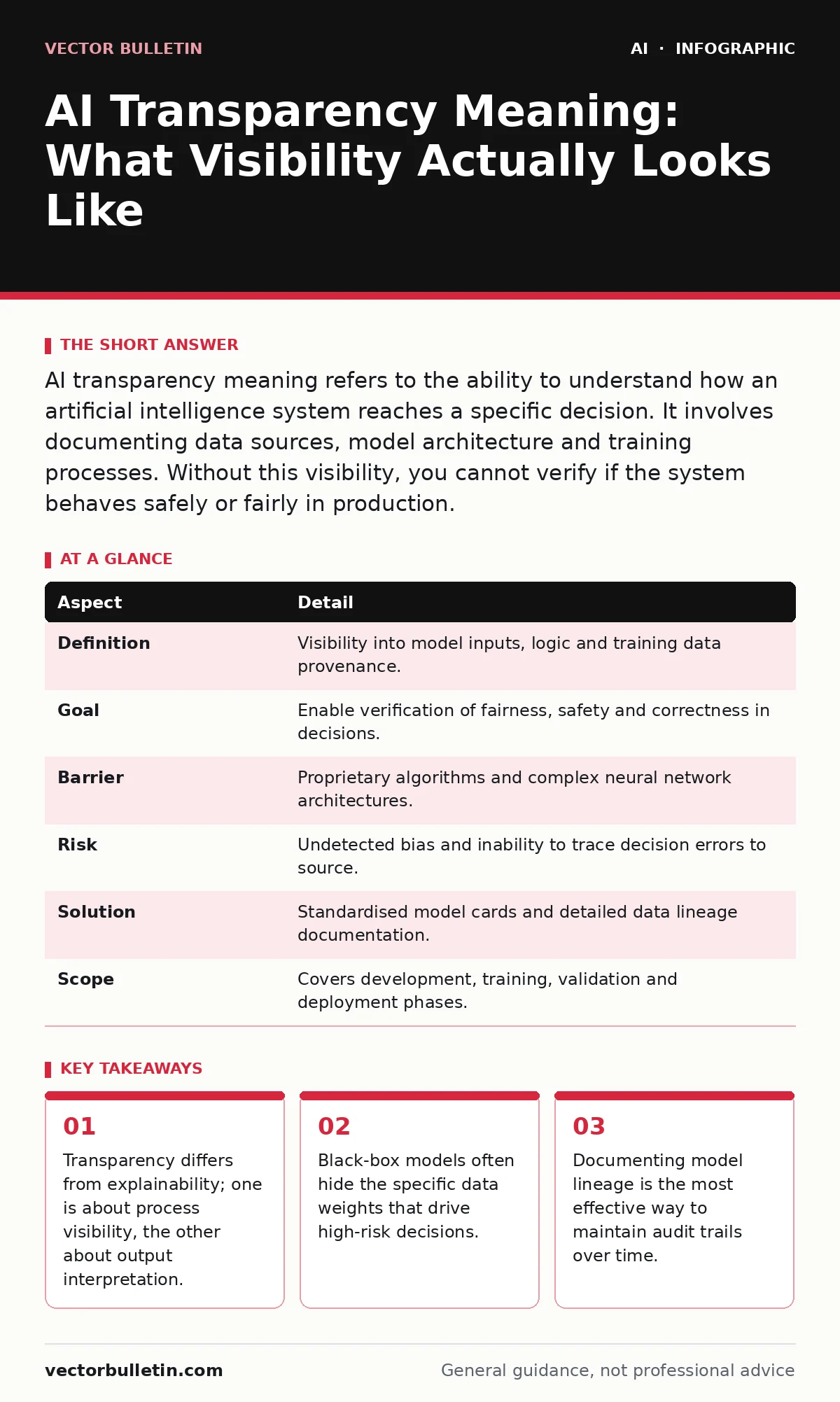
AI transparency meaning refers to the ability to understand how an artificial intelligence system reaches a specific decision. It involves documenting data sources, model architecture and training processes. Without this visibility, you cannot verify if the system behaves safely or fairly in production.
The Glass Box Analogy
Imagine a chef preparing a complex dish. You can taste the final meal and describe its flavour. That is the output. AI transparency meaning requires you to see the recipe, the ingredients and the cooking method. If the chef uses a secret spice blend, you cannot determine if it contains allergens. You cannot replicate the dish. You cannot trust it for a sensitive dietary requirement. The output is visible, but the process is opaque. This distinction matters when the "dish" determines credit approval or medical diagnosis.
At a Glance
| Aspect | Detail |
|---|---|
| Definition | Visibility into model inputs, logic and training data provenance. |
| Goal | Enable verification of fairness, safety and correctness in decisions. |
| Barrier | Proprietary algorithms and complex neural network architectures. |
| Risk | Undetected bias and inability to trace decision errors to source. |
| Solution | Standardised model cards and detailed data lineage documentation. |
| Scope | Covers development, training, validation and deployment phases. |
How Transparency Works in Practice
Transparency is not a single feature. It is a chain of documentation. The chain starts with data provenance. You must record where training data came from, how it was cleaned and what labels were applied. Next comes model documentation. This describes the architecture, the parameters and the hyperparameters used during training. Finally, you need runtime observability. This tracks how the model behaves with new inputs. If any link in this chain breaks, the transparency claim fails. You cannot audit a decision if you do not know which data influenced it.
Neural networks operate as multi-layered function approximators. They transform inputs through thousands of mathematical operations. The internal states are often high-dimensional vectors that humans cannot interpret directly. This complexity creates the transparency gap. You see the input and the output, but the middle is a black box. To bridge this gap, engineers use techniques like feature attribution. These methods highlight which input variables contributed most to a specific prediction. This does not reveal the full logic, but it provides a partial map of the decision surface.
Who Is Affected by Opacity
The impact of poor transparency extends beyond the developers. End users suffer when they cannot contest decisions. If a loan application is denied, the user needs to know why. A generic "credit score too low" is not transparent. It does not allow for correction. Regulators are affected because they cannot verify compliance with fairness laws. They need evidence that protected attributes were not used as proxies. Operators face operational risk. When a model drifts or fails, they need to diagnose the cause quickly. Opacity turns debugging into guesswork.
Organisations that build these systems bear the legal burden. They must demonstrate that their models behave as intended. This is particularly difficult with third-party components. If you integrate a pre-trained model, you inherit its opacity. You do not have access to its training data or internal weights. This creates a dependency on the vendor's honesty. You must treat the model as untrusted until you have verified its behaviour independently. This connects directly to the risks outlined in AI supply chain risks. You are importing potential vulnerabilities and biases without full visibility.
What People Usually Get Wrong
Many teams confuse transparency with explainability. Explainability focuses on interpreting a single output. It answers "why did this happen?" for one case. Transparency focuses on the entire system. It answers "how does this work?" for all cases. You can have explainable outputs from an opaque system. Post-hoc explanation methods can generate plausible-sounding reasons for a decision. These reasons may not reflect the actual model logic. They are approximations. Relying on them creates a false sense of security. You think you understand the model, but you only understand the explanation tool.
Another common error is assuming that open-source equals transparent. Publishing the code is necessary but insufficient. Code does not show the training data. It does not show the data cleaning steps. It does not show the hyperparameter tuning process. A model trained on biased data will produce biased results, regardless of how clean the code is. True transparency requires data documentation. It requires model cards that describe intended use cases and known limitations. Without these documents, the code is just a black box with visible walls.
Steps to Improve Transparency
Start by implementing data lineage tracking. Record every transformation applied to the training data. Use version control for data sets, not just code. This allows you to reproduce the exact training environment. Next, adopt standard documentation practices. Model cards provide a structured way to report model performance across different subgroups. They force you to measure bias explicitly. If a model performs poorly on a specific demographic, the card must state this.
Integrate monitoring into the deployment pipeline. Track input distributions and output distributions over time. Detect when the live data differs from the training data. This is data drift. It often indicates that the model is operating outside its validated domain. When drift occurs, the transparency of past decisions becomes questionable. The model may be relying on new patterns that were not audited. Regular re-validation against a held-out test set helps maintain confidence in the model's behaviour.
The Limits of Current Methods
No current method provides full transparency for complex models. Feature attribution methods are approximate. They show correlations, not causal mechanisms. In high-dimensional spaces, these correlations can be unstable. Small changes in input can lead to large changes in attribution. This makes it difficult to rely on them for critical decisions. You must treat attribution scores as indicators, not proofs.
The trade-off is often between performance and transparency. Simpler models, like linear regression or decision trees, are inherently more transparent. They are easier to audit and explain. However, they may not capture complex patterns in the data. Deep learning models often achieve higher accuracy but sacrifice interpretability. You must choose the right tool for the risk level. High-stakes decisions require higher transparency. Low-stakes recommendations can tolerate more opacity. This balance is central to machine learning in cybersecurity. You need to detect anomalies, but you also need to know why an alert was triggered to avoid false positives.
Managing Third-Party Models
When you use external models, you face a transparency deficit. You cannot inspect the training data. You cannot verify the absence of backdoors. You must rely on the vendor's documentation and your own testing. Perform rigorous input-output testing. Check for consistent behaviour across similar inputs. Look for edge cases where the model fails. Document these findings. This creates a local transparency record that supplements the vendor's claims.
Consider the risks of sensitive data leaks through AI chatbots if you use conversational models. These models may retain fragments of input data. They may generate outputs that resemble training data. This is a privacy risk as well as a transparency risk. You need to know what the model remembers. If the vendor does not provide this information, you must assume the worst. Implement data minimisation. Do not send sensitive information to opaque external models. This reduces the impact of any hidden data retention.
Key takeaways
- Transparency differs from explainability; one is about process visibility, the other about output interpretation.
- Black-box models often hide the specific data weights that drive high-risk decisions.
- Documenting model lineage is the most effective way to maintain audit trails over time.
Frequently asked questions
Is AI transparency the same as model explainability?
No. Transparency covers the entire lifecycle, including data and training processes. Explainability focuses on interpreting individual model outputs. Transparency is about process visibility; explainability is about output interpretation.
How can I audit a black-box AI model?
You can use statistical testing and feature attribution methods. These techniques analyse input-output relationships to infer model behaviour. They do not reveal internal weights but can highlight biases and inconsistencies.
Does open-source code guarantee transparency?
No. Code visibility does not include training data or preprocessing steps. You need documentation on data provenance and model training parameters. Without this, the model remains partially opaque.
What is the biggest risk of low transparency?
The primary risk is undetected bias and inability to diagnose failures. You cannot fix what you cannot see. Opacity prevents root cause analysis when models produce incorrect or harmful decisions.
How this guide was produced: written by the Vector Bulletin editorial team with AI assistance, checked against the public references listed below, and reviewed when the facts change. See our editorial policy or report an error.