
AI Supply Chain Myths: What Your Security Model Gets Wrong
Trusting open-source weights as safe is a false premise because model parameters can embed backdoors that survive standard integrity checks and retraining.
AI supply chain risks extend beyond code to data, weights and infrastructure. Common beliefs about isolation, open-source safety and vendor responsibility ignore how models inherit bias from training data, how weights can be poisoned and how dependency graphs for machine learning are opaque and unverified.
Myth: Open-Source Models Are Safer Because the Code Is Visible
Reality: The ability to inspect source code does not guarantee that the underlying model is secure or free of malicious intent. While you can read the training scripts, you cannot easily reverse-engineer the millions of parameters within the neural networks to detect embedded logic bombs.
The transparency of open-source repositories often creates a false sense of security. Contributors may inadvertently include poisoned data in the training set, or an attacker may inject subtle biases that only trigger under specific conditions. This is distinct from traditional software vulnerabilities, which are usually syntax errors or logic flaws visible in the code structure.
Imagine you download a popular language model to run locally. You audit the Python scripts that trained it and find nothing suspicious. However, the model itself was trained on a dataset that included millions of subtly altered documents. These alterations taught the model to respond to a specific, rare phrase by executing a predefined action. This is a form of data poisoning that leaves no trace in the training code.
This risk is compounded by the fact that model weights are large binary files. They do not support traditional integrity checks like hash verification of source code lines. Once the weights are downloaded, the model behaves like a black box. You are trusting the mathematical output of the neural networks without a way to inspect their internal decision-making pathways.
Myth: Isolating the AI Component Removes Supply Chain Risk
Reality: Network isolation does not protect against vulnerabilities embedded in the model weights or the training data. If you download a pre-trained model and run it on an air-gapped machine, you are still executing code that was crafted by an external party.
The assumption is that cutting off network access prevents external manipulation. This is true for runtime attacks, where an adversary sends malicious prompts to alter behaviour. It does not address the supply chain issue, where the compromise occurs before the model ever reaches your environment.
Consider a scenario where you use a base model for a internal document summarisation tool. The model was trained on public data that included adversarial examples. Even without an internet connection, the model may still exhibit the behaviours learned during its training phase. The risk is baked into the parameters, not injected at runtime.
This mirrors the concept of zero-day vulnerabilities in traditional software. The code is isolated, but the flaw exists within the binary. For AI, the binary is the model file. Isolating the execution environment prevents new data from being poisoned, but it does not cleanse the existing model of historical compromises.
Myth: Vendors Are Liable for Model Misbehaviour and Security Flaws
Reality: Most AI providers offer models under permissive licences that disclaim liability for how the model is used or its accuracy. The responsibility for verifying safety and security shifts entirely to the integrator.
You might assume that a reputable vendor has conducted rigorous security testing. While many do, the scope of this testing is rarely disclosed. Furthermore, the definition of "secure" in AI is still evolving. A model might be tested for prompt injection but not for data leakage or weight poisoning.
When you fine-tune a base model, you are creating a new derivative work. The original vendor’s security guarantees do not extend to your modifications. If your fine-tuning process introduces a vulnerability, the vendor is not responsible. This is a critical distinction from traditional software, where patches are often provided by the original developer.
This lack of liability means you must treat every model as a third-party component with unknown risk levels. You cannot rely on vendor support to fix a compromised model. You must have the capability to detect anomalies and revert to previous versions if necessary.
Myth: Adversarial Attacks Are Only a Theoretical Concern
Reality: Adversarial examples are a practical and growing threat that can bypass safety filters and cause models to generate harmful or incorrect outputs. These attacks exploit the mathematical properties of neural networks.
You may believe that these attacks require sophisticated expertise and are rare. In practice, simple perturbations in input data can cause significant deviations in model output. For example, adding invisible noise to an image can cause an object detection system to misclassify it entirely.
This is not just a theoretical issue for research labs. Attackers are actively developing tools to generate adversarial examples at scale. These tools can be used to poison training data or to attack deployed models. The ease of generating such attacks means that any public-facing AI service is a potential target.
The impact of these attacks can be severe. In a medical diagnostic system, an adversarial attack could cause the model to miss a critical finding. In a financial system, it could lead to incorrect risk assessments. The defence against these attacks is not just monitoring, but robust training and input validation.
Myth: Data Provenance Is Tracked and Verifiable
Reality: The lineage of training data is often opaque, making it difficult to verify the integrity or legality of the data used to train a model. Data is aggregated from countless sources, and the original context is frequently lost.
You might assume that vendors curate their training data carefully. While many do employ filtering mechanisms, these are not perfect. Data can be scraped from the web, where malicious actors can inject poisoned content. This content can then be included in the training set without detection.
This lack of provenance makes it hard to assess the risk of bias or misinformation in the model. If you do not know where the data came from, you cannot verify its quality. This is a fundamental weakness in the AI supply chain.
Imagine you are using a model for legal document analysis. If the training data included forged legal precedents, the model could generate incorrect citations. You would not know this until it was too late. The inability to trace data back to its source is a significant risk factor.
Myth: Security Scanning Tools Can Detect AI Vulnerabilities
Reality: Traditional security tools are not designed to analyse model weights or training data. They look for known vulnerabilities in code, not for anomalies in mathematical parameters.
You may rely on static analysis tools to scan your software for security issues. These tools will not detect a backdoor in a neural network. The structure of AI models is fundamentally different from traditional software.
This means that AI supply chain security requires new approaches. You need tools that can analyse model behaviour, detect anomalies in outputs and verify the integrity of weights. These tools are still emerging and are not yet standard in most security operations.
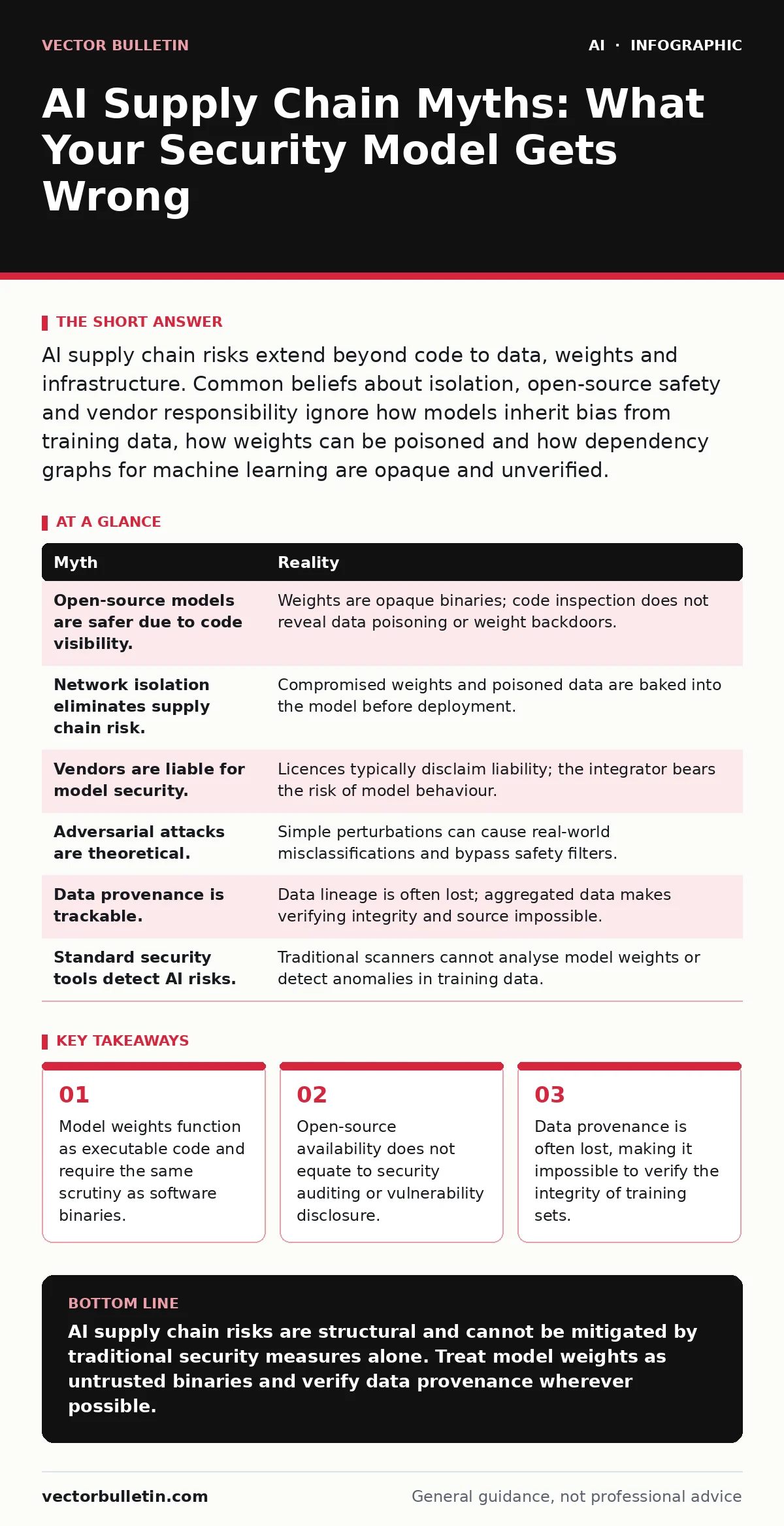
| Myth | Reality |
|---|---|
| Open-source models are safer due to code visibility. | Weights are opaque binaries; code inspection does not reveal data poisoning or weight backdoors. |
| Network isolation eliminates supply chain risk. | Compromised weights and poisoned data are baked into the model before deployment. |
| Vendors are liable for model security. | Licences typically disclaim liability; the integrator bears the risk of model behaviour. |
| Adversarial attacks are theoretical. | Simple perturbations can cause real-world misclassifications and bypass safety filters. |
| Data provenance is trackable. | Data lineage is often lost; aggregated data makes verifying integrity and source impossible. |
| Standard security tools detect AI risks. | Traditional scanners cannot analyse model weights or detect anomalies in training data. |
Key takeaways
- Model weights function as executable code and require the same scrutiny as software binaries.
- Open-source availability does not equate to security auditing or vulnerability disclosure.
- Data provenance is often lost, making it impossible to verify the integrity of training sets.
AI supply chain risks are structural and cannot be mitigated by traditional security measures alone. Treat model weights as untrusted binaries and verify data provenance wherever possible.
Frequently asked questions
How can I verify the integrity of a downloaded AI model?
You cannot easily verify the internal logic of weights. Use cryptographic hashes to ensure the file has not been tampered with in transit, but this does not prove the model is safe from poisoning.
What is the difference between AI supply chain risk and traditional software risk?
Traditional risks are in the code logic. AI risks are in the data and the mathematical weights, which are opaque and cannot be inspected line by line.
Can fine-tuning reduce supply chain risks?
Fine-tuning can help align a model to specific tasks, but it does not remove underlying vulnerabilities in the base model. It can even introduce new risks if the fine-tuning data is compromised.
Are there standards for AI supply chain security?
Frameworks like MITRE ATLAS are emerging to catalogue attack techniques, but there is no single standard for verifying AI supply chain integrity yet.
How this guide was produced: written by the Vector Bulletin editorial team with AI assistance, checked against the public references listed below, and reviewed when the facts change. See our editorial policy or report an error.