
Treating AI Models as Untrusted Insiders Checklist
Treating AI models as untrusted insiders prevents latent data leakage and logic manipulation that standard perimeter controls miss entirely.
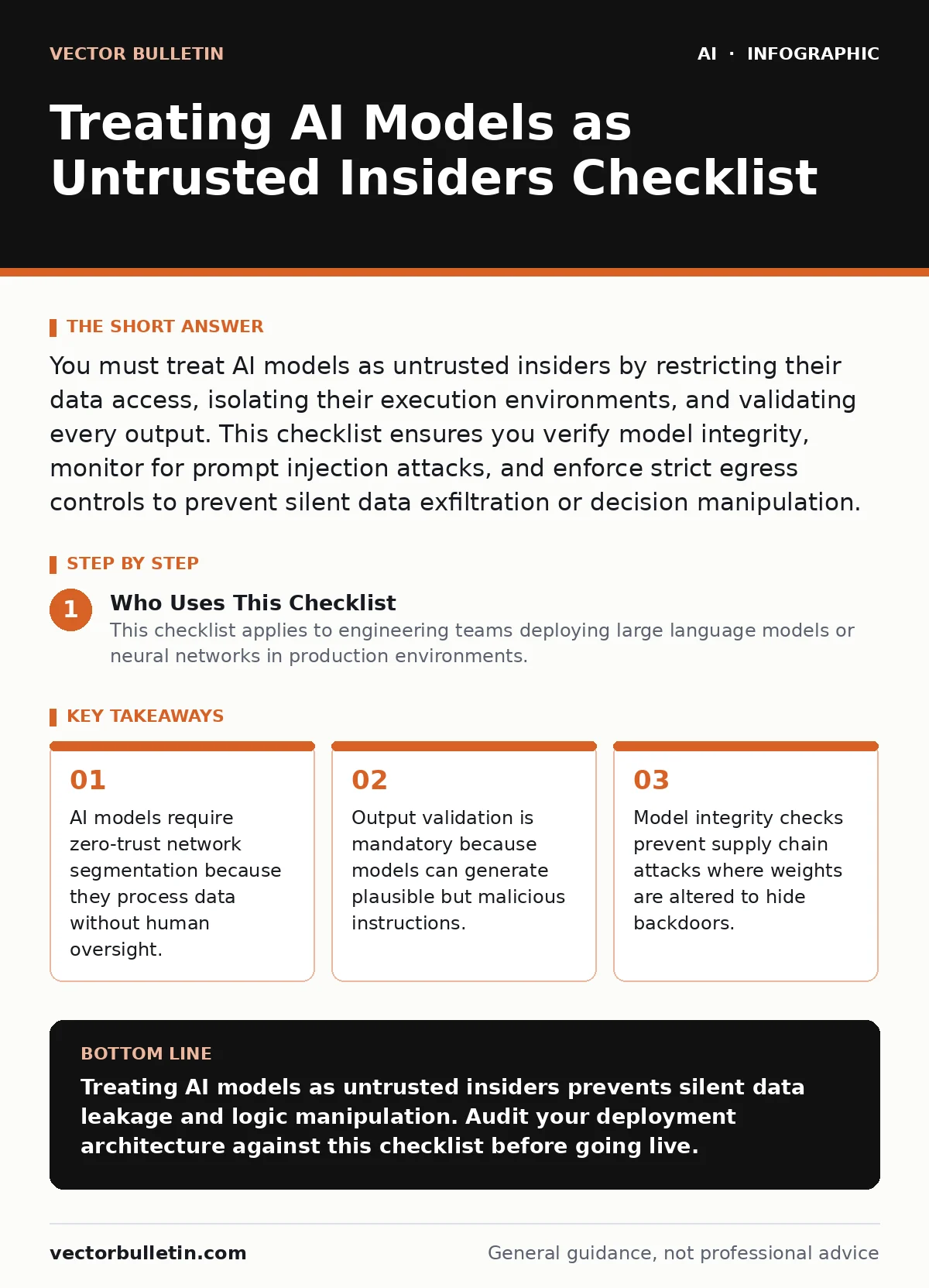
You must treat AI models as untrusted insiders by restricting their data access, isolating their execution environments, and validating every output. This checklist ensures you verify model integrity, monitor for prompt injection attacks, and enforce strict egress controls to prevent silent data exfiltration or decision manipulation.
Who Uses This Checklist
This checklist applies to engineering teams deploying large language models or neural networks in production environments. You use this list to audit your current deployment architecture. The goal is to verify that your infrastructure treats the model as a potential threat vector rather than a trusted component. You review these items before deployment and periodically during operation.
Data Access and Isolation
- Enforce least-privilege data access: Models should only read data required for the immediate task.
- Isolate model execution environments: Run models in containers with no persistent storage access.
- Separate training data from inference data: Prevent leakage of sensitive training examples into responses.
- Encrypt data in transit and at rest: Protect information even if the model environment is compromised.
- Restrict internal API access: Models cannot query internal databases without explicit, audited permission.
- Implement data minimization: Strip personally identifiable information before passing it to the model.
- Monitor data egress patterns: Detect unusual volumes of data leaving the model environment.
- Validate input data formats: Reject malformed inputs that could trigger parsing errors or injections.
Model Integrity and Supply Chain
- Verify model weights and hashes: Ensure the model file has not been altered since download.
- Audit fine-tuning datasets: Confirm that no malicious data was injected during the training phase.
- Check for embedded backdoors: Scan model architecture for hidden triggers or logic bombs.
- Validate source provenance: Only use models from verified, reputable sources with clear lineage.
- Monitor for model drift: Detect performance changes that might indicate tampering or degradation.
- Review dependency libraries: Ensure all supporting code and libraries are free from known vulnerabilities.
- Implement version control for models: Track every change to the model configuration and weights.
- Test for adversarial examples: Verify the model does not react unexpectedly to crafted inputs.
Output Validation and Control
- Validate all model outputs: Check responses against a strict schema or allowlist of acceptable actions.
- Implement human-in-the-loop for critical decisions: Require human approval for high-impact actions.
- Rate limit model interactions: Prevent abuse or resource exhaustion through excessive requests.
- Log all input and output pairs: Maintain an audit trail for forensic analysis and compliance.
- Detect prompt injection attempts: Identify inputs designed to override system instructions or safety filters.
- Sanitize generated code or commands: Never execute model-generated code without static analysis.
- Monitor for hallucination patterns: Flag responses that contain fabricated facts or sources.
- Enforce strict output formatting: Reject responses that do not match expected structural constraints.
Network and Runtime Security
- Segment model network access: Prevent the model from communicating with unrelated internal systems.
- Disable outbound internet access: Block the model from making external API calls unless explicitly required.
- Monitor runtime resource usage: Detect anomalies in CPU, memory, or GPU usage that suggest compromise.
- Implement emergency stop mechanisms: Allow immediate termination of model processes if behaviour becomes erratic.
- Restrict environment variable access: Prevent the model from reading sensitive configuration data.
- Use read-only file systems: Prevent the model from writing to the host or container file system.
- Audit network connections: Verify that all network traffic from the model is expected and authorised.
- Implement intrusion detection: Monitor for signs of lateral movement from the model environment.
Governance and Monitoring
- Define clear usage policies: Specify what tasks the model is authorised to perform.
- Conduct regular security assessments: Test the model and its environment for new vulnerabilities.
- Train staff on AI risks: Ensure teams understand the unique threats posed by generative AI.
- Establish incident response procedures: Define steps to take if the model is compromised or abused.
- Monitor for AI governance compliance: Ensure the deployment meets organisational and regulatory standards.
- Review access logs regularly: Identify any unauthorised attempts to interact with the model.
- Implement automated alerting: Notify security teams of suspicious activities in real-time.
- Document all security controls: Maintain clear records of how the model is secured and monitored.
Key takeaways
- AI models require zero-trust network segmentation because they process data without human oversight.
- Output validation is mandatory because models can generate plausible but malicious instructions.
- Model integrity checks prevent supply chain attacks where weights are altered to hide backdoors.
Treating AI models as untrusted insiders prevents silent data leakage and logic manipulation. Audit your deployment architecture against this checklist before going live.
Frequently asked questions
How do I detect prompt injection attacks?
Monitor for inputs that attempt to override system instructions or change the model's persona. Implement strict input validation and use filtering tools to block suspicious patterns.
What is the risk of model drift?
Model drift can indicate tampering or degradation in performance. It may lead to incorrect decisions or increased vulnerability to adversarial attacks if not monitored and corrected.
Why is output validation critical?
Models can generate plausible but malicious instructions. Validating outputs against a strict schema ensures that only safe and expected actions are executed by downstream systems.
How do I secure fine-tuning datasets?
Audit datasets for malicious content before training. Ensure data is sourced from trusted providers and scanned for embedded triggers or backdoors that could compromise the model.
How this guide was produced: written by the Vector Bulletin editorial team with AI assistance, checked against the public references listed below, and reviewed when the facts change. See our editorial policy or report an error.