How AI Data Centres Work: Infrastructure and Security Mechanics
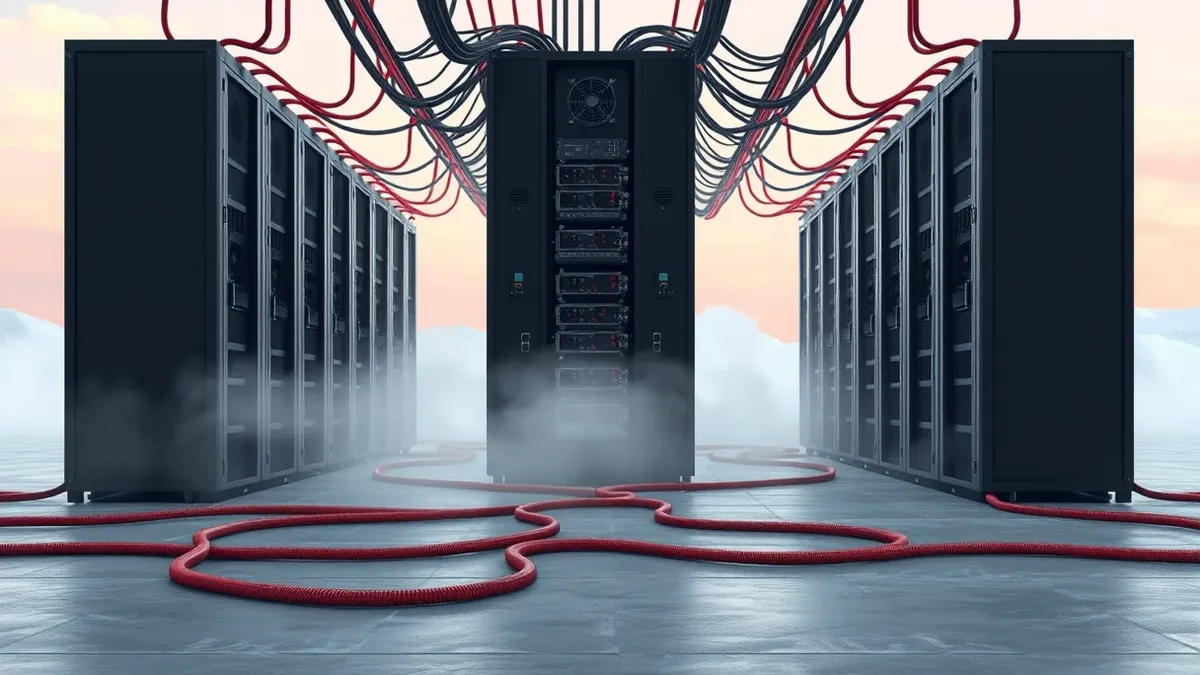
The physical cooling requirements of AI clusters dictate the network topology and create unique attack surfaces that traditional server farms do not possess.
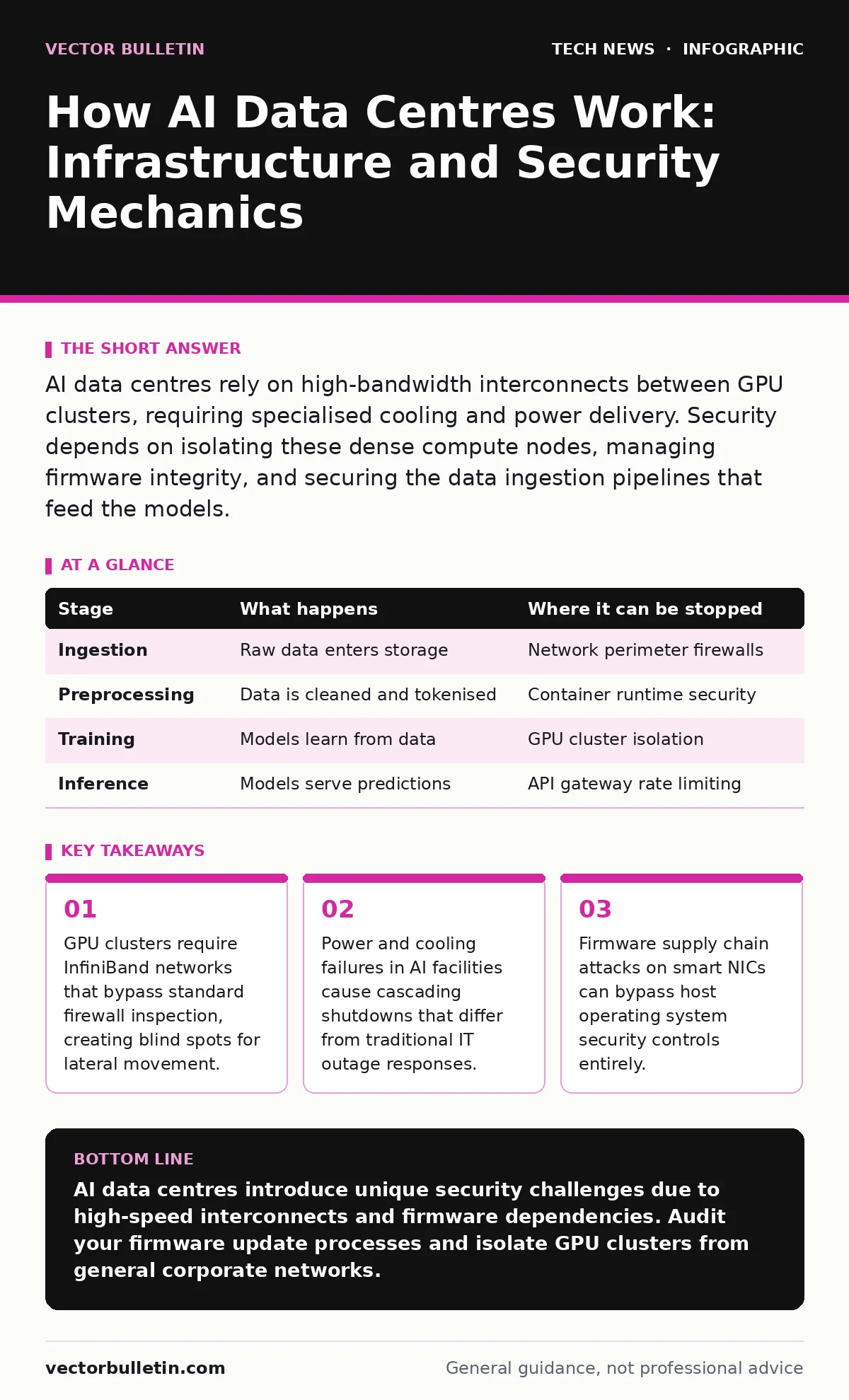
AI data centres rely on high-bandwidth interconnects between GPU clusters, requiring specialised cooling and power delivery. Security depends on isolating these dense compute nodes, managing firmware integrity, and securing the data ingestion pipelines that feed the models.
Physical Infrastructure and Power Delivery
AI workloads demand sustained high power density that exceeds standard server rack limits. A single GPU cluster draws significantly more electricity than traditional CPU servers. This density requires liquid cooling systems rather than air conditioning. The cooling infrastructure becomes a critical dependency for availability. Failure in coolant pumps stops computation immediately.
Power distribution units must handle massive transient spikes when models begin training. These spikes can trip breakers if not managed with sophisticated load balancing. The physical layout prioritises power and cooling over security perimeters. Cabling density creates fire hazards and complicates physical access controls. Maintenance windows are shorter because downtime costs are higher.
Network Topology and Interconnects
Standard Ethernet cannot handle the latency requirements of distributed AI training. Facilities use InfiniBand or high-speed RoCE networks for internal traffic. These protocols bypass traditional TCP/IP stacks to reduce overhead. This optimisation removes the stateful inspection capabilities of standard firewalls. Security teams lose visibility into east-west traffic between compute nodes.
The network fabric assumes internal trust, which is a dangerous assumption in shared environments. Switches use remote direct memory access to move data directly between GPUs. This eliminates CPU involvement in data transfers. An attacker with access to one node can potentially exfiltrate data from another without triggering host-based alerts.
Stage 1: Data Ingestion and Preprocessing
Raw data enters the facility through storage area networks or direct cloud feeds. This stage involves cleaning, normalising, and tokenising inputs. Data lakes store unstructured information before it reaches the compute layer. Access controls here determine what models can learn. Compromised ingestion pipelines introduce poisoned data that alters model behaviour. The preprocessing servers often run in privileged containers. These containers require careful image signing to prevent tampering. Data validation checks must occur before storage. Invalid formats can crash preprocessing jobs and waste compute resources.
| Stage | What happens | Where it can be stopped |
|---|---|---|
| Ingestion | Raw data enters storage | Network perimeter firewalls |
| Preprocessing | Data is cleaned and tokenised | Container runtime security |
| Training | Models learn from data | GPU cluster isolation |
| Inference | Models serve predictions | API gateway rate limiting |
Compute Clusters and Firmware Security
The core of the facility consists of GPU racks connected in high-speed fabrics. Each node runs a specialised operating system tailored for parallel processing. Firmware on network interface cards manages data movement. This firmware operates below the operating system kernel. Vulnerabilities in smart NIC firmware allow attackers to bypass host security. Updates to this firmware are rare and risky. Rolling back to older versions is often impossible without hardware replacement. The complexity of the firmware stack exceeds the audit capacity of most teams. Supply chain integrity is the primary defence here. Verify signatures for all firmware updates.
Cooling and Environmental Controls
Liquid cooling systems circulate coolant through cold plates attached to GPUs. These systems require precise temperature and pressure monitoring. Sensors feed data to building management systems. These systems often connect to the corporate network for alerts. A compromise of the building management system can disable cooling. Overheating triggers automatic shutdowns to prevent hardware damage. These shutdowns are abrupt and can corrupt ongoing training jobs. The cooling infrastructure has its own power requirements. Redundant pumps and chillers are standard but not foolproof. Physical access to coolant lines is a security risk. Tampering can cause leaks that short-circuit electronics.
Model Training and Resource Allocation
Training jobs request specific amounts of compute resources. Orchestrators manage the allocation of GPUs across multiple jobs. This process uses container orchestration platforms. These platforms define resource limits and isolation boundaries. Poorly configured limits allow noisy neighbour attacks. One job can starve others of resources. The orchestrator logs resource usage but not data content. This logging gap hides data exfiltration attempts. Training jobs run for days or weeks. Long-running processes increase the window for exploitation. Monitoring must focus on resource anomalies rather than just process crashes.
Stage 2: Model Training Execution
The orchestrator assigns GPUs to training jobs. Data moves from storage to GPU memory. The model updates its weights based on the data. This process generates massive amounts of temporary data. Checkpoints save the model state periodically. These checkpoints are valuable targets for theft. Encryption at rest protects static checkpoints. Encryption in transit is harder to implement due to performance costs. The trade-off between security and speed is constant. Most facilities prioritise speed, leaving gaps in encryption.
Inference Serving and API Gateways
Trained models serve predictions via application programming interfaces. These APIs handle requests from external users. Rate limiting prevents abuse and denial of service attacks. Input validation ensures requests match expected formats. Malformed inputs can trigger errors that reveal system details. The inference layer is the public face of the facility. It requires strict authentication and authorisation. API key security is critical here. Leaked keys allow unauthorised access to model capabilities. Logging of API requests helps detect anomalous usage patterns.
Monitoring and Incident Response
Standard monitoring tools struggle with AI workloads. Metrics focus on GPU utilisation and power consumption. Security monitoring must integrate with these operational metrics. Anomalies in power draw can indicate cryptojacking. Unusual network traffic patterns suggest data exfiltration. Log aggregation from all layers is necessary. Correlating events across physical, network, and application layers is complex. Automated response plays are difficult to implement. False positives in AI environments are costly. Manual verification is often required before taking action. The noise level in AI logs is high. Filtering must be precise to avoid alert fatigue.
Stage 3: Inference and Output Delivery
The model processes incoming requests. It generates predictions or completions. These outputs are sent back to the user. The system logs the request and response. Pii in outputs must be filtered. This filtering adds latency to responses. The trade-off between privacy and performance is significant. Most facilities implement basic filtering. Advanced filtering requires additional compute resources. The cost of filtering scales with traffic volume.
Supply Chain and Vendor Management
AI facilities rely on multiple vendors for hardware and software. Each vendor introduces potential vulnerabilities. The complexity of the stack exceeds the audit capacity of most teams. Third-party risk management is essential. Vendors must provide security attestations. These attestations are often self-reported and unreliable. Independent verification is costly and time-consuming. The speed of AI innovation outpaces security auditing. New hardware arrives before security teams can assess it. The gap between deployment and audit is widening.
Integration with Existing Security Frameworks
AI data centres must integrate with existing corporate security. This integration is challenging due to the unique architecture. Standard firewall rules may not apply to high-speed interconnects. Open port management becomes complex with dynamic workloads. The OSI model provides a framework for analysis. Each layer presents different risks. Physical layer risks include cooling and power failures. Network layer risks include firmware vulnerabilities. Application layer risks include API abuse. Integrating these layers into a unified view is difficult. Siloed monitoring leads to blind spots. A holistic approach is necessary but rarely achieved.
Key takeaways
- GPU clusters require InfiniBand networks that bypass standard firewall inspection, creating blind spots for lateral movement.
- Power and cooling failures in AI facilities cause cascading shutdowns that differ from traditional IT outage responses.
- Firmware supply chain attacks on smart NICs can bypass host operating system security controls entirely.
AI data centres introduce unique security challenges due to high-speed interconnects and firmware dependencies. Audit your firmware update processes and isolate GPU clusters from general corporate networks.
Frequently asked questions
How do AI data centres differ from traditional cloud servers?
They use specialised high-speed networks and liquid cooling to support dense GPU clusters, which changes the attack surface and failure modes.
Can firewalls protect AI training clusters?
Standard firewalls cannot inspect high-speed interconnect traffic like InfiniBand, requiring alternative segmentation and monitoring strategies.
What is the biggest risk in AI infrastructure?
Firmware vulnerabilities on network interface cards that operate below the operating system and bypass standard security controls.
How do you secure data ingestion pipelines?
Use strict access controls, validate data formats before storage, and sign container images to prevent tampering during preprocessing.
How this guide was produced: written by the Vector Bulletin editorial team with AI assistance, checked against the public references listed below, and reviewed when the facts change. See our editorial policy or report an error.