
Synthetic Media Explained: How AI Forgeries Work and How to Detect Them
Synthetic media is not just about deepfakes; it is a structural shift in how digital evidence is generated, verified and trusted across your infrastructure.
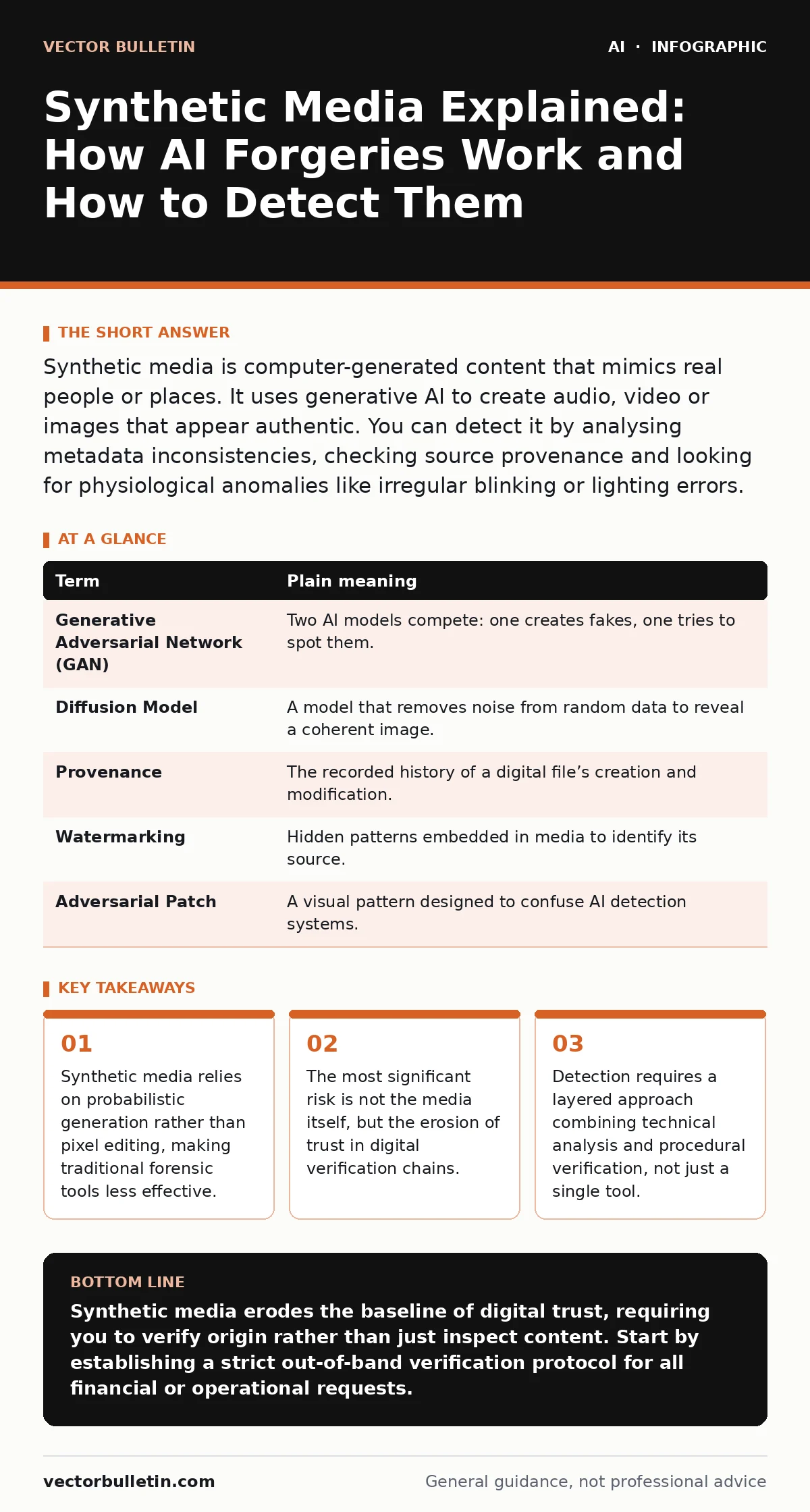
Synthetic media is computer-generated content that mimics real people or places. It uses generative AI to create audio, video or images that appear authentic. You can detect it by analysing metadata inconsistencies, checking source provenance and looking for physiological anomalies like irregular blinking or lighting errors.
The Recipe Analogy for Understanding Synthesis
Imagine a chef who has never cooked but has read every recipe book in existence. You ask for a lasagne. The chef does not retrieve a photo of a lasagne. Instead, they synthesize one from scratch, layer by layer, based on statistical probabilities of what a lasagne usually contains. They know cheese should be on top and sauce should be red.
They do not know the specific taste of your grandmother’s recipe, but they know the general concept perfectly. This is how generative AI works. It does not copy-paste reality; it predicts the next most likely pixel or sound wave based on vast patterns of existing data. The result looks real because it follows the rules of reality, even though it has no connection to any specific real event.
Defining the Core Mechanisms
To understand the threat, you must distinguish between the model and the output. The generative model is the system trained on datasets to learn patterns. It is the chef’s brain. The synthetic media is the output: the lasagne. It is the generated content that appears to depict a real person, place or event. A latent space is the mathematical environment where the model compresses complex data into simplified representations. It is where the chef stores the abstract concept of "cheesiness" or "redness" before assembling the final dish.
Common Points of Confusion
Readers often confuse synthetic media with traditional photo editing. Editing modifies existing pixels; synthesis creates new ones from noise. Another confusion involves the term deepfake. This refers specifically to face-swapping technology using neural networks. Not all synthetic media is a deepfake. Text-to-video generation, voice cloning and AI-generated music are also synthetic media but do not involve swapping faces. Understanding this distinction matters because the detection methods differ. A face-swap leaves seams around the jawline. A text-to-video generation might struggle with the physics of a moving object.
The Hidden Cost of Verification
The primary cost of synthetic media is not the creation of the fake, but the effort required to prove the real. This is known as the asymmetry of trust. It is computationally cheap to generate convincing fakes. It is computationally expensive to verify authentic content. You cannot simply scan a file for a "fake" label. You must verify its origin, its integrity and its context. This shifts the burden of proof from the accuser to the verifier. In a security operation, this means you must assume any unverified media from an external source could be synthetic until proven otherwise.
Technical Detection Strategies
Detection relies on finding inconsistencies that the model missed. Metadata analysis checks the file’s header data for signs of generation software. Provenance standards like C2PA embed cryptographic signatures in files to prove their origin. However, these signatures can be stripped. Physiological analysis looks for biological anomalies. Humans blink irregularly; early models blinked at fixed intervals. Humans reflect light in specific ways; synthetic faces may have flat lighting or incorrect reflections in the eyes.
| Term | Plain meaning |
|---|---|
| Generative Adversarial Network (GAN) | Two AI models compete: one creates fakes, one tries to spot them. |
| Diffusion Model | A model that removes noise from random data to reveal a coherent image. |
| Provenance | The recorded history of a digital file’s creation and modification. |
| Watermarking | Hidden patterns embedded in media to identify its source. |
| Adversarial Patch | A visual pattern designed to confuse AI detection systems. |
Operational Resilience and Policy
Technology alone cannot solve this problem. You need processes. Implement a out-of-band verification policy. If you receive suspicious media via email, verify the request through a separate channel, such as a phone call to a known number. Do not rely on the contact details provided in the suspicious message. Train staff to recognise the signs of urgency, which is the primary social engineering trigger for synthetic media attacks. For deeper insights into how these models operate, see our guide on neural networks. Understanding the underlying architecture helps you appreciate why certain errors occur.
Integrating with Broader Security
Synthetic media is part of a larger ecosystem of AI risks. It intersects with AI supply chain risks when you use third-party generation tools that may inject malicious code or biases. It relates to AI transparency because you must understand what data your models are trained on. It also connects to sensitive data leaks through AI chatbots if employees use public generative tools with proprietary data.
While machine learning in cybersecurity offers detection tools, it also powers the attacks. See securing AI agents for guidance on protecting autonomous systems that might generate or process such media. Finally, AI hallucinations can create false information that, while not malicious, still damages trust.
- Audit your current media verification workflows.
- Implement out-of-band verification for high-value requests.
- Train staff to recognise physiological and contextual anomalies.
Key takeaways
- Synthetic media relies on probabilistic generation rather than pixel editing, making traditional forensic tools less effective.
- The most significant risk is not the media itself, but the erosion of trust in digital verification chains.
- Detection requires a layered approach combining technical analysis and procedural verification, not just a single tool.
Synthetic media erodes the baseline of digital trust, requiring you to verify origin rather than just inspect content. Start by establishing a strict out-of-band verification protocol for all financial or operational requests.
Frequently asked questions
Can I detect synthetic media just by looking at it?
Not reliably. As models improve, visual artifacts disappear. You must rely on metadata, provenance and procedural verification rather than visual inspection alone.
Is watermarking enough to prevent misuse?
No. Watermarks can be removed by cropping or re-encoding. They are a supplementary measure, not a primary defence. Use cryptographic provenance standards instead.
How do I handle synthetic audio specifically?
Audio is harder to detect visually. Listen for unnatural breathing, lack of background noise or inconsistent reverberation. Verify the speaker’s identity through a separate channel.
Does AI transparency help with detection?
Yes. Transparency initiatives push for standardised metadata that indicates content was AI-generated. This helps automated systems filter synthetic media before it reaches users.
How this guide was produced: written by the Vector Bulletin editorial team with AI assistance, checked against the public references listed below, and reviewed when the facts change. See our editorial policy or report an error.