
Breach Notification Laws: What You Must Report and When
Notification deadlines often start the moment you detect the breach, not when you confirm data was stolen, forcing teams to act on incomplete evidence.
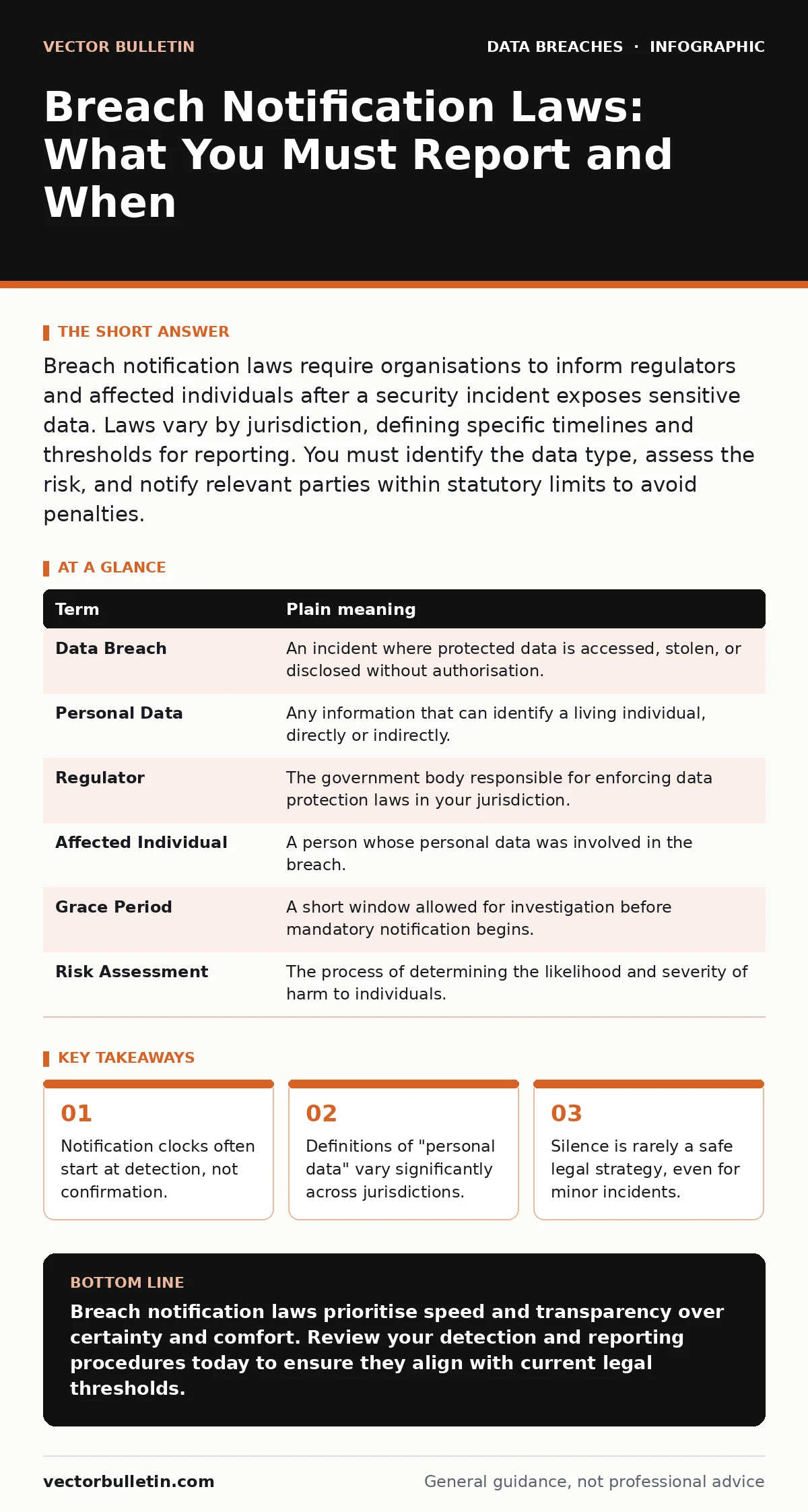
Breach notification laws require organisations to inform regulators and affected individuals after a security incident exposes sensitive data. Laws vary by jurisdiction, defining specific timelines and thresholds for reporting. You must identify the data type, assess the risk, and notify relevant parties within statutory limits to avoid penalties.
The Postal Service Analogy
Imagine you run a private postal service. A van carrying sealed letters crashes. You do not know which letters were read, only that the vehicle was compromised. Most people assume you should wait until you know exactly who was affected. The law often disagrees. You must report the crash itself because the risk of exposure exists, regardless of whether you can prove specific letters were opened. This analogy frames the core tension in breach notification: you are liable for the potential of harm, not just the confirmed reality.
Core Terminology
Understanding the legal requirements requires precise definitions. Terms that seem similar in casual conversation carry distinct legal weights. Confusing these terms can lead to missed deadlines or unnecessary panic.
| Term | Plain meaning |
|---|---|
| Data Breach | An incident where protected data is accessed, stolen, or disclosed without authorisation. |
| Personal Data | Any information that can identify a living individual, directly or indirectly. |
| Regulator | The government body responsible for enforcing data protection laws in your jurisdiction. |
| Affected Individual | A person whose personal data was involved in the breach. |
| Grace Period | A short window allowed for investigation before mandatory notification begins. |
| Risk Assessment | The process of determining the likelihood and severity of harm to individuals. |
The Detection Trigger
The most common mistake is waiting for certainty. Many regulations state the notification clock starts when the organisation becomes aware of the breach. "Awareness" is often interpreted as the moment internal systems flag an anomaly. You do not need to know the scope or the specific data types involved to start the timer. This creates a pressure to report quickly, often while the investigation is still in its early stages. Waiting to confirm the full extent can mean missing the deadline entirely.
Defining Personal Data
Not all data triggers notification requirements. Most laws distinguish between general data and personally identifiable information. However, the definition of personal data is broad. It can include IP addresses, cookie identifiers, or even employee IDs if they can be linked back to a specific person. This breadth means that seemingly technical logs may contain reportable data. You must review your data classification standards to understand what constitutes a breach. Understanding how file metadata can link data to individuals is often overlooked but critical here.
Jurisdictional Complexity
If your organisation operates across borders, you face multiple legal regimes. A single breach may trigger notifications in several countries simultaneously. Each jurisdiction has different thresholds, deadlines, and content requirements. One country may require notification within seventy-two hours; another may allow thirty days. The data type may matter more in one region than another. You must map your data flows to understand which laws apply. Ignoring a secondary jurisdiction can result in significant fines and reputational damage. This complexity is why data retention policies must be clear; you need to know what you hold and where.
See also: Privacy Audits: Definition, Purpose and Practical Execution · Personal data for small businesses: how to collect less and survive
Risk and Harm Assessment
Some laws allow you to delay or skip notification if the risk to individuals is low. This is not a subjective feeling but a structured assessment. You must consider the sensitivity of the data, the number of people affected, and the likelihood of misuse. For example, a breach of unencrypted passwords poses a high risk. A breach of encrypted data with the keys held securely elsewhere may pose a low risk. Document this assessment thoroughly. Regulators will ask for evidence of your reasoning. This process overlaps with principles found in medical identity theft prevention, where the harm is immediate and severe.
The Notification Content
Once you decide to notify, the content matters as much as the timing. You must provide clear, plain language explanations. Avoid legal jargon or technical deflection. Tell individuals what happened, what data was involved, and what steps you are taking. Provide contact details for further questions. Do not promise complete prevention of future harm; state what you are doing to mitigate the current incident. This transparency builds trust, even in a negative situation. Consider how remote desktop security failures often require this level of clear communication to users.
Verification and Audit
After the initial notification, the process continues. You may need to provide updates as you learn more. Keep records of all communications, decisions, and assessments. These records serve as evidence of compliance during audits or investigations. File integrity monitoring can help prove that your systems were not tampered with after the breach, supporting your narrative. Regular reviews of your notification procedures ensure you are ready for the next incident.
Immediate Actions
- Detect and Log: Record the timestamp of the first alert and preserve all logs immediately.
- Assess Scope: Determine if personal data was accessed and which jurisdictions are affected.
- Consult Legal: Engage legal counsel to interpret specific notification requirements and deadlines.
Key takeaways
- Notification clocks often start at detection, not confirmation.
- Definitions of "personal data" vary significantly across jurisdictions.
- Silence is rarely a safe legal strategy, even for minor incidents.
Breach notification laws prioritise speed and transparency over certainty and comfort. Review your detection and reporting procedures today to ensure they align with current legal thresholds.
Frequently asked questions
Do I need to notify if the data was encrypted?
It depends on the jurisdiction and whether the encryption keys were also compromised. Many laws consider encrypted data as low risk if the keys remain secure.
What if I am not sure if it is a breach?
If you are unsure, treat it as a potential breach and begin the assessment. Many laws allow for a brief grace period for investigation.
Can I notify the regulator without notifying individuals?
Yes, in cases where the risk to individuals is low, some laws require only regulator notification. Check local requirements.
Does a phishing email that is not clicked count?
Generally, no. A breach requires actual access or loss of data. An attempt that fails is a security incident, not necessarily a reportable breach.
How this guide was produced: written by the Vector Bulletin editorial team with AI assistance, checked against the public references listed below, and reviewed when the facts change. See our editorial policy or report an error.