
Medical Identity Theft: Five Myths Blocking Effective Detection
Medical identity theft rarely involves stealing a physical card; it exploits the fragmented nature of health data to create synthetic profiles for service fraud.
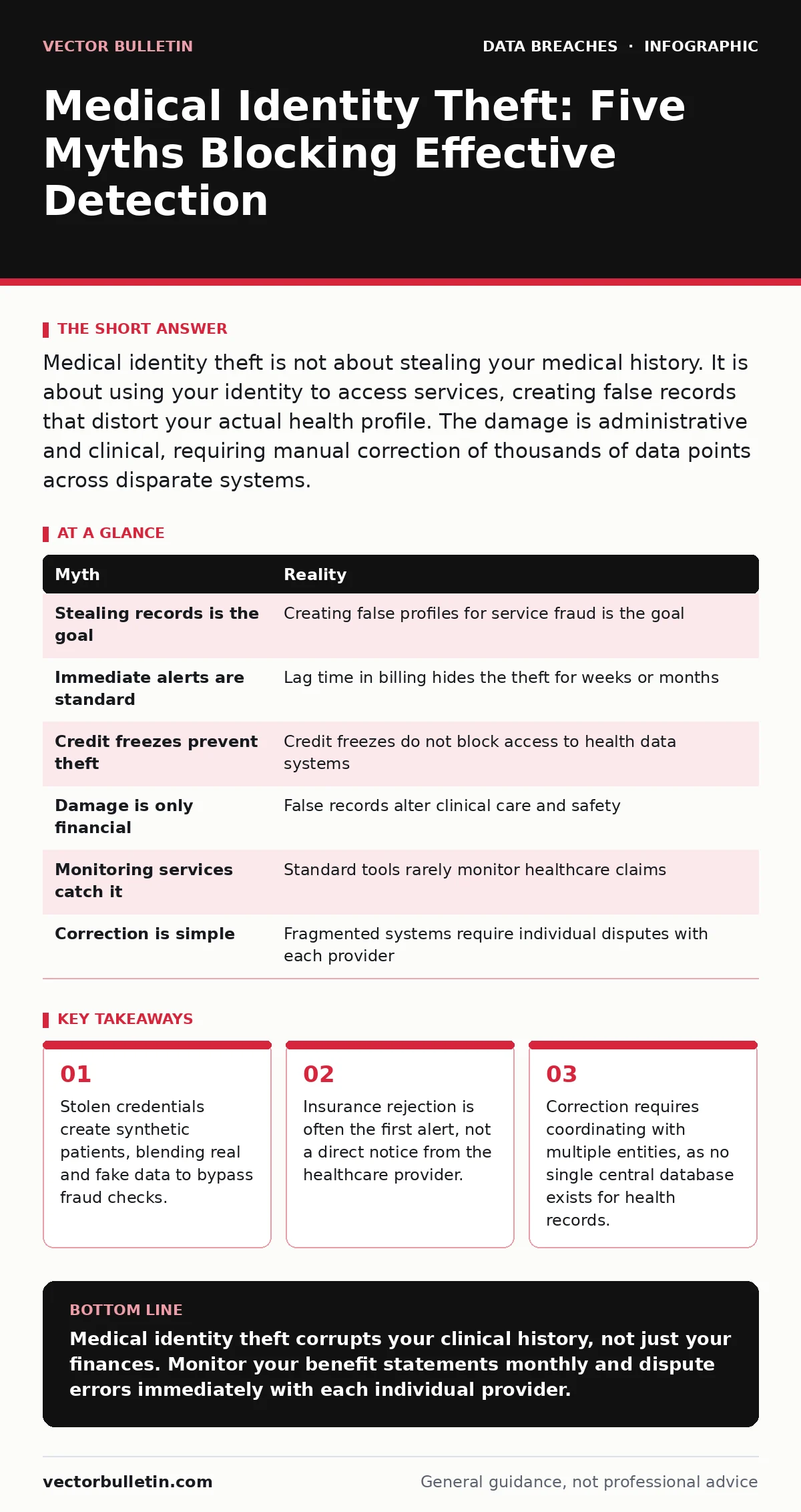
Medical identity theft is not about stealing your medical history. It is about using your identity to access services, creating false records that distort your actual health profile. The damage is administrative and clinical, requiring manual correction of thousands of data points across disparate systems.
Myth: Medical Identity Theft Is About Stealing Your Medical Records
Reality: The primary motive is rarely to read your actual health history. Perpetrators do not care about your cholesterol levels or past surgeries. They care about your name, date of birth, and insurance details. These data points allow them to register as a new patient.
Imagine a scenario where an attacker uses your identity to claim coverage for expensive medications. The goal is financial gain through the healthcare payment system. Your actual medical data becomes collateral damage. The false records attached to your name are often nonsensical or dangerous, but they are not the target. They are the byproduct of the fraud.
This misconception leads to a false sense of security. You might assume that because your medical history is private, you are safe. In reality, the privacy of your history is irrelevant to the attacker. The openness of your identity information is the vulnerability.
Myth: You Will Receive Immediate Notification of Unauthorized Use
Reality: There is no real-time alert system for most medical identity theft. Unlike a credit card transaction, which can be flagged instantly, medical services are often rendered before billing occurs. The lag time can be weeks or months.
Healthcare providers bill insurers, not patients, for the initial transaction. You may not see the charge until an Explanation of Benefits arrives. By then, the fraudulent service has already been added to your permanent record. The delay allows the fraud to compound. Multiple fake visits or prescriptions can accumulate before anyone notices the pattern.
This latency creates a window where the damage expands silently. You might receive a denial for legitimate care because the insurer sees conflicting data. The system flags your account as anomalous, but the correction process is slow. The initial theft is hidden behind administrative complexity.
Myth: A Single Credit Freeze Stops Medical Identity Theft
Reality: Credit freezes restrict access to your credit report. They do not block access to health information. Medical providers and insurers do not check credit bureaus to verify your identity when you seek care. They rely on internal databases and basic personal identifiers.
Imagine you freeze your credit to protect against financial fraud. An attacker still has your date of birth and insurance ID. They use this to schedule an appointment or pick up a prescription. The credit freeze is invisible to the healthcare system. It offers no protection against the creation of a medical profile.
This gap in protection is significant. Many assume that securing financial identity secures all identities. Health data operates in a separate ecosystem. The mechanisms for verification are weaker and less standardized. Relying on financial tools leaves your medical identity exposed.
Myth: The Damage Is Limited to Financial Loss
Reality: The clinical impact is far more severe than the financial one. False medical records can alter your actual care. If a fraudster claims you are allergic to penicillin, that allergy becomes part of your official history. Future doctors will see this warning.
Suppose you need emergency treatment. The system shows a history of drug allergies that do not exist. The physician may hesitate to use a critical medication. The false data introduces a barrier to correct care. This is not a billing error; it is a safety hazard.
These records are persistent. Deleting a false entry requires proving it never happened. In a system designed to capture care, proving a negative is difficult. The false data remains in various provider systems indefinitely. It creates a shadow history that complicates every future interaction with healthcare providers.
Myth: Identity Theft Protection Services Catch Medical Fraud
Reality: Standard identity monitoring services focus on financial indicators. They track credit inquiries, dark web data, and bank account activity. They rarely monitor healthcare claims or prescription databases. The data sources for health fraud are different and less accessible.
Imagine paying for a premium identity protection plan. It alerts you to a new credit card application. It does not alert you when someone uses your insurance ID to claim surgery. The monitoring blind spot is structural. Health data is siloed and protected by different regulations.
This means you are often unaware of the theft until it surfaces elsewhere. A denied claim or a strange item on a benefit statement is the first clue. By then, the monitoring service has missed the event entirely. The tools are designed for finance, not healthcare.
See also: How Compliance Audits Actually Work: The Mechanics of Verification · Backup Data Exposure: 7 Mistakes That Leave Your Archives Open
Myth: Correcting the Record Is a Simple Administrative Task
Reality: Correction is a fragmented, labour-intensive process. There is no central health database where you can submit a single correction. You must contact each provider, insurer, and pharmacy individually. Each entity has its own procedure for disputing records.
Suppose you identify three false entries. You must submit a correction request to the hospital, the lab, and the insurer. Each may require different forms and evidence. The hospital may refer you to the insurer. The insurer may refer you to the provider. The cycle repeats.
This fragmentation makes resolution slow and exhausting. You must act as the central coordinator for your own data. The burden of proof lies with you. You must demonstrate that you were not present for the service. This often requires police reports and sworn statements.
| Myth | Reality |
|---|---|
| Stealing records is the goal | Creating false profiles for service fraud is the goal |
| Immediate alerts are standard | Lag time in billing hides the theft for weeks or months |
| Credit freezes prevent theft | Credit freezes do not block access to health data systems |
| Damage is only financial | False records alter clinical care and safety |
| Monitoring services catch it | Standard tools rarely monitor healthcare claims |
| Correction is simple | Fragmented systems require individual disputes with each provider |
The Mechanics of Synthesis
Reality: Medical identity theft often involves "identity blending." Attackers take your real personal data and combine it with fake medical data. This creates a "synthetic" identity that looks legitimate to automated checks. The name and date of birth are real, which passes basic verification.
The medical history is fabricated. This hybrid profile is harder to detect because it contains truth and fiction. Automated fraud detection systems may see the valid personal details and allow the transaction. The false medical data is new to the system, so it does not trigger historical anomalies immediately.
This synthesis exploits the lack of interoperability. Provider A does not share real-time data with Provider B. The attacker exploits this gap. They create a record in one system that has no counterpart elsewhere. Until a human reviews the conflicting data, the synthetic identity persists.
Key takeaways
- Stolen credentials create synthetic patients, blending real and fake data to bypass fraud checks.
- Insurance rejection is often the first alert, not a direct notice from the healthcare provider.
- Correction requires coordinating with multiple entities, as no single central database exists for health records.
Medical identity theft corrupts your clinical history, not just your finances. Monitor your benefit statements monthly and dispute errors immediately with each individual provider.
Frequently asked questions
How do I know if my medical identity is stolen?
Look for Explanation of Benefits for services you did not receive. Check for prescriptions you did not fill and appointments you did not attend. Unusual denials for care are also a red flag.
Can I remove false medical records from my history?
You can dispute them with each provider. Submit a written correction request with evidence of non-attendance. The record may be amended but rarely fully deleted, leaving a note of the dispute.
Does HIPAA protect me from medical identity theft?
HIPAA regulates how providers handle data, not how they verify identity at intake. It mandates breach notification laws but does not prevent the initial fraudulent registration.
Should I freeze my credit to prevent this?
Freezing credit helps with financial fraud but does not stop medical identity theft. Healthcare providers do not use credit bureaus for patient verification. It is a necessary but insufficient step.
How this guide was produced: written by the Vector Bulletin editorial team with AI assistance, checked against the public references listed below, and reviewed when the facts change. See our editorial policy or report an error.