
How Compliance Audits Actually Work: The Mechanics of Verification
Auditors rarely test security controls directly; they verify the administrative trail that proves you tested them, shifting the burden of proof entirely.
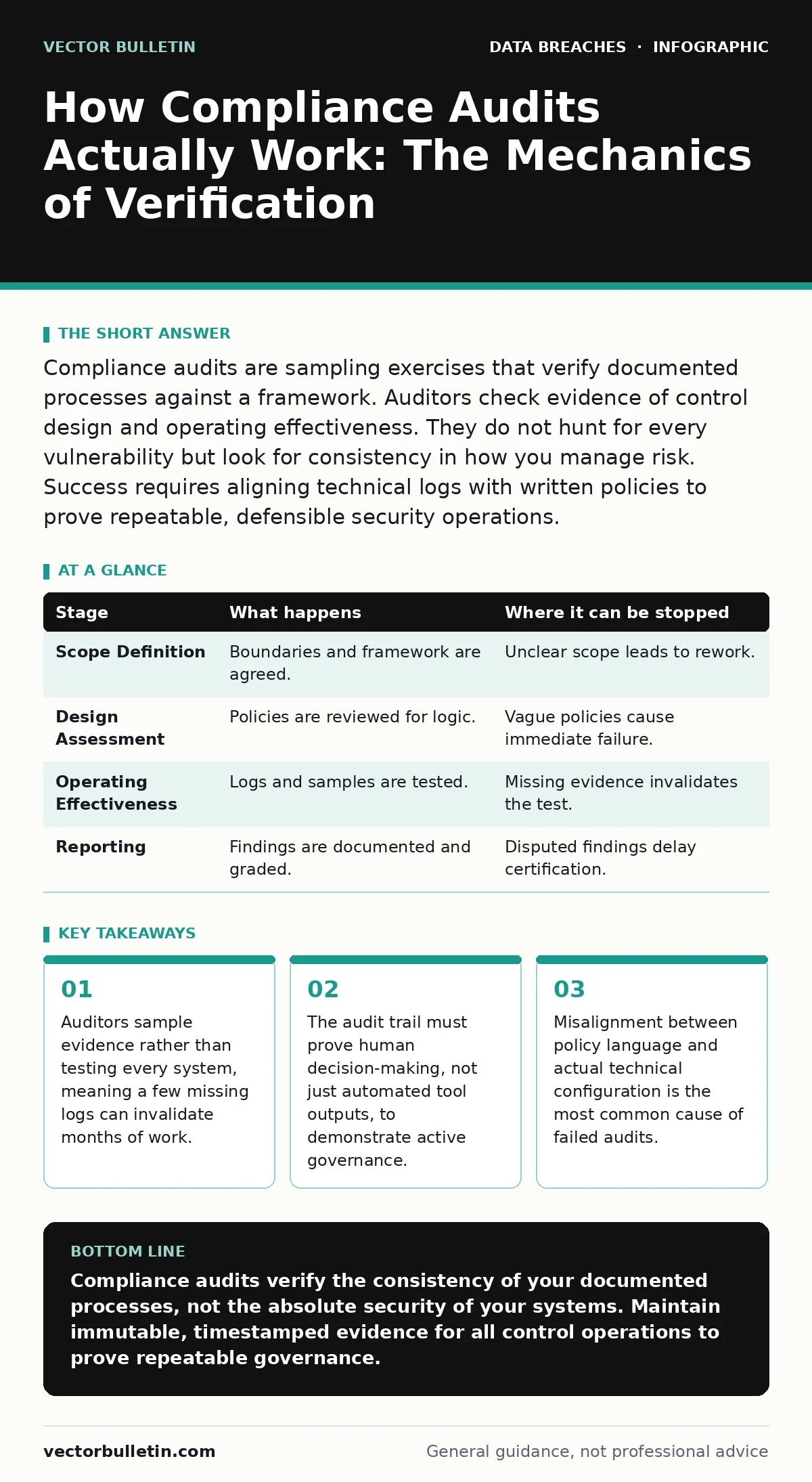
Compliance audits are sampling exercises that verify documented processes against a framework. Auditors check evidence of control design and operating effectiveness. They do not hunt for every vulnerability but look for consistency in how you manage risk. Success requires aligning technical logs with written policies to prove repeatable, defensible security operations.
The Administrative Burden of Verification
Compliance audits assess whether your security controls match stated policies. The process shifts focus from technical perfection to administrative consistency. You cannot pass an audit by having secure systems alone. You must prove you manage those systems deliberately. The auditor’s role is not to break your defences. It is to verify that you have a repeatable process for maintaining them. This distinction changes how you prepare. You spend more time documenting decisions than patching servers. The goal is defensible evidence, not absolute security. Imagine a highly secure server with no change log.
An auditor marks this as non-compliant because the security state cannot be verified over time. The lack of documentation is a finding, regardless of the server’s actual resilience. This creates a hidden cost: maintaining the evidence chain often consumes more resources than the control itself. You must design your operations to generate audit trails automatically. Manual evidence collection fails under scrutiny because it is inconsistent. Automated logging ensures every action is recorded with timestamps and user identities. This removes human error from the evidence-gathering phase.
Stage 1: Scope and Framework Alignment
The first stage defines what is being audited and against which rules. You select a framework such as ISO 27001 or SOC 2. The scope determines which systems, data sets and processes are in play. You must map your technical controls to specific framework requirements. This mapping is critical. If a control does not map to a requirement, it is invisible to the auditor. You ignore controls that fall outside the defined scope. This creates a boundary for the engagement. You define the physical and logical boundaries of your environment. You identify third-party vendors who handle data within that scope.
Their security posture becomes part of your responsibility. You cannot outsource compliance. You must verify their controls through their own audit reports. This stage sets the rules of evidence. You agree on what constitutes valid proof. You establish the period under review. This period usually covers the last twelve months of operations. You freeze your policy documents for this period. Any changes made during the review window require justification. The auditor checks for consistency between the policy version they see and the actual practice.
Stage 2: Control Design Assessment
The auditor examines whether your controls are designed correctly. They do not test if the control works yet. They check if the design can achieve its stated goal. You present your security policies and standard operating procedures. The auditor reviews these documents for clarity and completeness. A vague policy fails this stage. You must define who does what, when and how. The auditor checks for logical gaps in the design. For example, a password policy must specify complexity, rotation and storage methods. If it lacks storage details, the design is incomplete.
You must also define exception handling. What happens when a rule cannot be followed? The design must include a process for approving and documenting exceptions. This stage identifies theoretical weaknesses. You fix these before moving to testing. It is cheaper to rewrite a policy than to remediate a failed test. You ensure that every technical control has a corresponding administrative procedure. This alignment is often overlooked. Technical teams build controls in isolation. They forget to write the procedure that governs their use. The auditor sees this gap as a control failure.
| Stage | What happens | Where it can be stopped |
|---|---|---|
| Scope Definition | Boundaries and framework are agreed. | Unclear scope leads to rework. |
| Design Assessment | Policies are reviewed for logic. | Vague policies cause immediate failure. |
| Operating Effectiveness | Logs and samples are tested. | Missing evidence invalidates the test. |
| Reporting | Findings are documented and graded. | Disputed findings delay certification. |
Stage 3: Operating Effectiveness Testing
This stage tests if controls work in practice. The auditor selects a sample of transactions or events. They verify that the control operated as designed for each sample. You provide logs, screenshots or system outputs as evidence. The auditor checks for consistency across the sample. If one sample fails, the auditor expands the sample size. A second failure usually results in a finding. You must provide evidence that is immutable and time-stamped. Altered logs are grounds for audit failure. The auditor looks for human intervention in automated processes.
They verify that overrides are approved and documented. This stage reveals the gap between policy and reality. You often find that staff bypass controls for convenience. The auditor sees this as a breakdown in governance. You must prove that exceptions are rare and controlled. Regular staff behaviour must align with policy. The auditor may interview staff to verify their understanding. If staff cannot explain the control, the design is considered ineffective. Knowledge gaps are as damaging as technical failures.
Stage 4: Evidence Collection and Review
You gather evidence to support your claims. This is not a one-time event. It is a continuous process throughout the audit period. You store evidence in a secure, accessible repository. The auditor requests specific items by reference number. You must locate and provide them quickly. Delays suggest poor record-keeping. You redact sensitive data from evidence before sharing. Use data masking techniques to protect confidential information while preserving the audit trail. The auditor checks the integrity of the evidence.
They verify that it has not been tampered with. Chain of custody is vital. You must prove who created, handled and stored the evidence. Digital signatures or hash values help prove integrity. You keep a log of all evidence requests and responses. This log becomes part of the audit record. It shows transparency and cooperation. Hiding evidence is worse than missing evidence. It suggests malicious intent. The auditor notes any difficulty in retrieving evidence. This impacts their assessment of your operational maturity.
See also: 3-2-1 Backup Rule Example: A Working Model for Data Resilience · synthetic identity fraud: how to detect and stop it
Stage 5: Findings and Remediation
The auditor documents any deviations from the framework. These are called findings or exceptions. Each finding is graded by severity. High severity findings block certification. Low severity findings may be noted but do not stop approval. You receive a draft report for review. You can comment on factual inaccuracies. You cannot dispute the auditor’s professional judgment on control design. You must agree to a remediation plan for any findings. This plan includes steps, owners and deadlines. You implement the fixes and provide evidence of completion.
The auditor verifies the remediation. This may require a follow-up test. You repeat the testing process for the specific finding. Once all high-severity findings are closed, the audit concludes. The auditor issues a final report or certificate. This document is valid for a specific period. You must maintain controls throughout this period. Lapses after certification can void it. You must have a process for continuous monitoring. This ensures you stay compliant between audits. The cost of remediation is often higher than prevention. Fixing findings consumes budget and staff time.
Stage 6: Certification and Continuous Monitoring
The final stage issues the certificate or report. This confirms your compliance at a point in time. It does not guarantee future security. You must maintain the controls that were audited. Any significant change triggers a reassessment. You update your scope if new systems are added. You revise policies if threats evolve. Continuous monitoring tools help track control status in real time. You set alerts for policy violations. This allows you to fix issues before the next audit. You review your audit trail regularly. This identifies gaps early. You train staff on new policies promptly.
Knowledge decay is a risk. Regular refreshers ensure staff remember procedures. You treat compliance as an ongoing operational requirement. It is not a project with an end date. You integrate audit requirements into your development lifecycle. This reduces the burden of evidence collection. Automated controls reduce the risk of human error. You build compliance into your infrastructure. This approach is more sustainable than manual efforts. It reduces the cost of audits over time. You demonstrate to stakeholders that security is embedded in your culture.
Applying the Audit Results
You use the audit results to improve your security posture. The findings highlight areas of weakness. You prioritize remediation based on risk. High-severity findings require immediate attention. You address root causes, not just symptoms. If a policy was ignored, you investigate why. Was it unclear? Was it too burdensome? You adjust the policy to fit reality. You communicate changes to staff clearly. You provide training on new procedures. You update your evidence collection processes. This makes the next audit easier. You share lessons learned across teams. One team’s failure can inform another’s success. You build a culture of accountability. Staff understand that compliance is part of their job. You reward good practices. This reinforces positive behaviour.
You review your framework alignment regularly. Standards evolve. You must keep up with changes. You engage with industry groups for insights. You stay ahead of regulatory shifts. This proactive approach reduces surprises. You turn audits into opportunities for improvement. They are not just hurdles to clear. They are tools for strengthening your defences. You use the evidence to show value to leadership. You prove that security investments work. This justifies future budget requests. You build trust with customers and partners. Compliance is a competitive advantage. You leverage it in marketing and sales. You differentiate yourself from competitors. You show that you take data protection seriously. This trust is hard to earn and easy to lose. Protect it diligently.
Key takeaways
- Auditors sample evidence rather than testing every system, meaning a few missing logs can invalidate months of work.
- The audit trail must prove human decision-making, not just automated tool outputs, to demonstrate active governance.
- Misalignment between policy language and actual technical configuration is the most common cause of failed audits.
Compliance audits verify the consistency of your documented processes, not the absolute security of your systems. Maintain immutable, timestamped evidence for all control operations to prove repeatable governance.
Frequently asked questions
How do auditors select their sample size for testing?
Auditors use statistical sampling methods based on risk and volume. Higher risk areas require larger samples. They ensure the sample is representative of the whole population.
Can you fix a finding during the audit process?
Yes, you can remediate findings before the final report is issued. The auditor will verify the fix. This may extend the audit timeline and cost.
What happens if you fail a compliance audit?
You receive a report with findings. You must remediate high-severity issues. Certification is withheld until fixes are verified. Repeated failures can damage reputation.
How often should you conduct internal audits?
Conduct internal audits annually or before external audits. This identifies gaps early. It reduces the risk of surprise findings. Regular checks maintain compliance readiness.
How this guide was produced: written by the Vector Bulletin editorial team with AI assistance, checked against the public references listed below, and reviewed when the facts change. See our editorial policy or report an error.