
synthetic identity fraud: how to detect and stop it
Synthetic identity fraud combines real and fake data to create persons who never existed, bypassing standard identity verification checks.
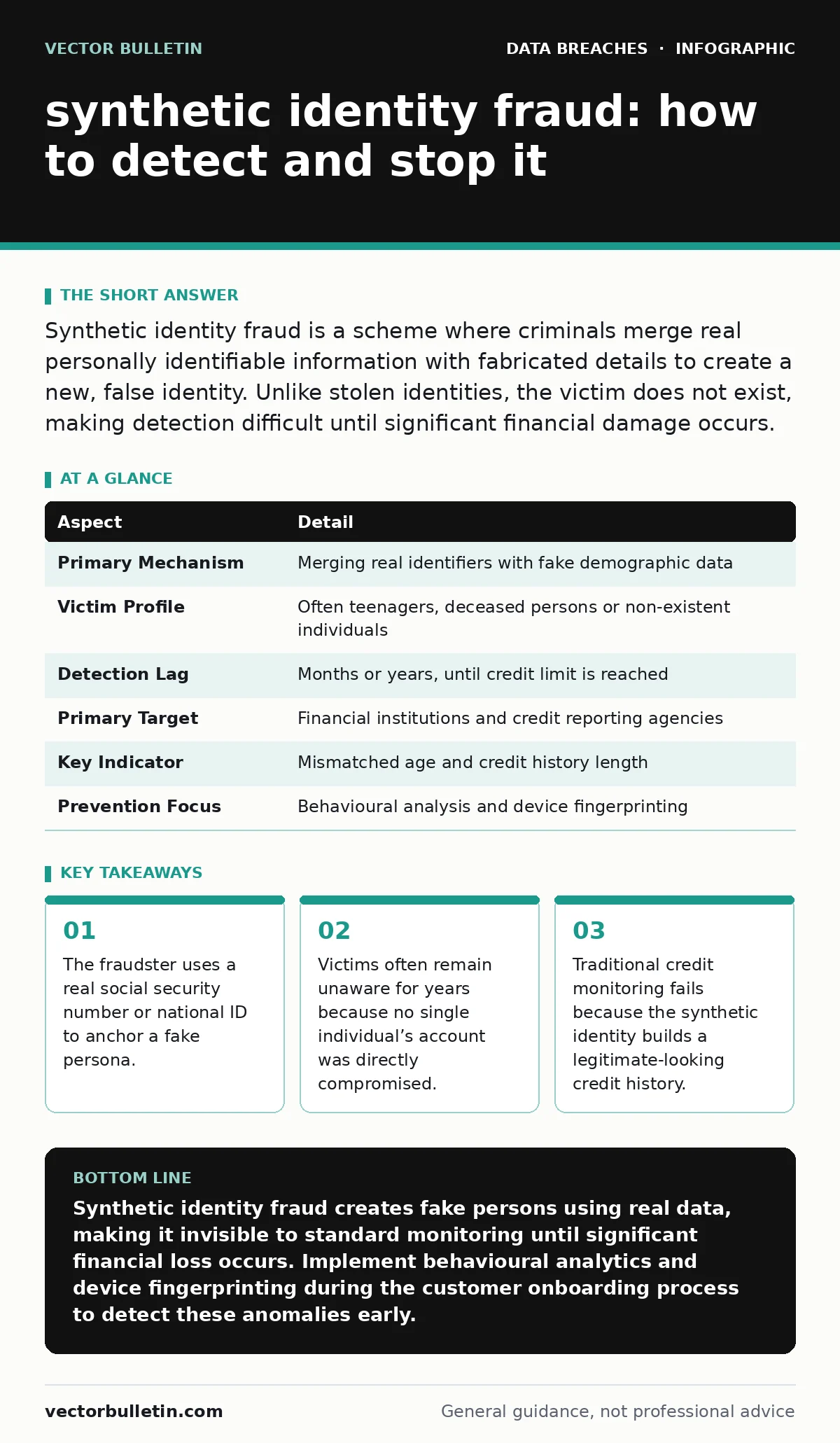
Synthetic identity fraud is a scheme where criminals merge real personally identifiable information with fabricated details to create a new, false identity. Unlike stolen identities, the victim does not exist, making detection difficult until significant financial damage occurs.
What is synthetic identity fraud
Imagine you are building a house of cards. You need a sturdy base to make the structure look real. Synthetic identity fraud operates on this principle. It is a type of identity theft where a criminal combines real personally identifiable information with fabricated details to create a person who does not exist. The real data provides credibility to government systems and credit bureaus. The fake data allows the criminal to control the new identity without linking it to a living human. This distinction matters because the victim is not a person whose account was hacked. The victim is the statistical anomaly in the data.
This method differs from traditional identity theft. In traditional theft, a criminal assumes the identity of a living person. The victim notices missing mail or unexpected debt. In synthetic identity fraud, there is no living victim to notice the theft. The "person" is a construct. This construct applies for loans, opens bank accounts and files taxes. The criminal builds a credit profile from scratch. They wait for the profile to mature. Then they "bust out" by maxing out credit lines and disappearing.
At a glance
| Aspect | Detail |
|---|---|
| Primary Mechanism | Merging real identifiers with fake demographic data |
| Victim Profile | Often teenagers, deceased persons or non-existent individuals |
| Detection Lag | Months or years, until credit limit is reached |
| Primary Target | Financial institutions and credit reporting agencies |
| Key Indicator | Mismatched age and credit history length |
| Prevention Focus | Behavioural analysis and device fingerprinting |
How the fraud cycle works
The process begins with data acquisition. Criminals purchase real social security numbers or national identification numbers from dark web markets. These numbers belong to real people, but the criminals do not use the associated names. They pair the real number with a fake name, address and date of birth. This combination creates a new identity. The real number passes initial government and bank checks. The fake details provide a clean slate.
Next comes the nurturing phase. The criminal applies for a low-limit credit card or a prepaid debit card. They make small purchases and pay them off on time. This builds a positive credit history. Credit scoring models reward this behaviour. The credit limit increases over time. The criminal repeats this process across multiple lenders. They may use different fake names but the same real identifier. This creates a web of synthetic identities.
Finally, the bust-out occurs. Once the credit limits are high enough, the criminal makes large purchases. They buy electronics, gift cards or cryptocurrency. They do not repay the debt. The identity is discarded. The lender is left with unpaid balances. The credit bureau records a default. The real owner of the social security number may see a negative mark on their record. They did not apply for the loan. They did not receive the goods. They must now prove they are not the fraudster.
Who gets affected
Financial institutions bear the direct cost. They issue the loans and absorb the losses. This drives up the cost of credit for everyone. Consumers face indirect consequences. The real owners of the stolen identifiers face confusion. Disputing these accounts is difficult. The lender has the fraudster’s signature. The credit bureau sees a valid application. The real owner must prove non-involvement. This process can take months.
Teenagers are frequent targets. Their social security numbers are rarely monitored. They have no credit history. A fraudulent account stands out less. Deceased persons are also targeted. Their death certificates are public record. Their credit files are inactive. A new application looks like a delayed estate settlement. Employers can suffer too. If a synthetic identity is used to apply for jobs, the employer may unwittingly hire a criminal. This creates liability and security risks.
EXAMPLE: The long game
See also: How Compliance Audits Actually Work: The Mechanics of Verification · Backup Data Exposure: 7 Mistakes That Leave Your Archives Open
What people usually get wrong
Many believe synthetic identity fraud is rare. It is not. It is one of the fastest-growing forms of financial crime. Another misconception is that strong passwords prevent it. Passwords protect existing accounts. They do not stop the creation of new, fake accounts. The fraud happens at the onboarding stage. The identity verification process is the weak point.
People also assume that credit monitoring will catch it. Standard monitoring alerts on changes to existing accounts. It does not alert on the creation of new accounts for non-existent persons. The synthetic identity has no prior history to monitor. The alert only comes when the fraudster defaults. By then, the damage is done. You need proactive detection methods. These methods look for behavioural anomalies. They look for device fingerprints. They look for inconsistencies in application data.
Detection and mitigation
Detection requires looking beyond static data. Static data is what the applicant says. Behavioural data is how the applicant acts. Look for mismatches. A young person with a long credit history is suspicious. A person with no employment history but high income is suspicious. Use device fingerprinting. This tracks the hardware used for applications. If multiple fake identities are created from the same device, flag them.
Implement step-up authentication. For high-value transactions, require additional verification. This could be a video call or a government ID scan. Do not rely on a single factor. Use multiple signals. Cross-reference application data with public records. Check for address reuse. Check for phone number reuse. If an address is linked to multiple identities, investigate.
Regularly review your compliance audits. Ensure your identity verification processes meet current standards. Update your models frequently. Criminals adapt. Your defences must adapt too. Educate your staff. They are the first line of defence. They can spot anomalies that algorithms miss. Train them to question unusual patterns. Encourage them to report suspicions.
The role of data hygiene
Your digital footprint matters. The more personal data you share online, the more fuel you provide for synthetic identity fraud. Criminals scrape social media for names, birthdays and addresses. They combine this with leaked databases. Reduce your exposure. Limit what you post. Use privacy settings. Monitor your credit reports. Look for accounts you do not recognise. Dispute them immediately.
This connects to the principles of the 3-2-1 backup rule. While that rule applies to data recovery, the mindset applies to identity. Keep your records safe. Keep them separate. Keep them secure. If your identity is compromised, you need proof of your true self. Keep digital copies of your passport, birth certificate and tax returns. Store them in a secure, encrypted location. This helps you prove your identity during a dispute.
Account takeover fraud is different but related. In account takeover, a criminal hijacks an existing account. In synthetic identity fraud, they create a new one. Defences overlap. Strong authentication helps both. But synthetic identity fraud requires stronger onboarding controls. You must verify the person before you trust the data.
Key takeaways
- The fraudster uses a real social security number or national ID to anchor a fake persona.
- Victims often remain unaware for years because no single individual’s account was directly compromised.
- Traditional credit monitoring fails because the synthetic identity builds a legitimate-looking credit history.
Synthetic identity fraud creates fake persons using real data, making it invisible to standard monitoring until significant financial loss occurs. Implement behavioural analytics and device fingerprinting during the customer onboarding process to detect these anomalies early.
Frequently asked questions
How is synthetic identity fraud different from traditional identity theft?
Traditional identity theft involves stealing the identity of a living person. Synthetic identity fraud combines real and fake data to create a new, non-existent person. There is no single victim in the traditional sense.
Can I freeze my credit to stop synthetic identity fraud?
A credit freeze stops new accounts from being opened in your name. It helps if your data is used for traditional theft. It does not stop synthetic identity fraud because the fraudster uses your identifier with a different name. The freeze may not apply to the synthetic persona.
What should I do if I find a suspicious account on my credit report?
Contact the credit bureau and the lender immediately. File a dispute. Provide evidence that you did not open the account. You may need to file a police report. This starts the investigation process. It may take time to resolve.
Do businesses need to worry about synthetic identity fraud?
Yes. Any business that issues credit or verifies identity is at risk. Financial institutions face the highest risk. But retailers with store credit cards and telecom providers are also targets. Implement robust identity verification and monitoring systems.
How this guide was produced: written by the Vector Bulletin editorial team with AI assistance, checked against the public references listed below, and reviewed when the facts change. See our editorial policy or report an error.