
Data Masking: How to Obscure Sensitive Information Without Breaking Systems
Data masking creates a usable but non-functional replica of production data, allowing development teams to test software without risking exposure of real customer records.
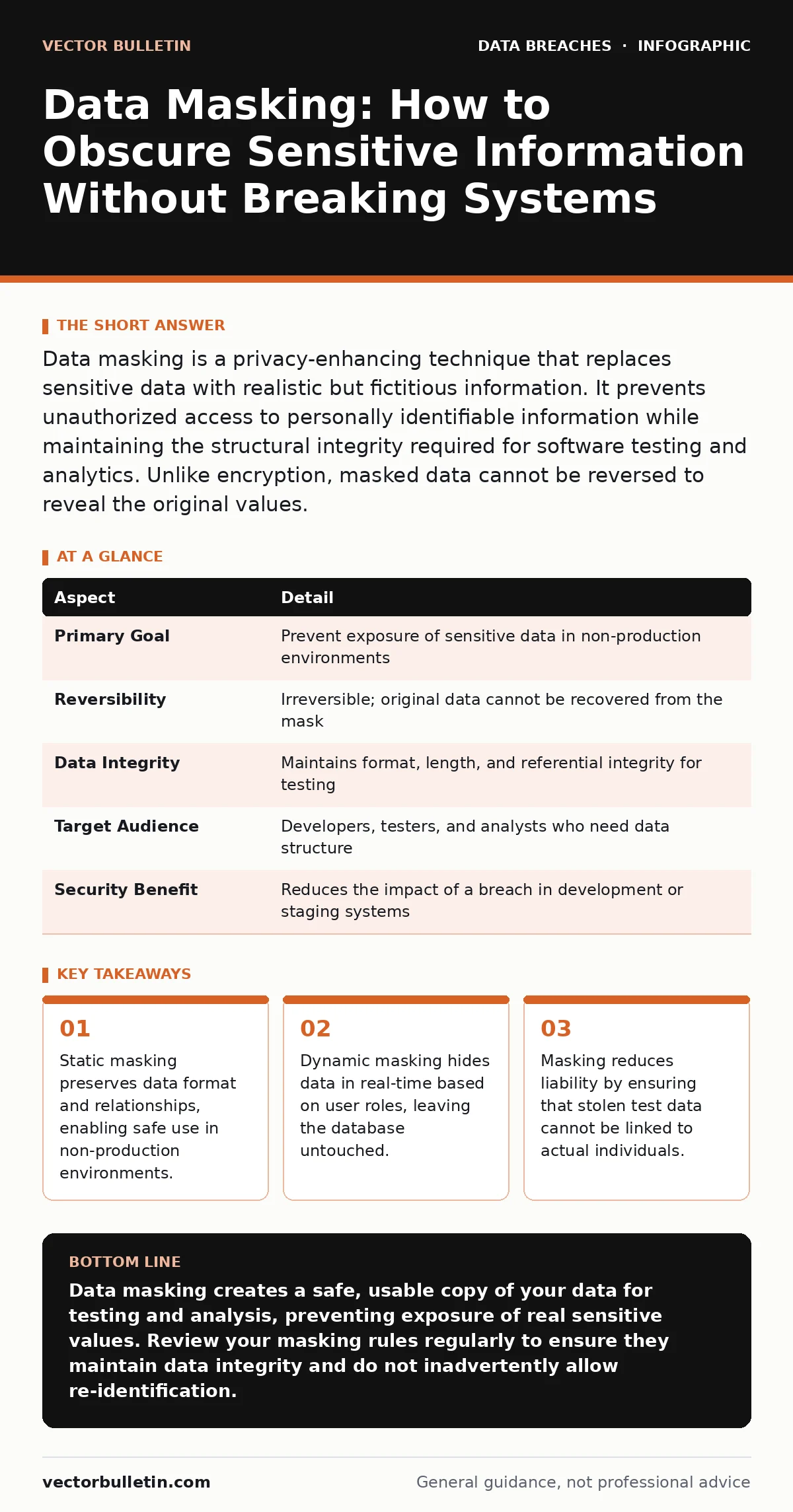
Data masking is a privacy-enhancing technique that replaces sensitive data with realistic but fictitious information. It prevents unauthorized access to personally identifiable information while maintaining the structural integrity required for software testing and analytics. Unlike encryption, masked data cannot be reversed to reveal the original values.
The Library Analogy for Data Protection
Imagine a library that holds original manuscripts of immense value. Researchers need to study the structure of these texts, their grammar, and their layout. They do not need the specific content to understand the writing style. If you give them the original book, they might accidentally destroy it, lose it, or leak its contents.
Instead, you provide a photocopy where every name is replaced by "John Smith" and every address by "123 Main Street." The researcher can still analyse the sentence structure and page layout. They cannot, however, identify the real people mentioned. This is the core logic of data masking. It allows you to use the shape of your data without exposing its substance.
Defining the Mechanism and Its Purpose
Data masking is the process of obscuring specific data within a database to protect sensitive information. It generates a realistic but inauthentic version of the production data. The primary purpose is to allow secondary uses of data, such as software testing, development, and analytics, without exposing the original sensitive values. This differs from encryption, which protects data at rest or in transit but allows authorised systems to decrypt it back to the original state. Masked data is irreversible. Once a name is masked, the original name is lost unless you keep the unmasked source in a separate, highly secured location.
| Aspect | Detail |
|---|---|
| Primary Goal | Prevent exposure of sensitive data in non-production environments |
| Reversibility | Irreversible; original data cannot be recovered from the mask |
| Data Integrity | Maintains format, length, and referential integrity for testing |
| Target Audience | Developers, testers, and analysts who need data structure |
| Security Benefit | Reduces the impact of a breach in development or staging systems |
The Core Components of a Masking Strategy
A functional masking strategy relies on three distinct components. First, you need a discovery mechanism to identify which fields contain sensitive data. This often involves scanning schemas and samples to find patterns like credit card numbers or national insurance numbers. Second, you require a transformation engine.
This applies the masking rules, such as substitution, shuffling, or nullification, to the identified fields. Third, you need a verification step. This ensures that the masked data still behaves like the original data. For example, if you mask email addresses, the new values must still contain an "@" symbol and a valid domain structure so that email validation routines do not crash.
Static Versus Dynamic Masking Approaches
There are two primary methods for applying these transformations, each with different trade-offs. Static data masking is applied to a copy of the data, usually during a transfer from production to a test environment. The original database remains unchanged. This is useful for long-term testing where performance matters, as the masked data sits in a separate database. Dynamic data masking, however, operates in real-time. It intercepts queries and alters the results on the fly based on the user’s permissions. The underlying data remains unmasked in the database. This approach is heavier on system resources but ensures that no unmasked copies ever leave the production environment.
Where Masking Fits in the Defence Stack
Data masking is not a standalone solution. It is a layer within a broader defence strategy. It works alongside access controls, which determine who can see the data, and encryption, which protects the data while it is stored or moving. Masking addresses the specific risk of insider threats and accidental exposure in non-secure environments. It is particularly relevant when considering data retention policies. By masking historical data that no longer needs to be in its original form, you reduce the attack surface. If an attacker breaches a legacy system, they find only useless, masked records rather than actionable intelligence.
See also: Data Subject Access Requests: How to Handle Them Correctly
Common Misconceptions About Masking
Many organisations believe that masking is a one-time project. This is incorrect. Data schemas change, new fields are added, and new types of sensitive information emerge. Masking rules must be reviewed regularly. Another common error is assuming that masking makes data anonymous. If you mask names but leave unique identifiers like user IDs or timestamps, an attacker can often re-identify individuals by linking the masked data with other datasets. This is known as linkage attack.
You must mask or remove these quasi-identifiers as well. Furthermore, some teams use simple replacement, such as replacing all names with "User1", "User2". This breaks referential integrity. If "User1" appears in the customers table and the orders table, the relationship is broken. Proper masking uses consistent substitution so that "User1" in the customers table matches "User1" in the orders table.
The Hidden Cost of Complexity
The most significant challenge in implementing data masking is managing complexity. Large organisations have hundreds of databases with inconsistent schemas. Mapping these schemas and ensuring that masking rules do not break application logic is labour-intensive. If a masking rule is too aggressive, it may strip out necessary data variations, causing tests to pass falsely. If it is too weak, it may leave enough information to reconstruct the original data. This balancing act requires close collaboration between security teams and database administrators. It also means that masking adds latency to data extraction processes. You must account for this overhead in your operational planning.
Integration with Broader Privacy Frameworks
Data masking supports compliance with various privacy regulations by minimising the amount of personally identifiable information available in non-secure environments. It helps organisations meet the principle of data minimisation, which states that you should only hold the data you need. By masking data in development and testing, you demonstrate that you are taking proactive steps to protect user privacy. This is distinct from breach notification laws, which focus on what happens after a compromise. Masking is a preventive measure. It also complements end-to-end encryption by ensuring that even if encryption keys are compromised, the data in test environments remains useless.
Conclusion on Implementation
Implementing data masking requires a clear understanding of your data flows and the specific risks associated with each environment. Start by identifying the most sensitive data and the environments where it is most vulnerable. Apply static masking for development and testing, and dynamic masking for live production access by support staff. Regularly review your masking rules to ensure they remain effective as your data and applications evolve. Remember that masking is a tool for risk reduction, not elimination. It must be part of a layered security approach that includes strong access controls, encryption, and continuous monitoring.
Key takeaways
- Static masking preserves data format and relationships, enabling safe use in non-production environments.
- Dynamic masking hides data in real-time based on user roles, leaving the database untouched.
- Masking reduces liability by ensuring that stolen test data cannot be linked to actual individuals.
- It complements other controls by reducing the volume of sensitive data present in development systems.
Data masking creates a safe, usable copy of your data for testing and analysis, preventing exposure of real sensitive values. Review your masking rules regularly to ensure they maintain data integrity and do not inadvertently allow re-identification.
Frequently asked questions
Does data masking protect data while it is being transmitted?
No, masking itself does not protect data in transit. You must use encryption protocols like TLS to secure the connection between the source and the masking engine.
Can masked data be used for machine learning models?
Yes, static masked data is often used for training machine learning models. It preserves the statistical properties of the data while removing sensitive identifiers, though some correlation may be lost.
Is data masking the same as data anonymisation?
They are related but distinct. Anonymisation aims to make data unidentifiable permanently. Masking is a technique used to achieve anonymisation or pseudonymisation, often with the intent of maintaining data utility for testing.
How do I choose between static and dynamic masking?
Use static masking for development and testing environments where performance is key and data does not need to be real-time. Use dynamic masking for production environments where real-time access is needed but must be restricted based on user roles.
How this guide was produced: written by the Vector Bulletin editorial team with AI assistance, checked against the public references listed below, and reviewed when the facts change. See our editorial policy or report an error.