
Hashing in SQL: Deterministic Storage and Lookup Strategies
SQL hashing transforms variable data into fixed-length identifiers, enabling rapid lookups while permanently obscuring the original input from storage.
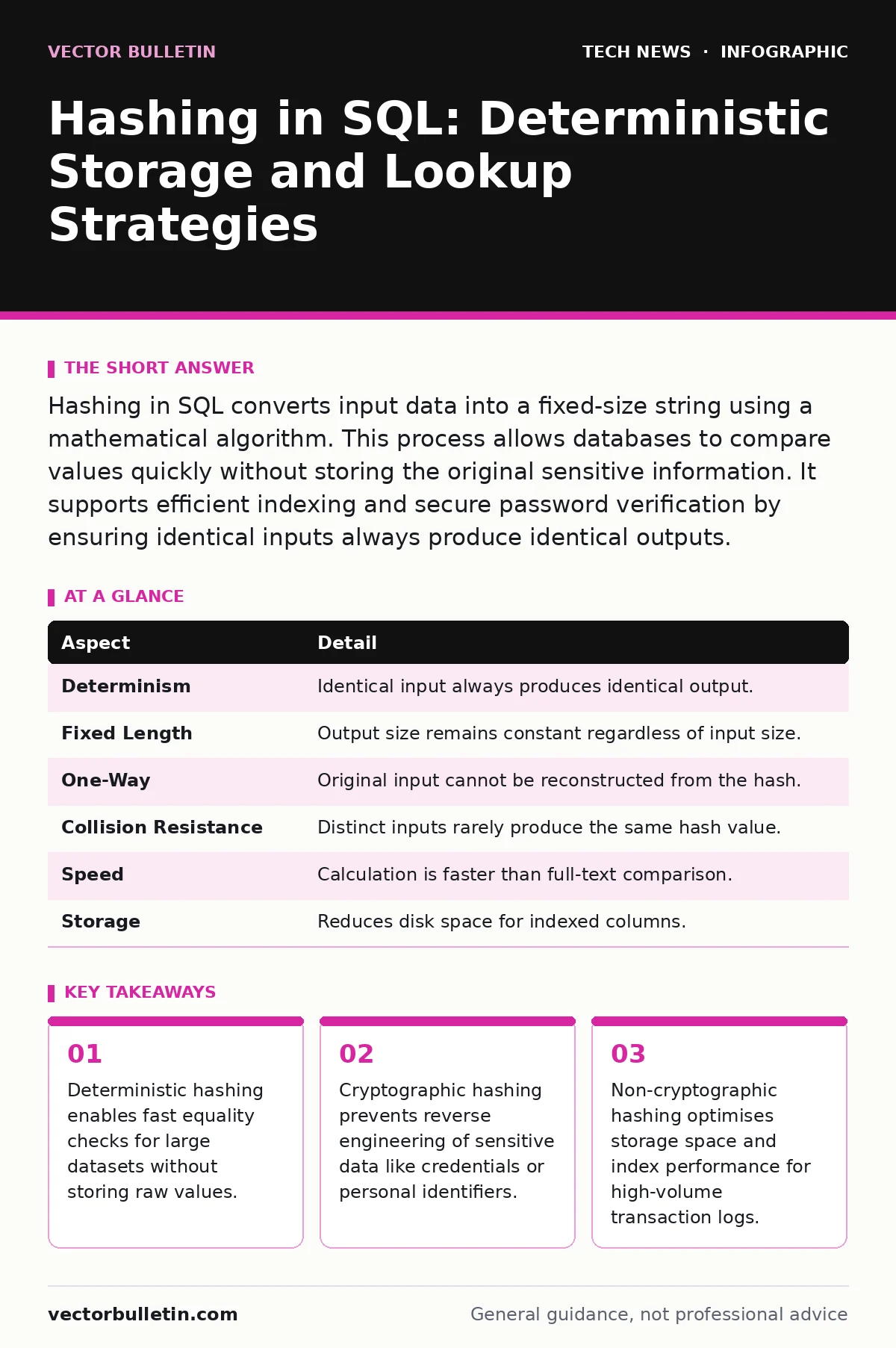
Hashing in SQL converts input data into a fixed-size string using a mathematical algorithm. This process allows databases to compare values quickly without storing the original sensitive information. It supports efficient indexing and secure password verification by ensuring identical inputs always produce identical outputs.
Hashing in SQL: The Core Mechanism
Imagine you need to verify that two people submitted the same document, but you cannot store the document itself due to privacy laws. You run both documents through a shredder that produces a unique pattern of confetti. If the confetti patterns match, the documents were identical. You never see the original text, only the result of the transformation. This is the fundamental principle of hashing in SQL.
Hashing takes an input of any length and produces a fixed-length output, known as a hash value or digest. The algorithm processes the input bits through mathematical operations to generate this unique fingerprint. In a relational database, this mechanism serves two distinct purposes. It secures sensitive data by making it computationally infeasible to retrieve the original input. It also optimises performance by allowing the database engine to compare short, fixed-length strings instead of long, variable-length texts.
| Aspect | Detail |
|---|---|
| Determinism | Identical input always produces identical output. |
| Fixed Length | Output size remains constant regardless of input size. |
| One-Way | Original input cannot be reconstructed from the hash. |
| Collision Resistance | Distinct inputs rarely produce the same hash value. |
| Speed | Calculation is faster than full-text comparison. |
| Storage | Reduces disk space for indexed columns. |
How Hashing Works in Database Engines
When you insert data into a table, the database engine may apply a hashing function to specific columns. This process occurs before the data is written to the disk. The engine calculates the hash value and stores that value in an index structure. When a query searches for a record, the engine hashes the search term and compares it against the stored hashes. This comparison is significantly faster than scanning every row for a text match.
The choice of algorithm dictates the security and performance characteristics. Cryptographic functions like SHA-256 or SHA-512 are designed to be resistant to tampering and reverse engineering. They are slower to compute but provide strong security guarantees. Non-cryptographic functions like MurmurHash or CityHash prioritise speed and uniform distribution. These are suitable for internal indexing where data integrity is managed by other controls.
Who It Affects and Why It Matters
Database administrators rely on hashing to maintain system performance under heavy load. Without hashed indexes, full table scans would degrade response times as data volume grows. Application developers use hashing to enforce password policies without storing plaintext passwords. If the database is compromised, attackers gain only the hash values, not the actual secrets.
Compliance officers require hashing to meet data protection regulations. Storing sensitive information in plaintext violates most privacy frameworks. Hashing allows organisations to prove that data is protected at rest. It also affects end-users indirectly. Faster query responses mean smoother application experiences. Secure storage means reduced risk of identity theft if a breach occurs.
What People Usually Get Wrong
Many practitioners confuse hashing with encryption. Encryption is a two-way process. You encrypt data with a key and decrypt it with the same or a paired key. Hashing is a one-way process. There is no key to reverse the operation. You cannot "decrypt" a hash to get the original password. You can only hash a guess and compare it to the stored hash.
Another common error is using weak or deprecated algorithms. Functions like MD5 and SHA-1 are no longer considered secure for cryptographic purposes. They are vulnerable to collision attacks, where two different inputs produce the same hash. This breaks the integrity guarantee. Even non-cryptographic hashes can fail if the input distribution is biased, leading to index fragmentation and poor query performance.
Implementing Hashing Correctly
To implement hashing effectively, you must choose the right function for the task. For password storage, use a dedicated key derivation function like Argon2 or bcrypt. These functions are intentionally slow and include a salt, a random value added to the input before hashing. The salt ensures that identical passwords produce different hashes, defeating rainbow table attacks.
For general data integrity, use SHA-256. It provides a good balance of speed and security. For internal indexing, consider MurmurHash3. It is fast and distributes values evenly across the index space. Always store the salt alongside the hash. Without the salt, you cannot verify the input. Ensure your database schema has sufficient column width to store the hash output. A SHA-256 hash requires 64 hexadecimal characters.
Integration with Other Security Controls
Hashing does not operate in isolation. It works alongside digital signatures to verify the authenticity of data sources. A signature proves who created the data, while a hash proves the data has not changed. Together, they provide non-repudiation and integrity.
You must also manage API key security carefully. Hashing API keys before storage prevents exposure if the database is leaked. However, the application server must still handle the raw key during authentication. This requires strict access controls and firewall rules to limit who can access the authentication service.
Common Pitfalls and Edge Cases
One subtle issue is the handling of null values. Hashing a null input may produce a valid hash, which can be confused with a hash of an empty string or a specific character sequence. Define how your system treats nulls before implementing the hash function.
Another edge case is character encoding. Different encodings can produce different bytes for the same visual character. If your database uses UTF-8 and your application uses Latin-1, the same password may hash to different values. Ensure consistent encoding across the entire stack. Verify that the hash function handles byte arrays correctly, not just string representations.
Bottom Line
Hashing in SQL provides a reliable method for securing sensitive data and optimising query performance. It transforms variable inputs into fixed, comparable identifiers that protect original values from exposure.
Implement strong cryptographic hashing for credentials and use consistent encoding practices to prevent verification failures.
Key takeaways
- Deterministic hashing enables fast equality checks for large datasets without storing raw values.
- Cryptographic hashing prevents reverse engineering of sensitive data like credentials or personal identifiers.
- Non-cryptographic hashing optimises storage space and index performance for high-volume transaction logs.
Frequently asked questions
Can I reverse a SQL hash to get the original data?
No, hashing is a one-way mathematical process. You cannot reverse it to retrieve the original input. You can only verify data by hashing it again and comparing the results.
What is the difference between hashing and encryption in SQL?
Encryption allows decryption with a key, restoring the original data. Hashing produces a fixed-length digest that cannot be reversed. Encryption protects confidentiality, while hashing verifies integrity and secures credentials.
Should I hash all columns in my database?
No, hash only columns that require security or performance benefits. Hashing adds computational overhead and prevents direct sorting or range queries. Use it for passwords, tokens, and high-frequency lookup keys.
How do I handle password resets if passwords are hashed?
You cannot retrieve the original password. Instead, generate a temporary, single-use reset token. Send this token to the user via email. The user uses the token to set a new password, which is then hashed and stored.
How this guide was produced: written by the Vector Bulletin editorial team with AI assistance, checked against the public references listed below, and reviewed when the facts change. See our editorial policy or report an error.