How End-to-End Encryption Works: The Mechanics of Secure Messaging
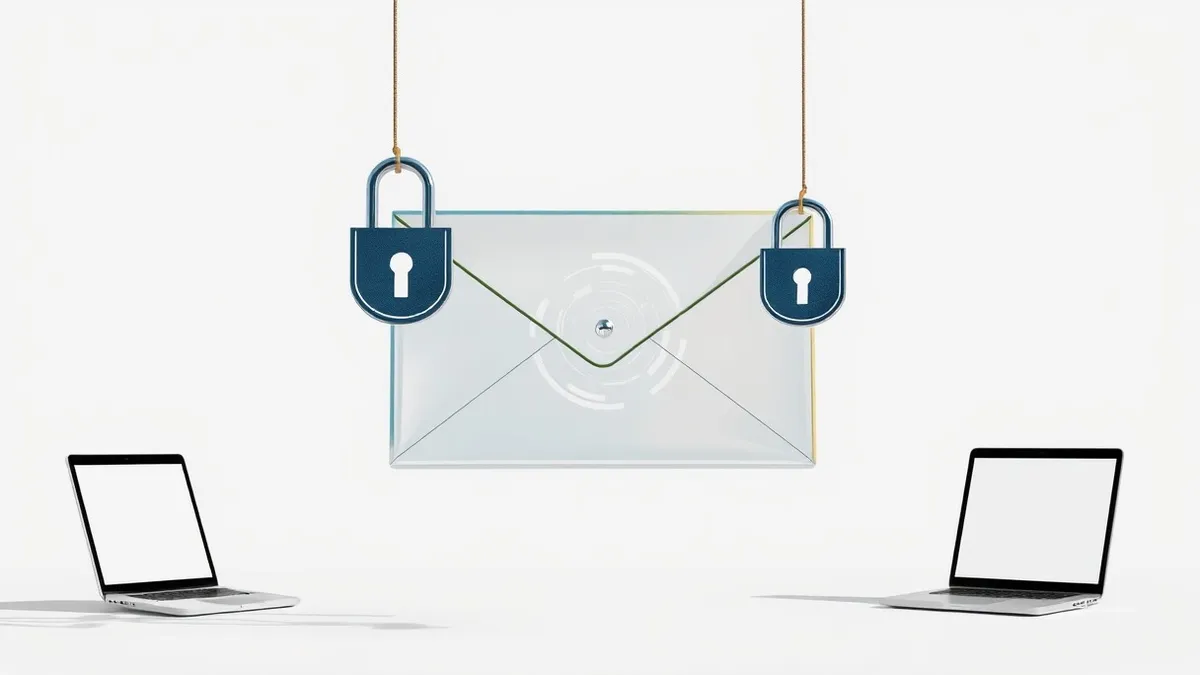
Encryption keys never touch the server, meaning the provider cannot read your messages even if compelled to do so by law.
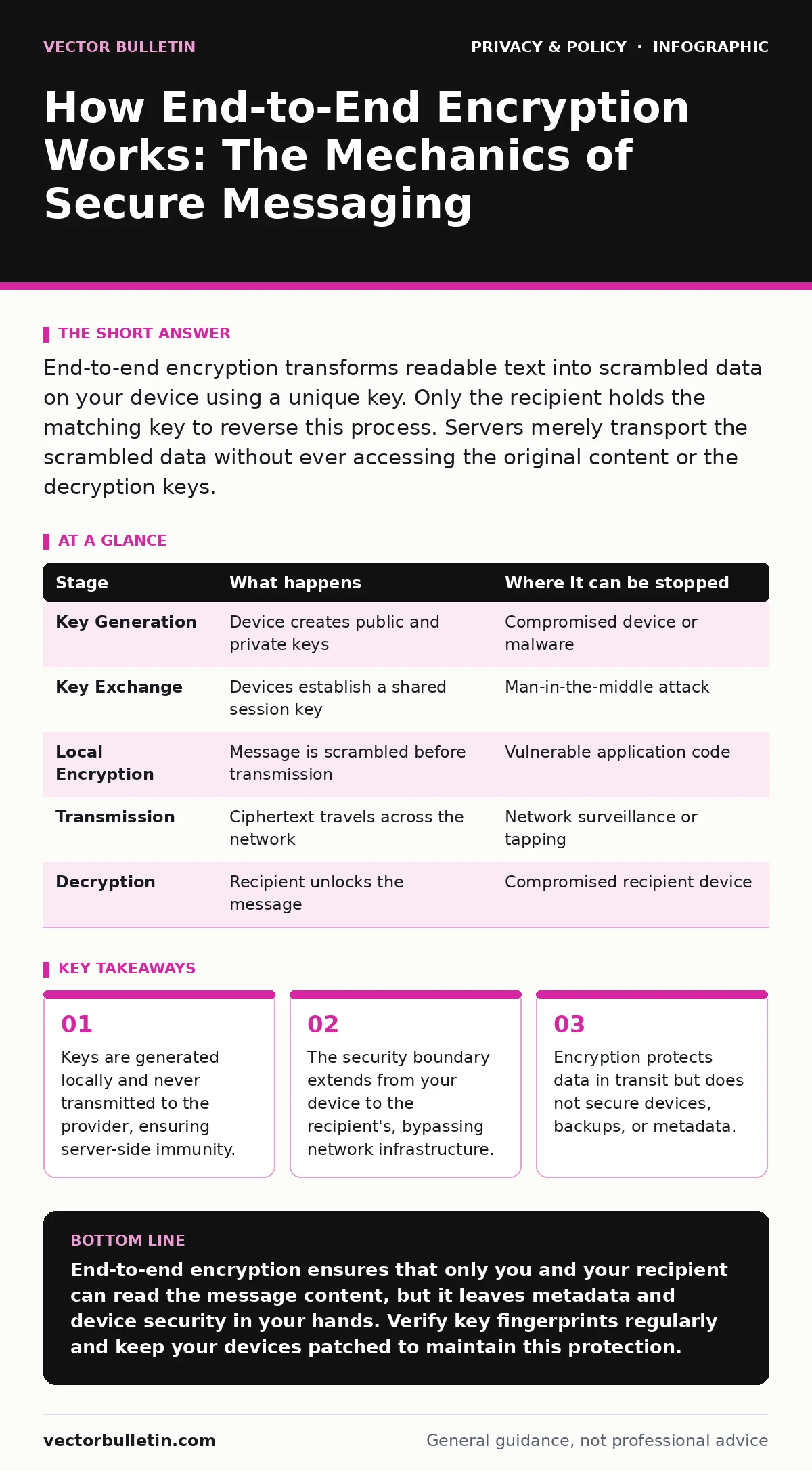
End-to-end encryption transforms readable text into scrambled data on your device using a unique key. Only the recipient holds the matching key to reverse this process. Servers merely transport the scrambled data without ever accessing the original content or the decryption keys.
The Foundation of Asymmetric Cryptography
End-to-end encryption relies on a mathematical concept known as public-key cryptography. Unlike symmetric encryption, which uses a single shared key, this method employs a pair of keys. One is public, and the other is private. You share the public key freely, but you keep the private key hidden. Any data encrypted with the public key can only be decrypted by the corresponding private key. This asymmetry solves the problem of key exchange. You do not need to meet your recipient to agree on a secret. The system guarantees that only the holder of the private key can read the message.
### Stage 1: Key Generation and Storage
The process begins on your device. The application generates a unique pair of cryptographic keys. The private key remains stored locally on your hardware. It never leaves your device under normal operation. The public key is uploaded to the provider’s servers. This allows other users to retrieve it when they wish to send you a message. If an attacker intercepts the public key, they cannot derive the private key from it. The mathematical relationship is one-way. This stage establishes your digital identity within the network.
### Stage 2: Key Exchange and Verification
When you start a conversation, your device retrieves the recipient’s public key from the server. The two devices then perform a key exchange protocol. This creates a shared secret, often called a session key, that both parties can use for symmetric encryption. Symmetric encryption is faster for processing large amounts of data. The exchange ensures that even if the server stores the public keys, it cannot calculate the session key. You should verify the recipient’s key fingerprint. This step confirms that you are communicating with the intended person and not an imposter.
### Stage 3: Local Encryption
Before the message leaves your device, the application encrypts it. It uses the session key generated in the previous stage. The readable text transforms into ciphertext, a string of seemingly random characters. This encryption happens in the memory of your device. The operating system and the network stack see only the encrypted blob. The provider’s infrastructure receives no plaintext. This local processing is critical. If the application sends the message before encryption, the protection fails. The integrity of this step depends on the software running on your device.
| Stage | What happens | Where it can be stopped |
|---|---|---|
| Key Generation | Device creates public and private keys | Compromised device or malware |
| Key Exchange | Devices establish a shared session key | Man-in-the-middle attack |
| Local Encryption | Message is scrambled before transmission | Vulnerable application code |
| Transmission | Ciphertext travels across the network | Network surveillance or tapping |
| Decryption | Recipient unlocks the message | Compromised recipient device |
### Stage 4: Transmission Across the Network
The encrypted message travels from your device to the provider’s servers. It then hops across the internet to reach the recipient. Throughout this journey, the data remains scrambled. Internet service providers, network administrators, and the messaging platform itself cannot read the content. They can see that data is moving. They can see the size of the packet and the timing of the transfer. However, the payload is opaque to them. This is the core benefit of the architecture. The server acts as a dumb pipe, not a reader.
See also: Data Subject Access Requests: How to Handle Them Correctly
### Stage 5: Decryption at the Destination
The recipient’s device receives the ciphertext. It uses the local session key to reverse the encryption process. The scrambled data transforms back into readable text. This decryption happens on the recipient’s hardware. The provider’s servers are not involved in this final step. If the recipient’s device is compromised, the protection is void. The encryption protects the data in transit, not the data at rest on a hacked phone. The security chain is only as strong as its weakest endpoint.
The Limits of Protection
End-to-end encryption does not protect everything. It secures the content of the message, but not the metadata. Metadata includes who you are talking to, when, and how often. This information can reveal sensitive patterns about your life. The provider can still collect this data. Additionally, encryption does not protect against social engineering. If you are tricked into revealing a password or scanning a malicious QR code, the encryption is bypassed. The technology assumes rational actors and secure endpoints. It cannot fix human error.
Hidden Costs and Trade-offs
Implementing end-to-end encryption introduces friction. You cannot search through your encrypted messages on the server. The provider cannot index your chats for spam detection or content moderation. This shifts the burden of safety to the user. Furthermore, key management is complex. If you lose your device, you may lose access to your past messages. Backing up encrypted data requires careful handling. If you back up the keys, you weaken the security. If you do not, you risk permanent data loss. This trade-off is inherent to the design.
Integrating with Broader Privacy Practices
Encryption is one layer of defence. It must work alongside other measures. You should consider privacy by design when selecting tools. This principle ensures that privacy is built into the system from the start, not added later. You might also use email aliases to hide your primary address from unknown senders. This reduces the risk of your real identity being linked to your encrypted communications. Regular privacy audits can help you identify where your data flows and where it might be exposed. These practices complement the technical protection of encryption.
Maintaining Security Hygiene
The effectiveness of encryption depends on your device health. Keep your operating system and applications updated. Patches often fix vulnerabilities that could allow attackers to bypass encryption. Use strong authentication methods to protect your device access. If your phone is stolen, a strong lock screen prevents immediate access to your keys. Be wary of third-party plugins or extensions. These can inject code that reads your screen or keystrokes before encryption occurs. The security of the channel is irrelevant if the endpoints are compromised.
Key takeaways
- Keys are generated locally and never transmitted to the provider, ensuring server-side immunity.
- The security boundary extends from your device to the recipient's, bypassing network infrastructure.
- Encryption protects data in transit but does not secure devices, backups, or metadata.
End-to-end encryption ensures that only you and your recipient can read the message content, but it leaves metadata and device security in your hands. Verify key fingerprints regularly and keep your devices patched to maintain this protection.
Frequently asked questions
Can the service provider read my encrypted messages?
No, the provider only handles scrambled data. They do not possess the private keys required to decrypt the messages, making server-side reading mathematically impossible under normal conditions.
Does encryption hide who I am talking to?
No, encryption hides the content of the message. Metadata, such as the identity of the sender and recipient, the time of the message, and the volume of data, is often visible to the provider and network operators.
What happens if I lose my phone?
You lose access to your private keys stored on that device. Unless you have a secure, encrypted backup, you cannot decrypt your past messages on a new device. The security model prioritises confidentiality over convenience.
Is end-to-end encryption the same as SSL?
No, SSL encrypts the connection between your device and the server. The server can decrypt and read the data. End-to-end encryption keeps data scrambled until it reaches the specific recipient, bypassing the server's ability to read it.
How this guide was produced: written by the Vector Bulletin editorial team with AI assistance, checked against the public references listed below, and reviewed when the facts change. See our editorial policy or report an error.