
Why is biometric data theft a serious concern for you
Biometric templates are immutable secrets that cannot be reset when compromised, creating a permanent liability for identity verification systems.
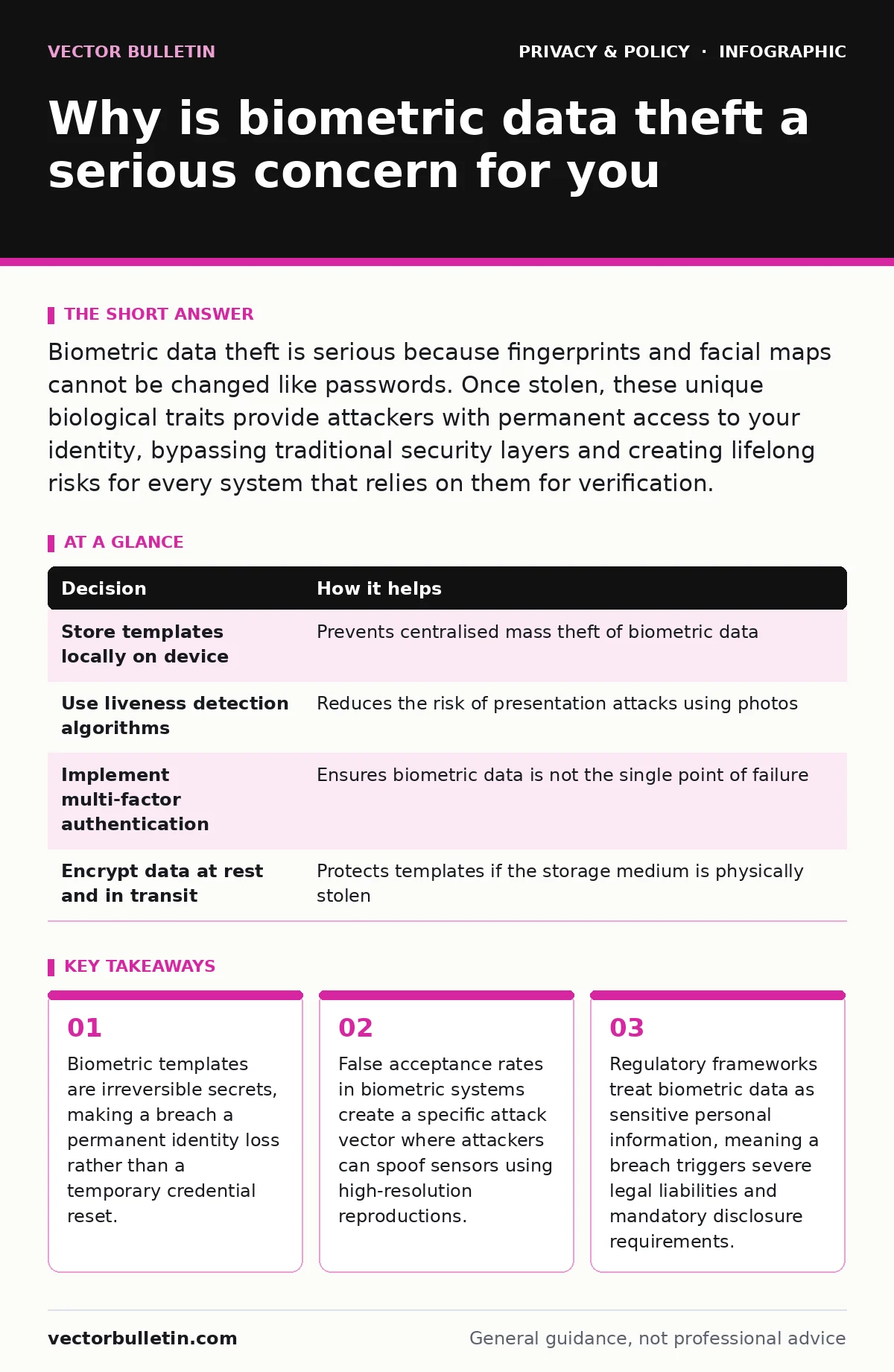
Biometric data theft is serious because fingerprints and facial maps cannot be changed like passwords. Once stolen, these unique biological traits provide attackers with permanent access to your identity, bypassing traditional security layers and creating lifelong risks for every system that relies on them for verification.
The immutable nature of biometric secrets
Biometric data theft is a serious concern because the asset itself cannot be revoked. When a password is compromised, you change it. The old password becomes useless. Biometric identifiers, such as a fingerprint scan or an iris pattern, are tied to your physical body. You cannot generate a new fingerprint if the digital template of your current one is stolen. This permanence transforms a security incident from a manageable operational issue into a lifelong identity risk. The attacker gains a master key that works across multiple systems and timeframes.
The core mechanism involves the conversion of raw biological data into a mathematical template. This template is stored in a database or on a device. If an attacker exfiltrates this template, they possess a static representation of your identity. Unlike a one-time code or a password hash that can be rotated, this static representation remains valid indefinitely. The security model fails because it assumes the secret can be renewed. It cannot. The exposure is total and permanent.
Template reversal and presentation attacks
Attackers do not need to understand the complex mathematics of a biometric template to exploit it. They can use template reversal techniques to reconstruct a usable image from the stolen data. This reconstructed image can then be used to create a physical spoof, such as a gelatin finger or a high-resolution photo. This process is known as a presentation attack. The sensor sees a valid biological trait and grants access. The system does not distinguish between a live human and a high-quality reproduction.
The risk increases when multiple services use the same biometric identifier. If your fingerprint template is stolen from one provider, it may be usable to bypass authentication on another device that uses the same sensor technology. This cross-service correlation amplifies the damage. A single breach compromises your ability to authenticate on any platform that relies on that specific biological trait. The attack surface expands beyond the initial point of compromise.
The false acceptance vulnerability
Biometric systems are designed to balance security with convenience. This balance creates a known weakness called the false acceptance rate. This is the probability that the system incorrectly matches an impostor to a registered user. Developers often set this rate higher to reduce user frustration from failed scans. A higher false acceptance rate means the system is more likely to accept a spoofed biometric trait. Attackers exploit this margin of error.
Imagine a team that sets a very lenient threshold to ensure smooth user experience. They accept 1 in 1,000 mismatches. An attacker with a slightly degraded template might still gain access. Conversely, a stricter threshold reduces false acceptances but increases false rejections. This forces legitimate users to retry, causing friction. Security teams must choose between usability and security. There is no perfect setting. The choice determines how easily an attacker can bypass the system with imperfect data.
Regulatory weight and legal exposure
Biometric data is classified as sensitive personal information under many privacy laws. This classification imposes strict handling requirements. Organisations must obtain explicit consent before collecting this data. They must also provide clear information about how the data is stored and used. A breach of biometric data triggers mandatory notification requirements. The legal consequences are severe because the harm is considered irreparable.
The regulatory burden extends to the entire lifecycle of the data. You must prove that the data was encrypted at rest and in transit. You must demonstrate that access controls were effective. Failure to meet these standards results in significant fines and reputational damage. The cost of compliance is high, but the cost of a breach is higher. Organisations must treat biometric data with the highest level of care. This includes regular audits and strict access logging.
| Decision | How it helps |
|---|---|
| Store templates locally on device | Prevents centralised mass theft of biometric data |
| Use liveness detection algorithms | Reduces the risk of presentation attacks using photos |
| Implement multi-factor authentication | Ensures biometric data is not the single point of failure |
| Encrypt data at rest and in transit | Protects templates if the storage medium is physically stolen |
Mitigation strategies for security teams
You can reduce the risk of biometric data theft by adopting specific technical controls. First, store biometric templates locally on the user's device rather than in a centralised server. This limits the blast radius of a breach. If the server is compromised, the attacker does not get the biometric data. Second, use liveness detection to ensure the sensor is interacting with a live person. This prevents attacks using static images or casts.
Third, never use biometric data as the sole factor for authentication. Combine it with something you know, like a PIN, or something you have, like a hardware token. This multi-factor approach ensures that even if the biometric template is stolen, the attacker cannot access the account without the second factor. This layered defence significantly reduces the impact of a biometric breach. It shifts the burden from the immutable secret to a revocable credential.
See also: CCPA Compliance Checklist: Inventory, Rights, and Vendor Management
The hidden cost of convenience
The drive for seamless user experience often leads to weaker security configurations. Developers may disable additional checks to improve speed. This trade-off is rarely visible to the end user. The user sees a faster login. The security team sees a larger attack surface. The hidden cost is the increased probability of successful spoofing attacks. Convenience erodes the security boundary.
Organisations must evaluate the risk of each convenience feature. Does the speed gain justify the security loss? In many cases, the answer is no. The permanent nature of biometric data demands a higher standard of protection. You cannot afford to cut corners for the sake of user satisfaction. The long-term liability outweighs the short-term gain. Prioritise security over speed in your design decisions.
Integrating privacy by design
You should embed privacy controls into the development process from the start. This approach is known as privacy by design. It involves minimising data collection and ensuring that only necessary information is stored. For biometrics, this means storing only the mathematical template, not the raw image. It also means providing users with the option to opt out of biometric authentication.
Refer to our guide on privacy by design for detailed implementation steps. This framework helps you build systems that respect user privacy while maintaining security. It also aligns with regulatory requirements like the CCPA. By adopting these principles, you reduce the amount of sensitive data at risk. Less data means less exposure. This proactive approach is more effective than reacting to breaches after they occur.
Consider using differential privacy techniques when aggregating biometric data for analytics. This method adds noise to the data, making it difficult to identify individual users. It allows you to gain insights without compromising individual privacy. This balance is critical for organisations that need to analyse user behaviour without storing raw biometric records.
Key takeaways
- Biometric templates are irreversible secrets, making a breach a permanent identity loss rather than a temporary credential reset.
- False acceptance rates in biometric systems create a specific attack vector where attackers can spoof sensors using high-resolution reproductions.
- Regulatory frameworks treat biometric data as sensitive personal information, meaning a breach triggers severe legal liabilities and mandatory disclosure requirements.
Frequently asked questions
Can I change my fingerprint if it is stolen?
No, biometric traits are physical characteristics that cannot be changed. If a fingerprint template is compromised, you must rely on other authentication methods for all affected services.
Is facial recognition more secure than fingerprints?
Facial recognition can be more vulnerable to remote spoofing using photos or videos. Fingerprints require physical contact, which makes remote attacks harder, but both can be spoofed with high-quality reproductions if liveness detection is weak.
How do I know if my biometric data was stolen?
You usually will not know until you are locked out of an account or see unauthorised activity. Services are required to notify you of a breach, but this notification may come weeks or months after the initial theft.
Does encryption protect biometric data?
Encryption protects data at rest and in transit, but if the attacker gains access to the decryption keys, the templates are exposed. Encryption is a necessary layer, but it does not prevent all forms of theft or misuse.
How this guide was produced: written by the Vector Bulletin editorial team with AI assistance, checked against the public references listed below, and reviewed when the facts change. See our editorial policy or report an error.