
Privacy Audits: Definition, Purpose and Practical Execution
Move beyond compliance checklists to understand how privacy audits map data flows, identify blind spots and reduce residual risk across your infrastructure.
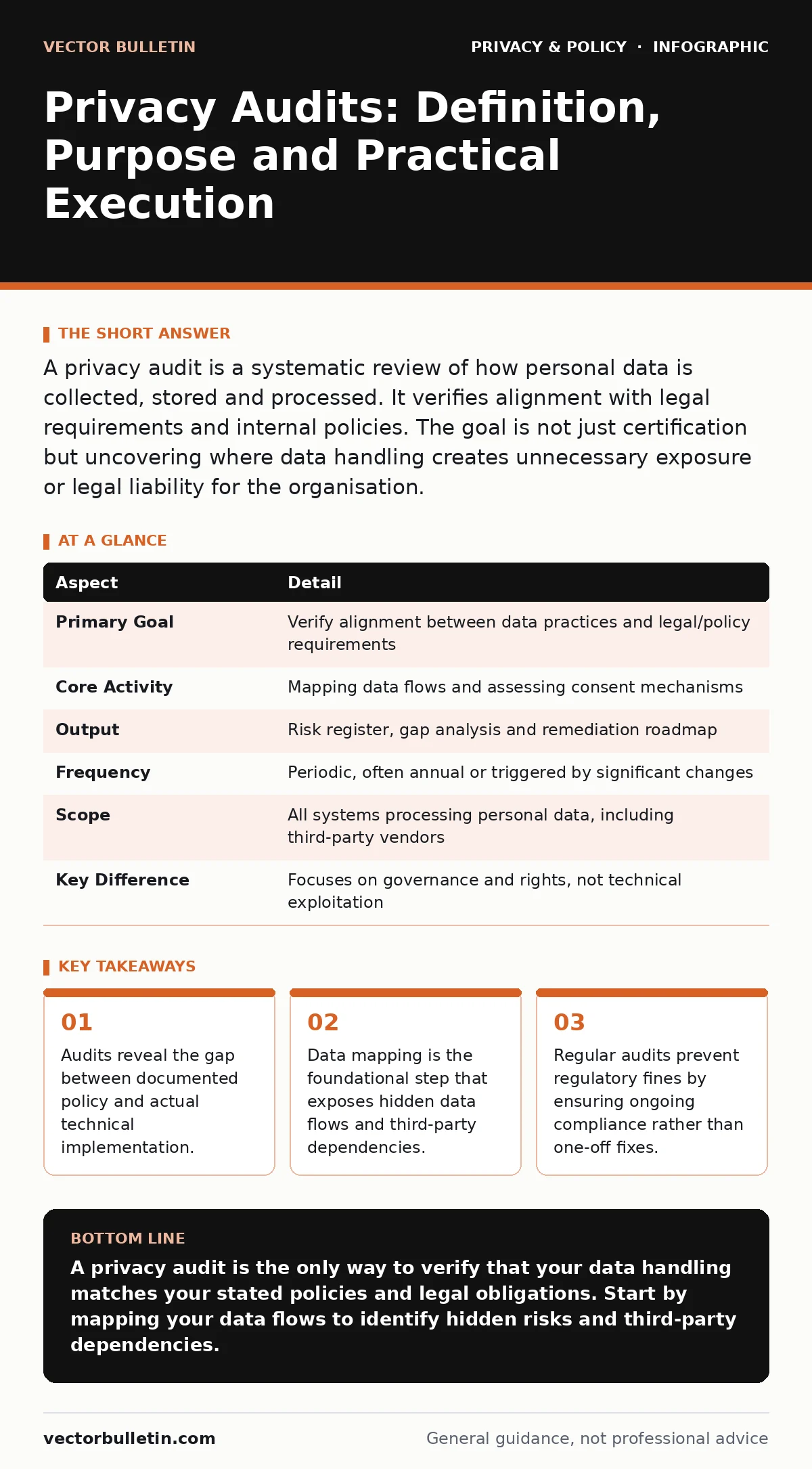
A privacy audit is a systematic review of how personal data is collected, stored and processed. It verifies alignment with legal requirements and internal policies. The goal is not just certification but uncovering where data handling creates unnecessary exposure or legal liability for the organisation.
The Inventory Analogy
Imagine running a warehouse where you know exactly what goods entered the building last year. You have receipts, delivery notes and supplier contracts. However, you have no idea where those goods are currently stored. Some might be in the main aisle, others in the basement, and some may have been discarded or sold without record.
Without this physical verification, your inventory records are fiction. In the context of data, the "goods" are personal information about individuals. The "warehouse" is your digital infrastructure. The audit confirms that your records match reality and that the handling of sensitive information does not expose your organisation to unnecessary risk.
Defining the Mechanism
A privacy audit is a structured assessment of an organisation’s data handling practices. It examines how personal data is collected, stored, used, shared and destroyed. The process compares these actual practices against applicable laws, regulatory standards and internal privacy policies.
This is not a security penetration test. It does not attempt to break into systems. Instead, it evaluates governance and process. It asks whether the organisation knows what data it holds and whether it has legitimate reasons for holding it. The output is often a report detailing gaps, risks and recommended remediation steps.
| Aspect | Detail |
|---|---|
| Primary Goal | Verify alignment between data practices and legal/policy requirements |
| Core Activity | Mapping data flows and assessing consent mechanisms |
| Output | Risk register, gap analysis and remediation roadmap |
| Frequency | Periodic, often annual or triggered by significant changes |
| Scope | All systems processing personal data, including third-party vendors |
| Key Difference | Focuses on governance and rights, not technical exploitation |
The Problem It Solves
Organisations accumulate data faster than they document it. New features are deployed, APIs are connected and legacy systems are repurposed. Over time, the original purpose for collecting data becomes unclear. This drift creates two major problems.
First, you may be holding data you no longer need. Storing unnecessary personal information increases the impact of any future breach. If you do not need the data, you should not have it. Second, you may be sharing data with partners who do not meet your security or privacy standards. Without an audit, these relationships are often governed by outdated contracts or verbal agreements that do not reflect current risks.
The audit forces a conversation between legal, technical and business teams. It surfaces these hidden liabilities before regulators or customers do. It transforms privacy from a abstract legal concept into a tangible operational reality.
Core Components of the Process
The audit begins with data mapping. You must identify every system that touches personal data. This includes databases, email servers, cloud storage and even temporary memory buffers. You need to document where the data comes from, where it goes and how long it stays.
Next, you assess the legal basis for processing. For each data set, you must justify why you have it. Is it necessary for a contract? Is there explicit consent? Is it in the legitimate interest of the business? If you cannot articulate a clear reason, the data is likely a liability.
You then review access controls and retention policies. Who can see the data? Do they need to see it? Is there a process to delete data when it is no longer required? Finally, you evaluate third-party risk. Vendors who process data on your behalf extend your liability. Their practices must align with your own standards.
Integration with Security Defences
Privacy and security are related but distinct disciplines. Security protects data from unauthorised access. Privacy ensures data is used appropriately. A system can be secure but violate privacy. For example, encrypting all employee health records is good security. Collecting those records without a clear medical necessity is a privacy violation.
An effective audit sits alongside security assessments. It uses the technical findings of security audits as input. If a security scan reveals unencrypted data in transit, the privacy audit evaluates the risk of that exposure to individual rights. Conversely, privacy requirements often drive security decisions. If you determine that data must be deleted after one year, the security team must implement technical controls to enforce that deletion.
This integration prevents siloed thinking. Security teams focus on threats. Privacy teams focus on rights. The audit bridges the gap, ensuring that technical controls support legal and ethical obligations.
See also: Breach Notification Laws: What You Must Report and When
Common Misconceptions
Many organisations treat privacy audits as a box-ticking exercise. They assume that having a privacy policy is sufficient. This is incorrect. A policy is a statement of intent. An audit is the verification of action. Without verification, the policy is merely aspirational.
Another mistake is limiting the scope to customer data. Employee data, contractor data and partner data are also subject to privacy laws. Ignoring these categories leaves significant blind spots. You may comply with consumer regulations while violating employment laws.
Finally, some believe that an audit is a one-time event. Data flows change constantly. New software is installed, new vendors are engaged and new features are launched. A static audit becomes outdated quickly. The value lies in establishing a continuous monitoring process, not just passing a single review.
Establishing a Baseline
The first audit is often the most difficult. You are discovering the extent of your own ignorance. Do not expect perfection. Expect to find significant gaps. This is normal. The goal is to establish a baseline understanding of your current state.
From this baseline, you can prioritise remediation efforts. Focus on high-risk areas first. Data that is sensitive, widely shared or poorly documented should be addressed immediately. Lower-risk areas can be planned for subsequent cycles.
By treating the audit as a diagnostic tool rather than a judgment, you create a culture of continuous improvement. You demonstrate to regulators and customers that you are proactive about protecting their information. This builds trust and reduces the likelihood of severe penalties in the future.
Key takeaways
- Audits reveal the gap between documented policy and actual technical implementation.
- Data mapping is the foundational step that exposes hidden data flows and third-party dependencies.
- Regular audits prevent regulatory fines by ensuring ongoing compliance rather than one-off fixes.
A privacy audit is the only way to verify that your data handling matches your stated policies and legal obligations. Start by mapping your data flows to identify hidden risks and third-party dependencies.
Frequently asked questions
How often should we conduct a privacy audit?
Conduct a full audit at least annually. Trigger additional audits whenever you launch major new products, change data processors or undergo significant organisational changes.
Who is responsible for performing the audit?
Internal privacy teams can conduct initial assessments. However, for objectivity and external trust, many organisations engage independent third-party auditors or legal specialists to validate the findings.
What is the difference between a privacy audit and a DPIA?
A Data Protection Impact Assessment (DPIA) is a prospective analysis for high-risk processing activities before they begin. A privacy audit is a retrospective review of existing practices to verify compliance and identify gaps.
Can an automated tool replace a manual audit?
No. Automated tools can assist with data discovery and mapping. However, they cannot assess legal basis, contextual fairness or complex vendor relationships. Human judgment is required to interpret the findings and apply policy.
How this guide was produced: written by the Vector Bulletin editorial team with AI assistance, checked against the public references listed below, and reviewed when the facts change. See our editorial policy or report an error.