
Prevent Shadow IT: 4 Measures That Actually Stop Unauthorised Cloud Use
Blocking ports fails because modern apps use standard web traffic; you must control the identity that initiates the connection, not the pipe it flows through.
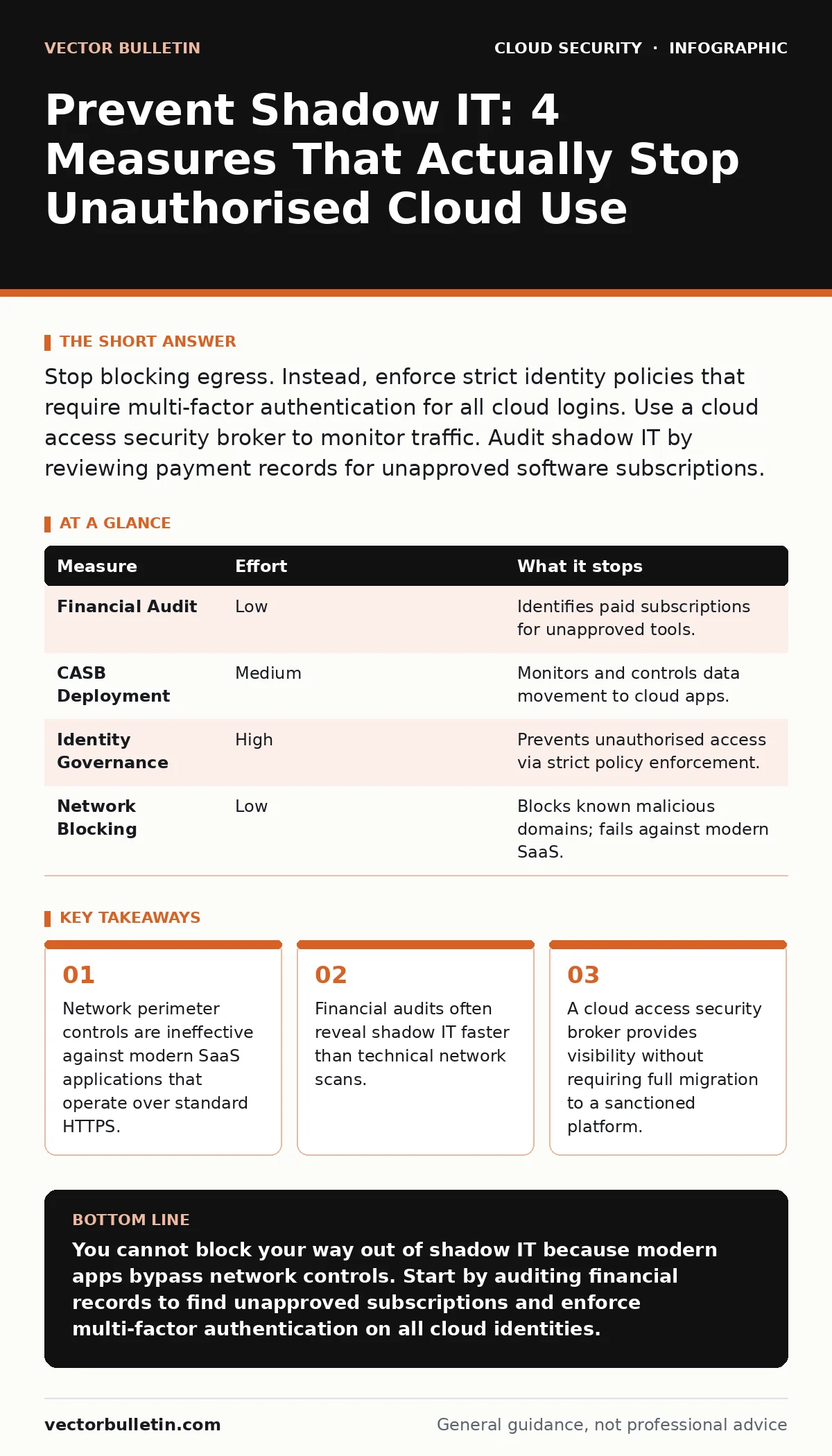
Stop blocking egress. Instead, enforce strict identity policies that require multi-factor authentication for all cloud logins. Use a cloud access security broker to monitor traffic. Audit shadow IT by reviewing payment records for unapproved software subscriptions.
The Identity Gap in Cloud Security
Shadow IT exists because the barrier to adopting new software has vanished. Any employee can subscribe to a service using a corporate credit card or even a personal one, then integrate it with company data. The traditional security model relied on controlling the network boundary. You allowed traffic only to approved destinations. This model collapses when every application communicates via standard web protocols.
You cannot distinguish between a legitimate business tool and an unapproved service by looking at the traffic alone. Both use port 443 for HTTPS. Both look like encrypted data streams. The difference lies in who is authenticating and what data they are accessing. If you focus solely on the network, you are fighting a losing battle. The real control point is the identity credential that grants access to the cloud service.
Why Network Blocking Fails
Imagine you configure your firewall to block access to a specific unapproved application. The application updates its domain name. Your block list becomes obsolete. The employee uses a mobile data connection to bypass your network entirely. They use a personal device that never touches your corporate Wi-Fi. The data is already in the cloud. Blocking the pipe does not stop the flow if the user has valid credentials.
This is why many organisations see a rise in shadow IT despite strict firewall rules. The rules create friction for legitimate work but do not prevent data leakage. Employees find workarounds because they need to do their jobs. They share files via personal cloud storage because the approved system is too slow or complex. You are not stopping the risk; you are just making it harder to detect.
Financial Audits as Detection
The most reliable indicator of shadow IT is not a log file. It is a line item on a company expense report. Employees often expense software subscriptions they believe are necessary for their role. Finance teams see these charges before security teams see the traffic. This creates a natural feedback loop for detection.
You should establish a routine process where finance and security review recurring software charges. Look for subscriptions to SaaS platforms that are not on the approved list. When you find one, you have confirmed the existence of shadow IT. You can then assess the risk. Is the application handling sensitive data? Is it integrated with other systems? This approach is passive but highly accurate. It removes the guesswork from network monitoring.
Implementing a Cloud Access Security Broker
A Cloud Access Security Broker, or CASB, sits between the user and the cloud service. It inspects traffic for policy violations. It can enforce data loss prevention rules. It can require multi-factor authentication for high-risk actions. Crucially, it provides visibility into which applications are being used, even if you do not block them immediately.
You do not need to migrate all users to a CASB immediately. Start by deploying it in monitoring mode. This allows you to map your actual usage patterns. You will discover which applications are widely used but unapproved. You can then decide whether to sanction them or block them based on risk. This reduces the friction of sudden blocks. It allows you to make informed decisions rather than reactive ones.
| Measure | Effort | What it stops |
|---|---|---|
| Financial Audit | Low | Identifies paid subscriptions for unapproved tools. |
| CASB Deployment | Medium | Monitors and controls data movement to cloud apps. |
| Identity Governance | High | Prevents unauthorised access via strict policy enforcement. |
| Network Blocking | Low | Blocks known malicious domains; fails against modern SaaS. |
Enforcing Strict Identity Policies
The most effective prevention measure is to ensure that no identity can access a cloud service without proper verification. This means enforcing multi-factor authentication across all accounts. It means using single sign-on where possible. This centralises the authentication process. If you control the identity, you can revoke access instantly.
You should also review access rights regularly. Many shadow IT incidents occur because old accounts remain active. Employees leave, but their access to third-party tools remains. These dormant accounts become easy targets for attackers. By tying cloud access to your central identity provider, you ensure that access revocation is immediate and comprehensive. This reduces the window of exposure significantly.
The Hidden Cost of Over-Blocking
Suppose you decide to block all unapproved cloud storage services. Employees turn to encrypted messaging apps to share files. They use personal email accounts. They download data to local USB drives. The data leaves the secure environment, but now it is completely invisible to you. You have traded a known risk for an unknown one. This is the hidden cost of over-blocking.
The goal is not to eliminate all cloud usage. It is to manage the risk. Allow the use of tools that provide value, but enforce security controls. Require that any approved tool supports single sign-on. Require that it does not allow data export without logging. This balances productivity with security. It acknowledges that users will find ways to work, and guides them toward safer methods.
Building a Sustainable Program
Preventing shadow IT is not a one-time project. It is an ongoing process. You must adapt as new services emerge. You must educate users on why certain tools are restricted. Transparency builds trust. If users understand the risk, they are less likely to seek workarounds. They are more likely to request approved alternatives.
You should also integrate shadow IT detection into your broader cloud security strategy. This includes monitoring for leaked cloud access keys and managing identity sprawl. These related issues often compound the risk of shadow IT. By addressing them together, you create a more resilient environment. You reduce the attack surface without stifling innovation.
Immediate Actions for Reduction
You can reduce the risk of shadow IT today by focusing on three key areas. First, audit your recent software expenses to identify unapproved subscriptions. Second, enable multi-factor authentication for all cloud accounts, especially those with administrative privileges. Third, deploy a monitoring tool to gain visibility into current usage patterns. These steps provide immediate value without requiring a complete overhaul of your infrastructure.
By focusing on identity and visibility, you address the root cause of shadow IT. You stop trying to control the network and start controlling the access. This is a more sustainable approach. It adapts to the changing landscape of cloud computing. It protects your data while allowing your teams to work effectively.
Key takeaways
- Network perimeter controls are ineffective against modern SaaS applications that operate over standard HTTPS.
- Financial audits often reveal shadow IT faster than technical network scans.
- A cloud access security broker provides visibility without requiring full migration to a sanctioned platform.
You cannot block your way out of shadow IT because modern apps bypass network controls. Start by auditing financial records to find unapproved subscriptions and enforce multi-factor authentication on all cloud identities.
Frequently asked questions
How do I find shadow IT if I have no CASB?
Review corporate credit card statements and expense reports for recurring software subscriptions. Cross-reference these with your approved application list.
Should I block all personal cloud storage?
Blocking personal storage often drives users to less secure methods like USB drives. Instead, provide a sanctioned, easy-to-use alternative and enforce data loss prevention policies.
Does multi-factor authentication stop shadow IT?
It does not stop users from subscribing to services, but it prevents attackers from exploiting those accounts if credentials are compromised. It is a critical layer of defence.
How often should I audit for shadow IT?
Conduct a formal audit quarterly. Use continuous monitoring tools to detect new services in real-time. Adjust your frequency based on the sensitivity of your data.
How this guide was produced: written by the Vector Bulletin editorial team with AI assistance, checked against the public references listed below, and reviewed when the facts change. See our editorial policy or report an error.