
Cloud Incident Response: Correcting 6 Common Misreadings
Treating cloud incidents like on-premise failures ignores the dynamic nature of infrastructure and leads to prolonged exposure and data loss.
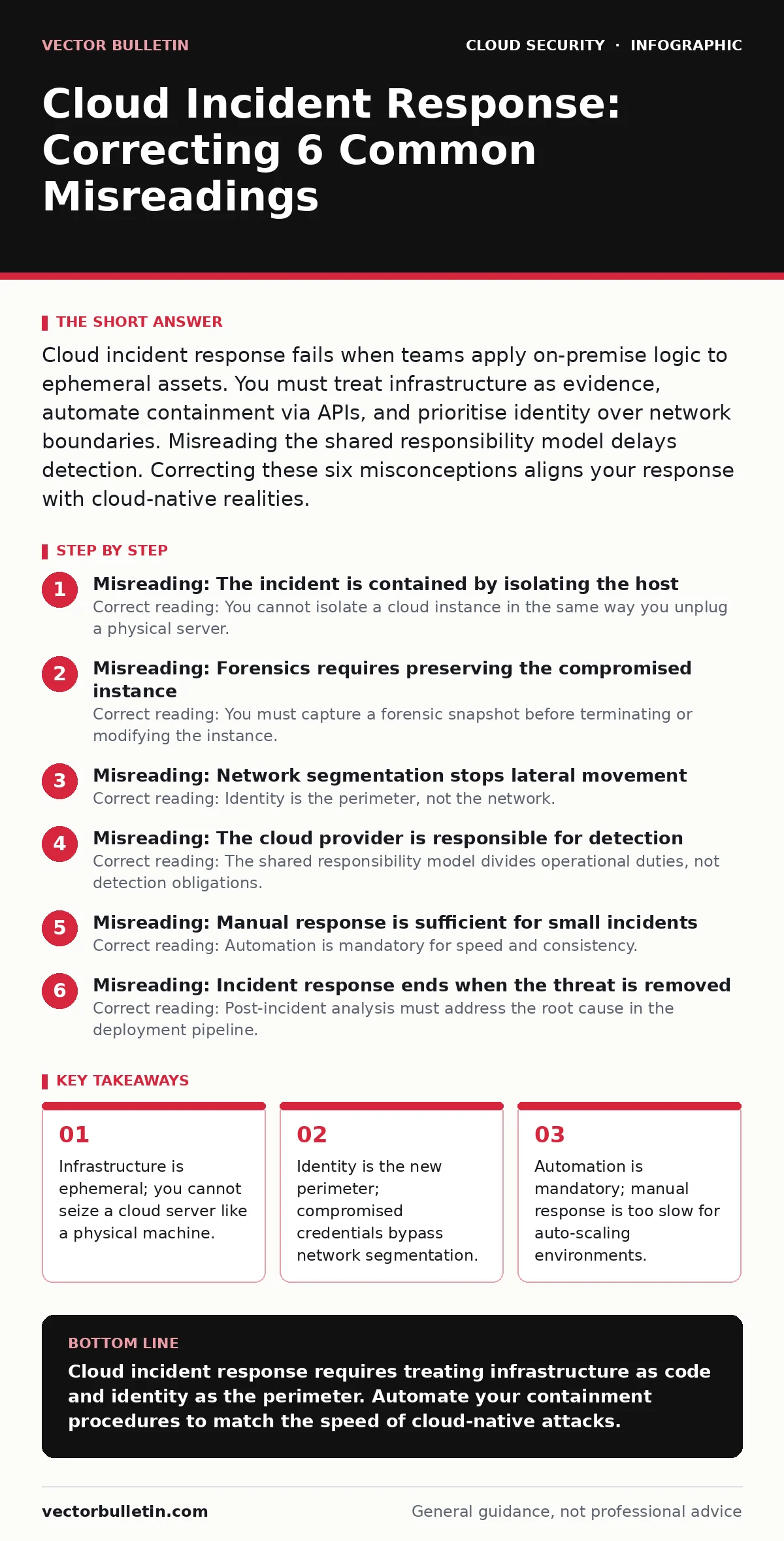
Cloud incident response fails when teams apply on-premise logic to ephemeral assets. You must treat infrastructure as evidence, automate containment via APIs, and prioritise identity over network boundaries. Misreading the shared responsibility model delays detection. Correcting these six misconceptions aligns your response with cloud-native realities.
Misreading: The incident is contained by isolating the host
Correct reading: You cannot isolate a cloud instance in the same way you unplug a physical server. Cloud infrastructure is ephemeral and defined by code. Isolating a compromised instance often requires detaching it from the virtual network or suspending it via the cloud provider’s API. This action stops further lateral movement but destroys the running state of the memory. You lose volatile evidence such as active processes, open sockets, and in-memory malware.
Suppose you detect a cryptominer on a web server. Pulling the network cable works in a data centre. In the cloud, you must send a programmatic request to change the security group rules or stop the instance. This takes seconds or minutes. During that window, the attacker exfiltrates data. More importantly, stopping the instance may trigger an auto-scaling group to launch a clean replacement. The incident effectively disappears, but the root cause remains active in the deployment pipeline. You have contained the symptom, not the infection.
This approach ignores the reality of infrastructure as code. The compromise likely originated from a misconfigured deployment script or a vulnerable container image. Fixing the runtime instance does not fix the build process. You must treat the deployment pipeline as part of the incident scope. Read more in our guide on cloud security architecture to understand how design flaws propagate.
Misreading: Forensics requires preserving the compromised instance
Correct reading: You must capture a forensic snapshot before terminating or modifying the instance. In physical environments, you seize the hard drive. In the cloud, you create a point-in-time copy of the block storage volume attached to the instance. This snapshot is immutable and can be mounted to a separate, isolated investigation environment. Terminating the instance without a snapshot destroys the primary evidence.
Imagine an attacker modifies system binaries on a Linux instance. If you reboot the machine, those binaries may reset from the base image, hiding the intrusion. If you terminate it, the volume is deleted. You must snapshot the volume first. This action is quick and non-disruptive to other services. It allows your analysts to mount the volume to a forensic workstation without impacting the production environment.
This method preserves the file system state. It does not preserve the memory state. For memory forensics, you need specialised tools that capture RAM before the instance stops. These tools are often not available in standard cloud toolkits. You must plan for this gap. The snapshot is the baseline. Memory dumps are the exception. Prioritise the snapshot to ensure you have a recoverable state for legal or compliance review.
Misreading: Network segmentation stops lateral movement
Correct reading: Identity is the perimeter, not the network. Traditional security relies on firewalls to separate segments. In the cloud, applications often require broad access to other services. A compromised application can use its own credentials to access databases, storage buckets, or other compute resources. Network rules may allow this traffic by design.
Suppose an attacker gains access to a low-privilege service account. They do not need to breach the firewall. They use the service account’s permissions to list objects in a storage bucket. If the bucket policy allows the account to read, the attacker succeeds. Network segmentation is irrelevant because the traffic is authorised. The control failure is in identity management, not network configuration.
You must enforce least privilege on every service account. Regularly audit permissions to remove unnecessary access. Use role-based access control to limit what each identity can do. This reduces the impact of a compromised credential. See our guide on identity sprawl for strategies to manage permissions at scale. Network controls are a backup, not the primary defence.
Misreading: The cloud provider is responsible for detection
Correct reading: The shared responsibility model divides operational duties, not detection obligations. The cloud provider secures the underlying infrastructure: the physical hardware, the hypervisor, and the global network. You secure what you put on it: your operating systems, applications, data, and configurations. The provider does not monitor your application logs or your database queries for malicious activity.
Imagine a database is accessed from an unusual geographic location. The cloud provider sees the network traffic but does not know it is malicious. That context belongs to you. You must implement logging and monitoring within your environment. You must correlate events to detect anomalies. Relying on the provider for application-level detection leaves you blind to sophisticated attacks.
You are responsible for configuring logging services correctly. You must ensure logs are stored securely and are tamper-proof. You must define alerts that trigger investigation. The provider offers tools, but you must build the detection logic. This distinction is critical for compliance and liability. Misunderstanding this boundary leads to gaps in visibility.
Misreading: Manual response is sufficient for small incidents
Correct reading: Automation is mandatory for speed and consistency. Cloud environments scale dynamically. An incident can propagate across hundreds of instances in minutes. Manual response is too slow and prone to human error. You must use infrastructure as code and API-driven responses to contain threats at the same speed as the attack.
Suppose a botnet compromises a web server and begins scanning internal services. A human analyst takes minutes to verify the alert. The bot takes seconds. By the time you manually block the IP, the attacker has pivoted. Automated playbooks can detect the pattern and immediately isolate the host. They can revoke compromised tokens and block malicious IPs across all security groups.
Automation ensures consistent response. It removes the delay between detection and containment. You must test your automated responses regularly. Broken scripts fail silently. You must monitor the health of your response tools. Automation is not a set-and-forget solution. It requires maintenance and validation. See our guide on cloud disaster recovery to understand how automated failover intersects with incident response.
Misreading: Incident response ends when the threat is removed
Correct reading: Post-incident analysis must address the root cause in the deployment pipeline. Removing malware from a server is only the first step. If the server was compromised because of a vulnerable library, you must update the library in the build process. If it was compromised due to weak credentials, you must enforce stronger authentication for all deployments.
Imagine you patch a server after a ransomware attack. The next deployment uses the same vulnerable image. The incident recurs. You have not solved the problem. You must trace the compromise back to the source code or configuration. You must fix the vulnerability in the repository. You must ensure that future builds do not include the flaw.
This approach prevents recurrence. It shifts security left in the development lifecycle. You must integrate security checks into the CI/CD pipeline. You must scan dependencies for known vulnerabilities. You must validate configurations before deployment. Incident response is a feedback loop. It informs development and operations. It improves the overall security posture.
Misreading: External threats are the primary concern
Correct reading: Insider threats and misconfigurations are more likely than external breaches. Attackers often exploit existing permissions or exposed services. A misconfigured storage bucket can leak sensitive data without any hacking. An employee with excessive privileges can exfiltrate data unnoticed.
Suppose a developer accidentally pushes access keys to a public code repository. The keys allow access to production databases. The attacker does not need to break in. They simply use the keys. This is not a network breach. It is a credential leak. You must monitor for leaked keys and rotate them immediately. See our guide on leaked cloud access keys for mitigation strategies.
You must assume that credentials will be compromised. Design your systems to minimise the impact. Use short-lived tokens. Enforce multi-factor authentication. Monitor for unusual access patterns. External attacks are dramatic. Internal failures are frequent. Address both.
Key takeaways
- Infrastructure is ephemeral; you cannot seize a cloud server like a physical machine.
- Identity is the new perimeter; compromised credentials bypass network segmentation.
- Automation is mandatory; manual response is too slow for auto-scaling environments.
- The shared responsibility model divides liability, not detection capabilities.
Cloud incident response requires treating infrastructure as code and identity as the perimeter. Automate your containment procedures to match the speed of cloud-native attacks.
Frequently asked questions
How do I preserve evidence in a serverless environment?
Serverless functions do not have persistent storage. You must rely on logging services. Ensure logs are streamed to a secure, immutable storage bucket. Analyse the logs to reconstruct the execution context and input data.
Can I use on-premise SIEM for cloud incidents?
Yes, but you must integrate cloud-native log sources. Ensure your SIEM can ingest logs from cloud providers, identity services, and container orchestration platforms. Correlate these logs to detect cross-platform threats.
What is the first step in a cloud incident?
Verify the alert to rule out false positives. Then, isolate the affected resource without destroying evidence. Create a forensic snapshot if the resource is stateful. Begin logging all actions taken during the response.
How do I handle a compromised identity?
Immediately revoke the compromised credentials. Force a password reset or disable the account. Audit all actions taken by that identity during the session. Identify affected resources and check for data exfiltration.
How this guide was produced: written by the Vector Bulletin editorial team with AI assistance, checked against the public references listed below, and reviewed when the facts change. See our editorial policy or report an error.