
Cloud Network Segmentation: 6 Misunderstandings That Leave Gaps
Static network boundaries fail when workloads move, so segmentation must follow identity and state rather than relying on fixed IP ranges or subnets.
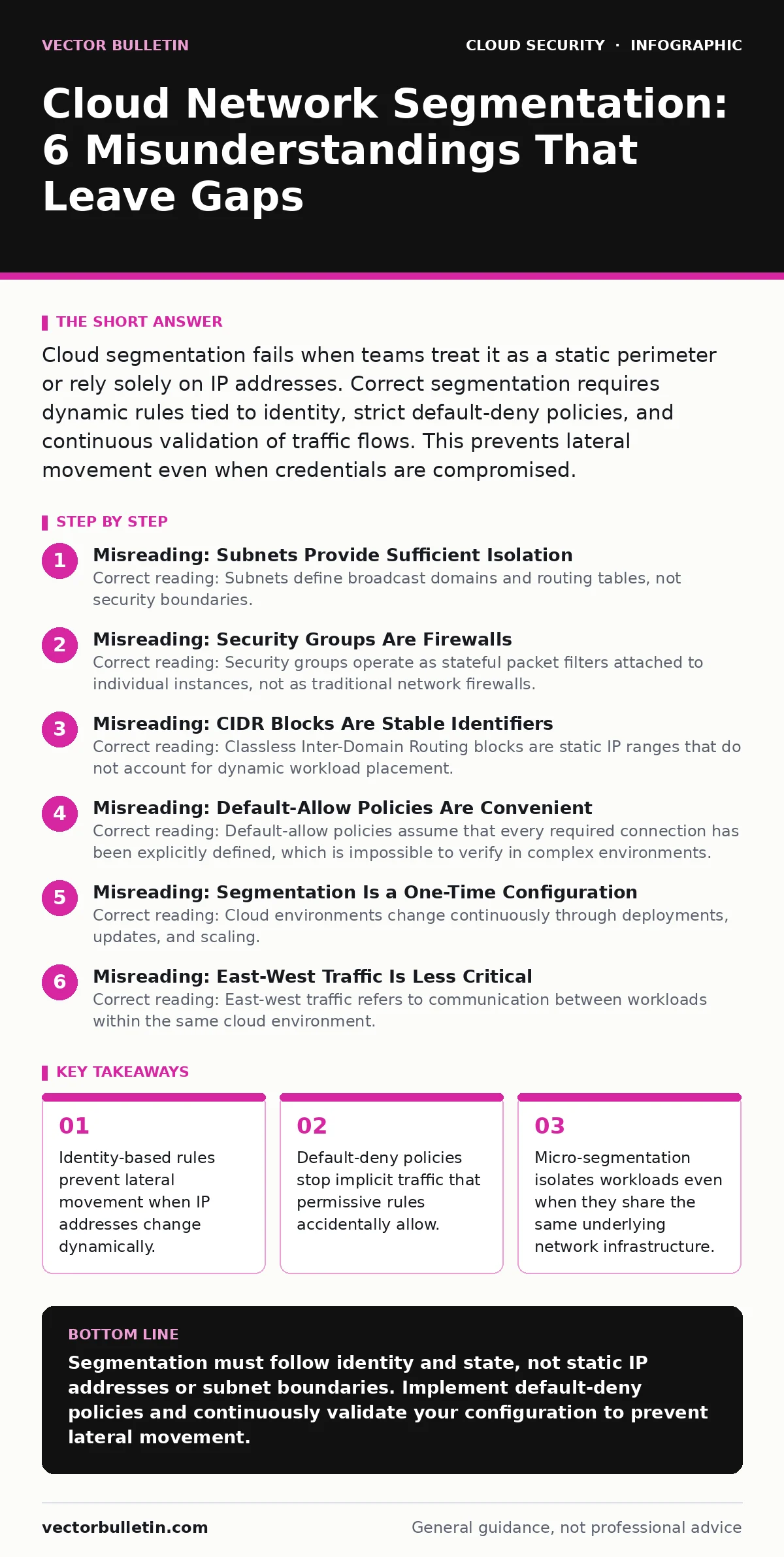
Cloud segmentation fails when teams treat it as a static perimeter or rely solely on IP addresses. Correct segmentation requires dynamic rules tied to identity, strict default-deny policies, and continuous validation of traffic flows. This prevents lateral movement even when credentials are compromised.
Misreading: Subnets Provide Sufficient Isolation
Correct reading: Subnets define broadcast domains and routing tables, not security boundaries. Placing workloads in separate subnets does not prevent an attacker from moving between them if the security group or firewall rules allow traffic. You must apply explicit deny rules between every subnet pair that does not require communication. Relying on network topology for security assumes that routing configuration remains static and error-free, which is rarely the case in dynamic cloud environments.
Imagine a developer creates a new subnet for a testing environment. The default configuration allows all traffic within the virtual network. An attacker compromises a test instance and scans the entire virtual network. Without explicit segmentation rules, the attacker accesses production databases in a different subnet. The subnet boundary offered no protection because the security policy was permissive by default.
Misreading: Security Groups Are Firewalls
Correct reading: Security groups operate as stateful packet filters attached to individual instances, not as traditional network firewalls. They evaluate traffic at the instance level and do not inspect deep packet content or application-layer protocols. You cannot use security groups to block specific malware signatures or complex application attacks. They are effective for controlling which ports and protocols reach an instance, but they do not replace intrusion prevention systems or web application firewalls.
Suppose you allow traffic on port 443 for HTTPS. A security group permits this traffic without inspecting the payload. An attacker sends a malicious SQL injection through the encrypted channel. The security group allows the packet because it matches the port rule. The attack succeeds because the security group does not understand the application layer. You need additional controls to inspect the content of allowed traffic.
Misreading: CIDR Blocks Are Stable Identifiers
Correct reading: Classless Inter-Domain Routing blocks are static IP ranges that do not account for dynamic workload placement. Cloud instances frequently change IP addresses during scaling events, updates, or failures. Rules based on CIDR blocks become stale and insecure as infrastructure changes. You must use tags, labels, or identity-based rules that follow the workload regardless of its current IP address. This ensures that security policies remain accurate even when the underlying network configuration shifts.
Consider an auto-scaling group that launches new instances in response to traffic spikes. Each new instance receives a different private IP address. A firewall rule allowing traffic from a specific CIDR block may miss these new instances or allow traffic from unrelated instances that happen to fall within that range. Identity-based segmentation ensures that only authorised instances communicate, regardless of their IP address assignment. This approach reduces the risk of misconfiguration during scaling events.
Misreading: Default-Allow Policies Are Convenient
Correct reading: Default-allow policies assume that every required connection has been explicitly defined, which is impossible to verify in complex environments. This approach creates implicit trust between any two resources that do not have an explicit deny rule. You must implement a default-deny posture where all traffic is blocked unless a specific rule permits it. This forces you to document and justify every communication path, reducing the attack surface significantly.
Imagine a legacy application that requires communication with a database. If the default policy is allow, the application can also communicate with other services it should not access. An attacker exploits a vulnerability in the legacy application and pivots to these other services. A default-deny policy would have blocked this lateral movement because no rule permitted the unexpected traffic. The convenience of default-allow masks the risk of unauthorised access.
Misreading: Segmentation Is a One-Time Configuration
Correct reading: Cloud environments change continuously through deployments, updates, and scaling. Static segmentation configurations quickly become outdated and ineffective. You must implement continuous validation and monitoring to detect configuration drift and policy violations. Automated tools should check that security rules match the intended architecture and alert when deviations occur. This ongoing process ensures that segmentation remains effective as the environment evolves.
Suppose a developer modifies a security group to allow access for debugging. They forget to revert the change after the session ends. The temporary rule remains in place, creating a persistent vulnerability. Continuous monitoring detects this deviation and alerts the operations team. Without this check, the rule remains active, increasing the risk of unauthorised access. Regular audits alone are insufficient because they miss changes that occur between audit cycles.
Misreading: East-West Traffic Is Less Critical
Correct reading: East-west traffic refers to communication between workloads within the same cloud environment. Attackers often target this traffic to move laterally after initial compromise. Many teams focus on north-south traffic, which enters and leaves the environment, while neglecting internal connections. You must apply strict segmentation to east-west traffic to limit the blast radius of a breach. Isolating workloads prevents an attacker from accessing critical systems after compromising a less secure component.
Imagine an attacker compromises a web server through a known vulnerability. They attempt to access the internal database server. If east-west segmentation is weak, the attacker succeeds. Strong segmentation blocks this internal movement, containing the breach to the web server. This containment allows the security team to respond without facing a widespread compromise. Ignoring east-west traffic assumes that external threats are the only risk, which is a dangerous misconception.
Misreading: Encryption Replaces Segmentation
Correct reading: Encryption protects data in transit but does not control who can initiate connections. Encrypting traffic between two services does not prevent an attacker from establishing an encrypted session if they have network access. Segmentation controls the permission to connect, while encryption protects the content of the connection. You need both to ensure that only authorised parties can communicate and that their data remains confidential.
Suppose you encrypt traffic between a frontend and backend service. An attacker gains network access to the backend subnet. They can initiate an encrypted connection to the frontend, even if the content is unreadable without keys. This connection allows the attacker to probe the service or exploit vulnerabilities. Segmentation prevents the initial connection, reducing the attack surface. Encryption alone does not stop unauthorised access attempts.
Key takeaways
- Identity-based rules prevent lateral movement when IP addresses change dynamically.
- Default-deny policies stop implicit traffic that permissive rules accidentally allow.
- Micro-segmentation isolates workloads even when they share the same underlying network infrastructure.
- Continuous validation detects configuration drift that static audits miss.
Segmentation must follow identity and state, not static IP addresses or subnet boundaries. Implement default-deny policies and continuously validate your configuration to prevent lateral movement.
Frequently asked questions
Does cloud network segmentation prevent data exfiltration?
Segmentation limits internal movement but does not stop data leaving the environment. You need additional controls like data loss prevention and egress filtering to prevent exfiltration.
How do I handle dynamic IP addresses in segmentation rules?
Use identity-based rules that rely on tags or labels rather than IP addresses. This ensures that policies follow workloads as they change IP addresses during scaling or updates.
Is micro-segmentation expensive to implement?
Micro-segmentation requires more initial configuration effort but reduces long-term risk. The cost of a breach often exceeds the implementation effort. Automate rule management to reduce operational overhead.
Can I use security groups for east-west traffic?
Yes, security groups can control east-west traffic at the instance level. However, they lack centralised management and deep inspection capabilities. Combine them with network firewalls for comprehensive control.
How this guide was produced: written by the Vector Bulletin editorial team with AI assistance, checked against the public references listed below, and reviewed when the facts change. See our editorial policy or report an error.