
Data Center Resilience Planning: Benefits, Limits, and Trade-offs
Resilience planning buys time for recovery, not instant continuity, and often fails against coordinated regional infrastructure failures that bypass local safeguards.
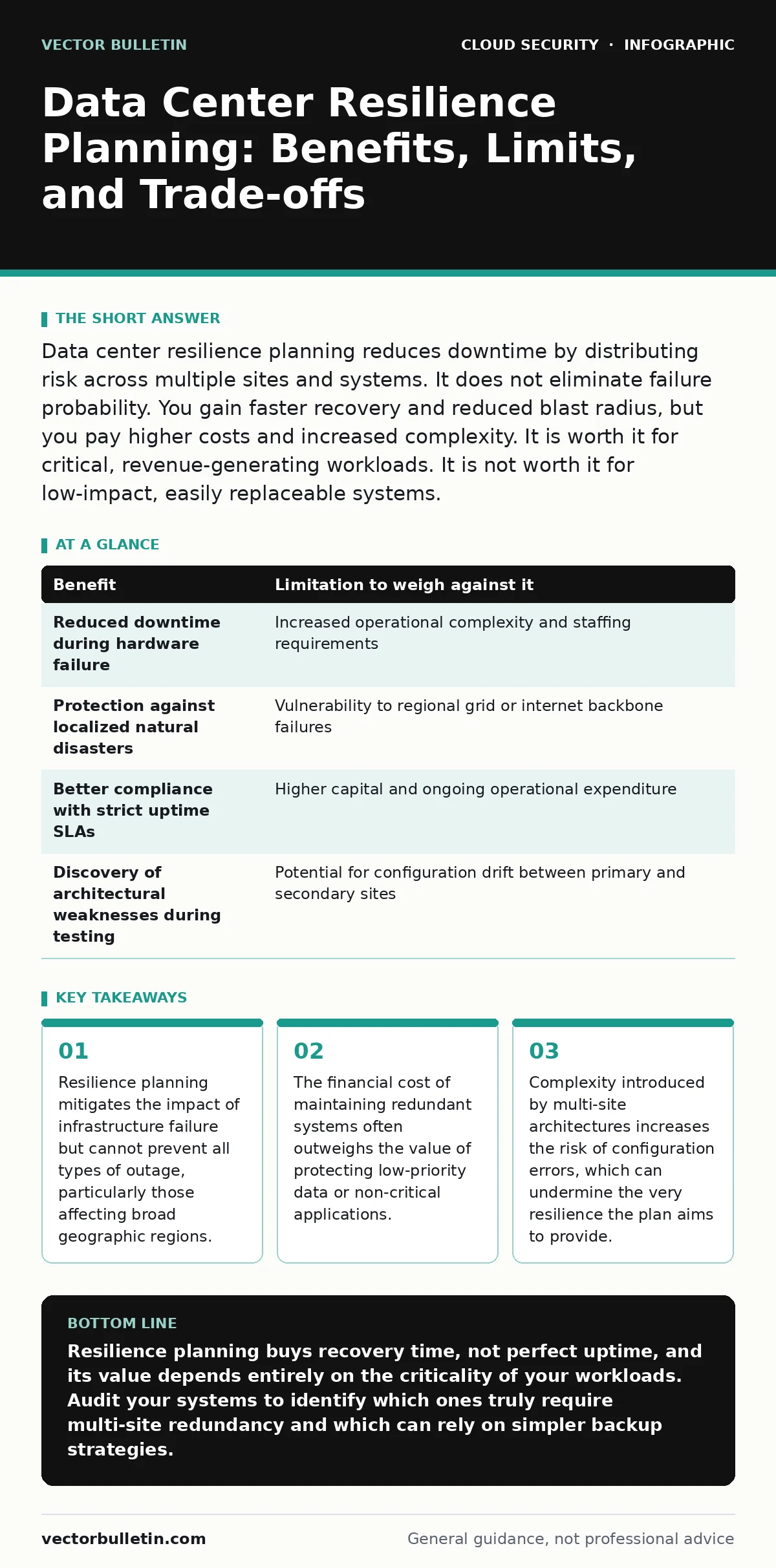
Data center resilience planning reduces downtime by distributing risk across multiple sites and systems. It does not eliminate failure probability. You gain faster recovery and reduced blast radius, but you pay higher costs and increased complexity. It is worth it for critical, revenue-generating workloads. It is not worth it for low-impact, easily replaceable systems.
Defining resilience in physical infrastructure
Resilience planning addresses the ability of a data center to withstand, adapt to, and recover from disruptions. This differs from simple backup strategies. Backup restores data from a previous state. Resilience maintains operational capacity during an event. You design systems to fail gracefully rather than catastrophically. The goal is to keep critical services running or to restore them within a defined timeframe. This requires redundant power supplies, network paths, and cooling systems. It also demands geographic distribution to avoid single points of failure.
Concrete benefits of distributed architecture
Distributing workloads across multiple data centers reduces the blast radius of any single failure. When one site loses power or connectivity, traffic shifts to another location. This minimises service interruption for end users. You also gain negotiating power with service providers. Multi-site dependencies force vendors to maintain higher service level agreements. Furthermore, resilience testing reveals hidden dependencies in your application stack. You discover which components break first under stress. This knowledge allows you to harden weak points before a real incident occurs.
Honest limitations of redundancy
Redundancy does not equate to immunity. If a flaw exists in your software logic, replicating that software across three data centres simply triples the exposure. You still face application-level failures. Additionally, geographic distribution introduces latency. Data must travel further, which can degrade performance for real-time applications. Synchronisation between sites also consumes bandwidth. If the primary site fails, the secondary site may hold slightly outdated data. This replication lag can lead to data loss for transactions processed during the outage window.
| Benefit | Limitation to weigh against it |
|---|---|
| Reduced downtime during hardware failure | Increased operational complexity and staffing requirements |
| Protection against localized natural disasters | Vulnerability to regional grid or internet backbone failures |
| Better compliance with strict uptime SLAs | Higher capital and ongoing operational expenditure |
| Discovery of architectural weaknesses during testing | Potential for configuration drift between primary and secondary sites |
The hidden cost of complexity
Every additional site adds layers of management overhead. You must maintain consistent security policies, patch levels, and network configurations across all locations. This synchronisation is difficult to automate perfectly. Configuration drift occurs when environments diverge over time. A firewall rule updated in the primary site might miss the secondary site. This creates security gaps that resilience plans do not address. You also need skilled personnel who understand the interplay between sites. Training and retaining this expertise is expensive. The complexity can also slow down deployment cycles, as changes must be validated in multiple environments.
When it is worth it
Resilience planning is justified for workloads that generate direct revenue or support legal obligations. Financial transactions, healthcare records, and real-time communication platforms require high availability. Downtime in these sectors results in immediate financial loss or regulatory penalties. You should also plan for resilience if your organisation depends on a single physical location for core operations. The risk of total business halt outweighs the cost of redundancy. In these cases, the investment protects brand reputation and customer trust. The cost of failure exceeds the cost of prevention.
When it is not
Resilience planning is often wasteful for non-critical systems. Internal wikis, test environments, and archival storage do not require multi-site redundancy. These systems can tolerate significant downtime without impacting business outcomes. The cost of maintaining a secondary site for such workloads rarely justifies the benefit. You also avoid resilience planning for short-lived projects. Temporary applications or proof-of-concept deployments will likely be decommissioned before a major incident occurs. In these scenarios, simple backup strategies suffice. Focus your resources on systems where failure causes measurable harm.
Integrating with broader security strategies
Resilience does not exist in isolation. It intersects with other security domains. For instance, cloud network segmentation ensures that a failure in one zone does not propagate to others. Without proper segmentation, a resilient architecture might simply amplify a breach. You must also consider identity sprawl.
Managing access rights across multiple data centres increases the attack surface. If identity providers fail, users cannot access resilient systems. Your plan must include recovery procedures for authentication services. Furthermore, cloud incident response plans must account for multi-site failures. Response teams need clear protocols for switching traffic and investigating issues across geographies.
Practical steps for implementation
Start by classifying your workloads by criticality. Identify which applications require high availability and which can tolerate downtime. Define your recovery time objective and recovery point objective for each tier. These metrics dictate the level of resilience required. Next, map your dependencies. Understand which services rely on others. Build a failure mode effects analysis to predict how single points of failure impact the whole system. Finally, automate your failover processes. Manual intervention during a crisis is slow and error-prone. Use infrastructure as code to ensure consistent deployment across sites.
Balancing cost and risk
The final decision rests on a balance between risk tolerance and budget. There is no perfect resilience. Every layer of protection adds cost and complexity. You must decide how much downtime is acceptable. For most organisations, a tiered approach works best. Critical systems get full geographic redundancy. Important systems get local redundancy. Low-priority systems get simple backups. This strategy optimises spending while maintaining necessary protection. Review your plan annually. Workloads change, and so do threats. A static resilience plan becomes obsolete quickly.
Key takeaways
- Resilience planning mitigates the impact of infrastructure failure but cannot prevent all types of outage, particularly those affecting broad geographic regions.
- The financial cost of maintaining redundant systems often outweighs the value of protecting low-priority data or non-critical applications.
- Complexity introduced by multi-site architectures increases the risk of configuration errors, which can undermine the very resilience the plan aims to provide.
Resilience planning buys recovery time, not perfect uptime, and its value depends entirely on the criticality of your workloads. Audit your systems to identify which ones truly require multi-site redundancy and which can rely on simpler backup strategies.
Frequently asked questions
Does cloud disaster recovery replace the need for data center resilience planning?
Cloud disaster recovery focuses on restoring data and systems after a failure, whereas resilience planning aims to maintain operations during a failure. They serve different purposes and are often used together.
How does shadow IT impact data center resilience efforts?
Shadow IT introduces unmanaged applications and data stores that bypass official resilience protocols. These systems can fail without warning, creating blind spots in your overall continuity strategy.
Can software-defined networking improve data center resilience?
Software-defined networking allows for dynamic traffic routing and automated failover. This flexibility can enhance resilience by quickly isolating failed components and redirecting traffic to healthy systems.
What is the role of public code repository leaks in resilience?
Public code repository leaks expose sensitive configuration details and credentials. Attackers can use this information to target resilient systems, undermining their effectiveness through sophisticated attacks.
How this guide was produced: written by the Vector Bulletin editorial team with AI assistance, checked against the public references listed below, and reviewed when the facts change. See our editorial policy or report an error.