
Cloud Security Architecture: Six Common Misreadings
Cloud security architecture relies on identity as the primary perimeter, rendering traditional network boundary controls largely ineffective for modern workloads.
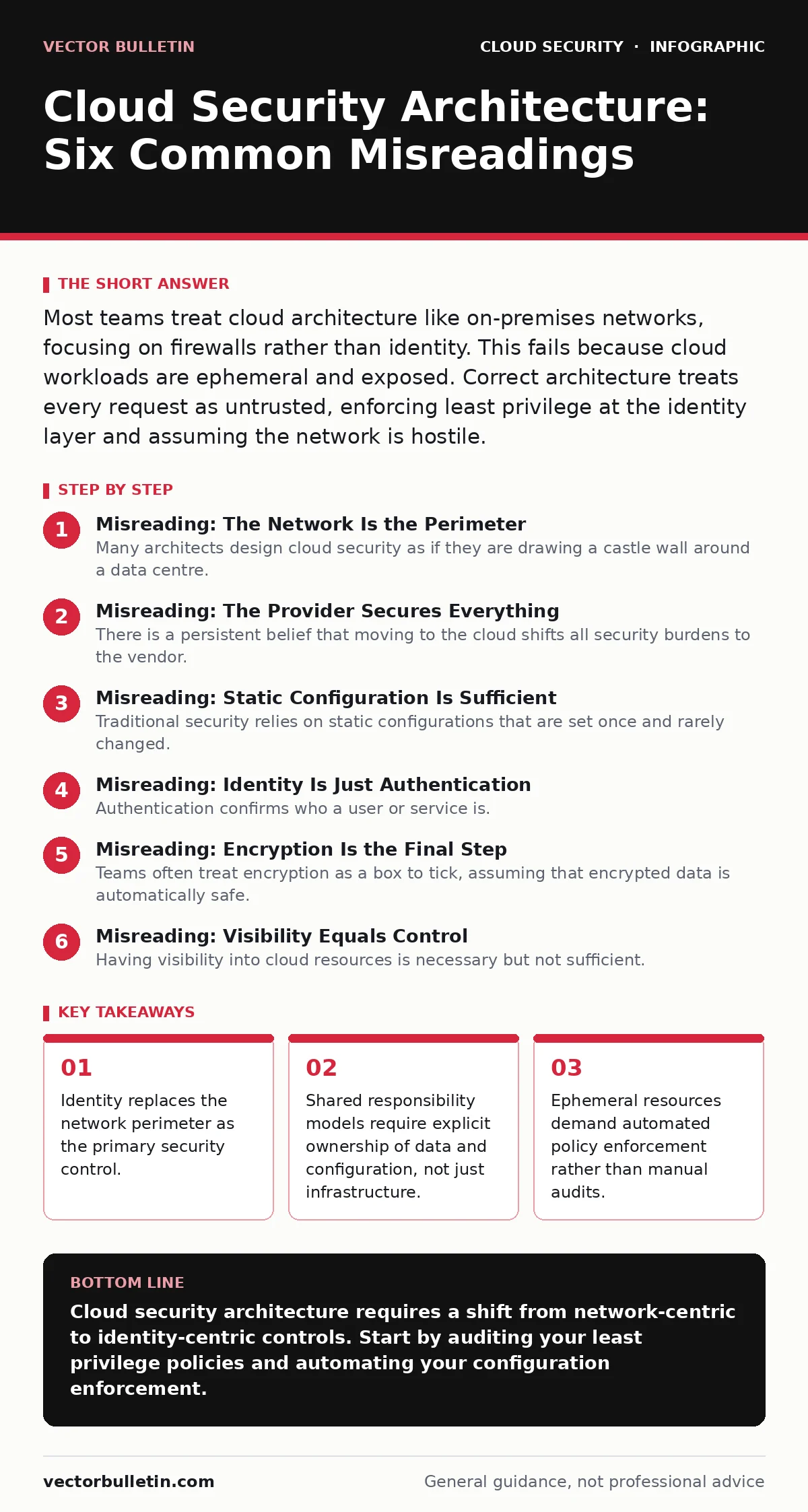
Most teams treat cloud architecture like on-premises networks, focusing on firewalls rather than identity. This fails because cloud workloads are ephemeral and exposed. Correct architecture treats every request as untrusted, enforcing least privilege at the identity layer and assuming the network is hostile.
Misreading: The Network Is the Perimeter
Many architects design cloud security as if they are drawing a castle wall around a data centre. They place heavy firewalls at the entry point and assume that anything inside is safe. This model collapses in the cloud because workloads are distributed, often public-facing, and frequently accessed from anywhere.
The cloud provider manages the physical infrastructure, but you manage the configuration of the virtual network. If you rely on network segmentation alone, you ignore the fact that compromised credentials can bypass network boundaries entirely. An attacker with valid API keys can access resources directly, regardless of firewall rules.
Correct reading: Treat the network as hostile and transient. Security controls must live at the identity and application layers, not just at the network edge. Assume that any component, whether internal or external, could be compromised at any time.
Misreading: The Provider Secures Everything
There is a persistent belief that moving to the cloud shifts all security burdens to the vendor. This is a misinterpretation of the shared responsibility model. The provider secures the cloud infrastructure itself, including the hardware, hypervisor, and global network.
You remain responsible for everything you put into that infrastructure. This includes your operating systems, applications, data, and access controls. If you fail to patch a virtual machine or misconfigure a storage bucket, the breach is your responsibility, not the provider’s.
Correct reading: You are responsible for the security in the cloud, while the provider is responsible for the security of the cloud. Document which controls sit on which side of this line for every service you use.
Misreading: Static Configuration Is Sufficient
Traditional security relies on static configurations that are set once and rarely changed. In the cloud, infrastructure is code. Workloads spin up and down automatically, often in response to demand. A security rule that fits a static server may block a legitimate automated scaling event.
If you audit security settings manually, you are auditing a snapshot that no longer exists by the time you finish. Ephemeral containers and serverless functions appear and disappear in minutes. Manual processes cannot keep pace with this dynamism.
Correct reading: Security must be automated and embedded in the deployment pipeline. Policies must enforce constraints before resources are created, not just after. This approach prevents insecure configurations from ever reaching the live environment.
Misreading: Identity Is Just Authentication
Authentication confirms who a user or service is. Authorization determines what that identity is allowed to do. Many teams focus heavily on strong authentication mechanisms, such as multi-factor authentication, while neglecting granular authorization.
An attacker who steals valid credentials can authenticate successfully. If the associated identity has excessive permissions, the attacker gains full access to sensitive data. This is a common vector in identity sprawl, where permissions accumulate over time and are rarely reviewed.
Correct reading: Implement least privilege at the authorization layer. Every identity, human or machine, should have only the minimum permissions necessary to perform its function. Regularly audit and revoke unused permissions to reduce the blast radius of a compromise.
Misreading: Encryption Is the Final Step
Teams often treat encryption as a box to tick, assuming that encrypted data is automatically safe. Encryption protects data at rest and in transit, but it does not protect the keys that decrypt it. If the keys are stored insecurely or accessible to too many users, the encryption provides a false sense of security.
Furthermore, encryption does not stop logic flaws or application-level attacks. An attacker can manipulate encrypted data or intercept it if the endpoint is compromised. Encryption is a control, not a strategy.
Correct reading: Manage keys with the same rigor as the data they protect. Use hardware security modules or managed key services to restrict access. Ensure that decryption happens only within trusted execution environments.
See also: Cloud Incident Response: Correcting 6 Common Misreadings
Misreading: Visibility Equals Control
Having visibility into cloud resources is necessary but not sufficient. Dashboards and logs show what is happening, but they do not prevent bad things from happening. Many teams build extensive monitoring solutions but lack the automated controls to act on the alerts.
This gap leads to alert fatigue and delayed response. You can see an anomalous login or a misconfigured storage bucket, but if you cannot automatically remediate it, the risk remains. Visibility without automation is merely observation.
Correct reading: Close the loop between detection and response. Integrate security tools with orchestration platforms to automatically isolate compromised resources or block malicious traffic. This reduces the time between detection and mitigation.
Imagine a scenario where a misconfigured database is exposed to the public internet. A monitoring tool alerts you, but it takes hours for a human to review and fix it. In that window, data can be exfiltrated. Automated policy enforcement would have blocked the exposure immediately.
Misreading: Cloud Attack Surface Is Fixed
The cloud attack surface is dynamic and expansive. New services, APIs, and integrations are added constantly. Each new addition introduces new potential vulnerabilities. Treating the attack surface as a fixed entity leads to blind spots.
You must continuously map and monitor your cloud attack surface. This includes third-party integrations, shadow IT deployments, and public code repository leaks that may contain sensitive configuration details.
Correct reading: Adopt a continuous discovery and mapping process. Treat every new service or integration as a potential entry point. Regularly review external-facing assets and remove unnecessary exposure.
Key takeaways
- Identity replaces the network perimeter as the primary security control.
- Shared responsibility models require explicit ownership of data and configuration, not just infrastructure.
- Ephemeral resources demand automated policy enforcement rather than manual audits.
Cloud security architecture requires a shift from network-centric to identity-centric controls. Start by auditing your least privilege policies and automating your configuration enforcement.
Frequently asked questions
Does using a cloud provider mean I no longer need a firewall?
No, but firewalls are no longer the primary control. You still need network segmentation, but identity-based access controls are more critical for preventing unauthorized access to resources.
How do I handle security for serverless functions?
Focus on the permissions granted to the function’s execution role and the inputs it processes. Since you do not manage the underlying OS, you cannot patch it, but you can control what the function is allowed to do.
Is encryption enough to protect data in the cloud?
No. Encryption protects data confidentiality, but you must also manage access to the encryption keys and ensure that the applications handling the data are secure against injection and logic flaws.
How do I prevent shadow IT in a cloud environment?
Implement centralized identity management and enforce policies that require approval for new resource creation. Monitor for unauthorised API usage and educate teams on the risks of bypassing official channels.
How this guide was produced: written by the Vector Bulletin editorial team with AI assistance, checked against the public references listed below, and reviewed when the facts change. See our editorial policy or report an error.