
Vulnerability Severity Ratings: What They Actually Mean
Severity scores measure technical exploitability, not business impact, meaning a high score may pose minimal risk while a low score could cause total failure.
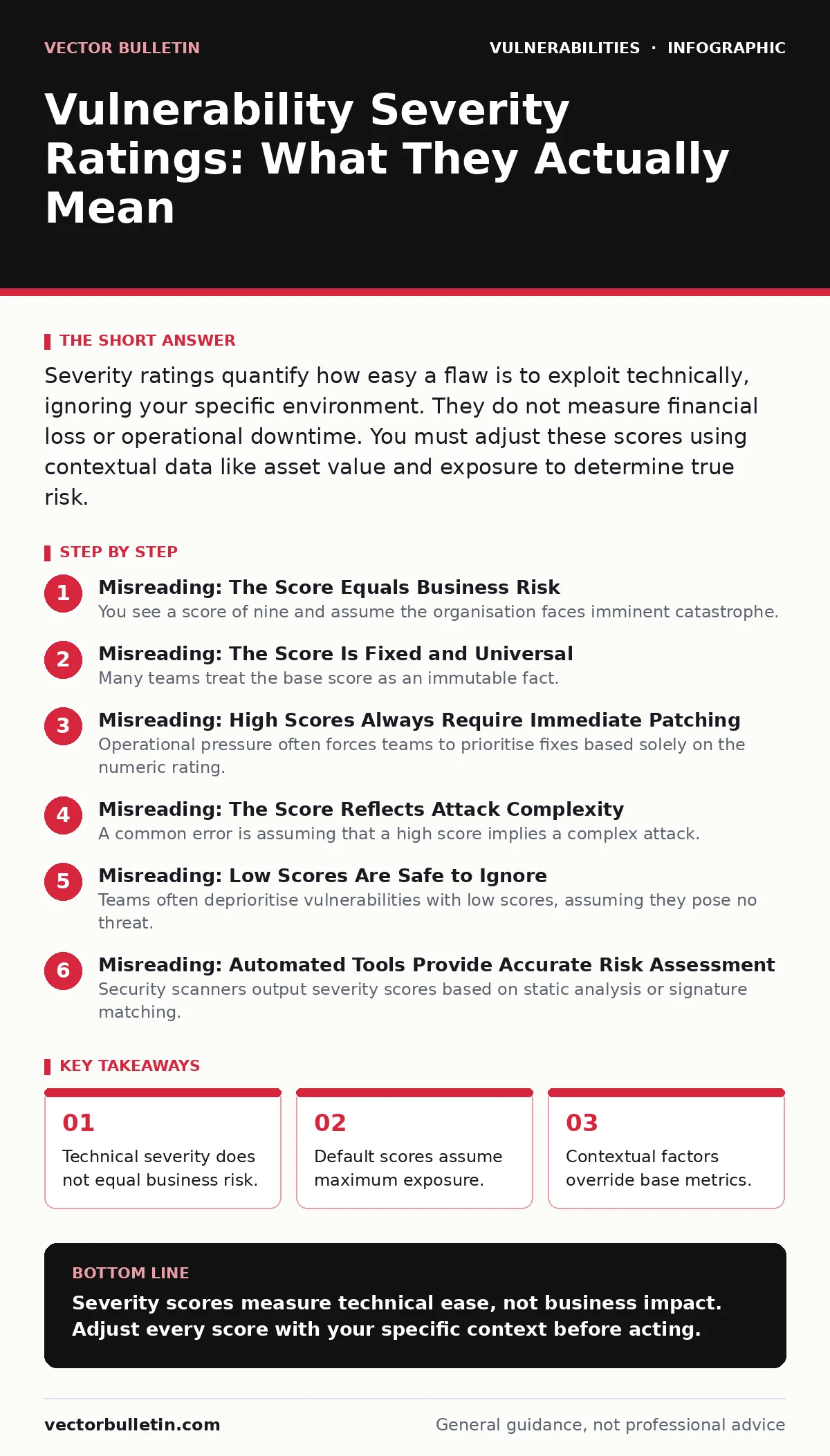
Severity ratings quantify how easy a flaw is to exploit technically, ignoring your specific environment. They do not measure financial loss or operational downtime. You must adjust these scores using contextual data like asset value and exposure to determine true risk.
Misreading: The Score Equals Business Risk
You see a score of nine and assume the organisation faces imminent catastrophe. This assumption conflates technical exploitability with business impact. The rating measures how easily an attacker can trigger the flaw, not how much damage they can cause once inside.
A flaw in an internal tool with no external access may have a high score because it is trivial to exploit locally. However, if that tool processes no sensitive data and has no path to critical systems, the business risk is negligible. Conversely, a low-score flaw in a public-facing payment gateway might allow slow data exfiltration that destroys customer trust.
The rating tells you about the door, not what is inside the room. You must separate the mechanics of the breach from the value of the asset.
Correct reading: Treat the score as a measure of technical friction. Combine this with asset classification to determine actual risk. A high score on a low-value asset is less urgent than a medium score on a crown jewel.
Misreading: The Score Is Fixed and Universal
Many teams treat the base score as an immutable fact. They believe that if a vendor assigns a score, it applies equally to every installation of that software. This ignores the variability of deployment configurations.
The same vulnerability in a web server exposed to the internet carries different weight than the same vulnerability in an isolated air-gapped network. The base score assumes the worst-case scenario for network accessibility and user privileges. Your environment rarely matches this theoretical maximum.
If your application requires authentication that the vulnerability model assumes is bypassed, the effective severity drops. If your network segmentation prevents lateral movement, the impact decreases.
Correct reading: The base score is a starting point, not a final verdict. You must adjust it based on your specific configuration, network topology, and access controls. The same flaw has different severity in different contexts.
Misreading: High Scores Always Require Immediate Patching
Operational pressure often forces teams to prioritise fixes based solely on the numeric rating. This leads to patching high-score items on non-critical systems while ignoring lower-score items on critical infrastructure. This approach wastes resources and leaves real risks unaddressed.
Patching carries its own risks, including system instability and downtime. Applying a patch to a stable production system solely because of a high score can introduce new failures. The cost of the fix may exceed the potential loss from the vulnerability.
You must weigh the effort of remediation against the likelihood of exploitation. If the attack vector is complex and the attacker needs physical access, the urgency diminishes significantly.
Correct reading: Prioritise based on risk, not just severity. Consider the exploitability in your specific environment and the cost of remediation. Sometimes, accepting the risk or implementing compensating controls is more rational than immediate patching.
Misreading: The Score Reflects Attack Complexity
A common error is assuming that a high score implies a complex attack. In reality, high scores often indicate that the attack is simple and requires little skill or special conditions. The scoring model rewards ease of exploitation.
A flaw that allows remote code execution with a single HTTP request scores higher than one requiring a specific file format or user interaction. The simplicity of the attack makes it more likely to be exploited at scale.
Do not confuse technical simplicity with strategic difficulty. An attacker may still need to find the vulnerable instance or bypass perimeter defences. The score does not account for your defensive layers.
Correct reading: High scores often mean the attack is easy to execute. This increases the likelihood of automated scanning and exploitation. You should focus on reducing exposure for these simple, high-score flaws.
Misreading: Low Scores Are Safe to Ignore
Teams often deprioritise vulnerabilities with low scores, assuming they pose no threat. This is dangerous because low scores can reflect specific constraints that do not exist in your environment.
A low score might result from the requirement for user interaction, such as clicking a link. If your application sends automated emails to users with malicious links, the interaction requirement is met. The effective severity rises.
Similarly, a low score might assume the attacker has low privileges. If your application runs with elevated privileges, the impact of the flaw increases. Ignoring low scores can leave critical paths open.
Correct reading: Evaluate low scores with scrutiny. Ask why the score is low. If the reason is a constraint that your environment violates, the risk is higher than the score suggests.
See also: National Vulnerability Database: Small Business Action Plan · Penetration Testing: Benefits, Limits, and When to Skip It
Misreading: Automated Tools Provide Accurate Risk Assessment
Security scanners output severity scores based on static analysis or signature matching. These tools lack context about your business processes, data sensitivity, and internal controls. They treat all endpoints as equally valuable.
Relying solely on automated scores creates a false sense of security. The tool may miss logical flaws that do not have known signatures. It may also overstate the risk of flaws in isolated systems.
You need human judgement to interpret these scores. The tool identifies the flaw; you assess the risk. This distinction is vital for effective security operations.
Correct reading: Use automated tools for discovery, not decision-making. Validate scores with manual assessment and contextual data. Integrate findings from your secure code review process to catch logical flaws that scanners miss.
Misreading: The Score Accounts for Compensating Controls
Some teams believe that if a firewall blocks access to a vulnerable service, the severity score drops automatically. The scoring model does not account for external controls like web application firewalls or network segmentation.
The score reflects the vulnerability in the software itself, not the environment. A web application firewall may block known attack patterns, but it cannot mitigate all exploitation attempts. The underlying flaw remains.
If you rely on compensating controls, you must document them and verify their effectiveness. The score does not change, but your residual risk does.
Correct reading: The score is intrinsic to the flaw. Your controls reduce risk, not severity. Document how your controls mitigate the specific attack vectors identified by the score.
Misreading: The Score Predicts Exploitation Probability
A high score does not mean an attacker will exploit the flaw. It means the flaw is easy to exploit if found. Many high-score vulnerabilities remain unexploited because they are in obscure software or hard-to-reach systems.
Conversely, low-score vulnerabilities in popular software often see widespread exploitation. Attackers target common platforms where the effort to find victims is low. The popularity of the software matters more than the score.
You must consider the attack surface and the value of the target. A high score on a rare application is less likely to be exploited than a medium score on a widely used platform.
Correct reading: Use threat intelligence to gauge exploitation likelihood. Combine this with the severity score to prioritise remediation. Focus on flaws in widely used, exposed systems first.
Key takeaways
- Technical severity does not equal business risk.
- Default scores assume maximum exposure.
- Contextual factors override base metrics.
- Automated tools cannot assess business value.
Severity scores measure technical ease, not business impact. Adjust every score with your specific context before acting.
Frequently asked questions
How do I adjust a severity score for my environment?
Use an environmental scoring tool that factors in network exposure, security requirements, and scope. Multiply the base score by environmental modifiers.
Should I patch all high-severity vulnerabilities immediately?
No. Assess the business impact and exploitability in your context. Prioritise based on risk, not just the numeric score.
What is the difference between base score and temporal score?
The base score is static and reflects the flaw itself. The temporal score adjusts for factors like exploit availability and remediation status.
Can I ignore low-severity vulnerabilities?
Only if you have verified that the constraints lowering the score apply to your environment. Otherwise, the risk may be higher than indicated.
How this guide was produced: written by the Vector Bulletin editorial team with AI assistance, checked against the public references listed below, and reviewed when the facts change. See our editorial policy or report an error.