
Penetration Testing: Benefits, Limits, and When to Skip It
Penetration testing proves exploitability of specific configurations but cannot guarantee security across changing codebases or unseen attack surfaces.
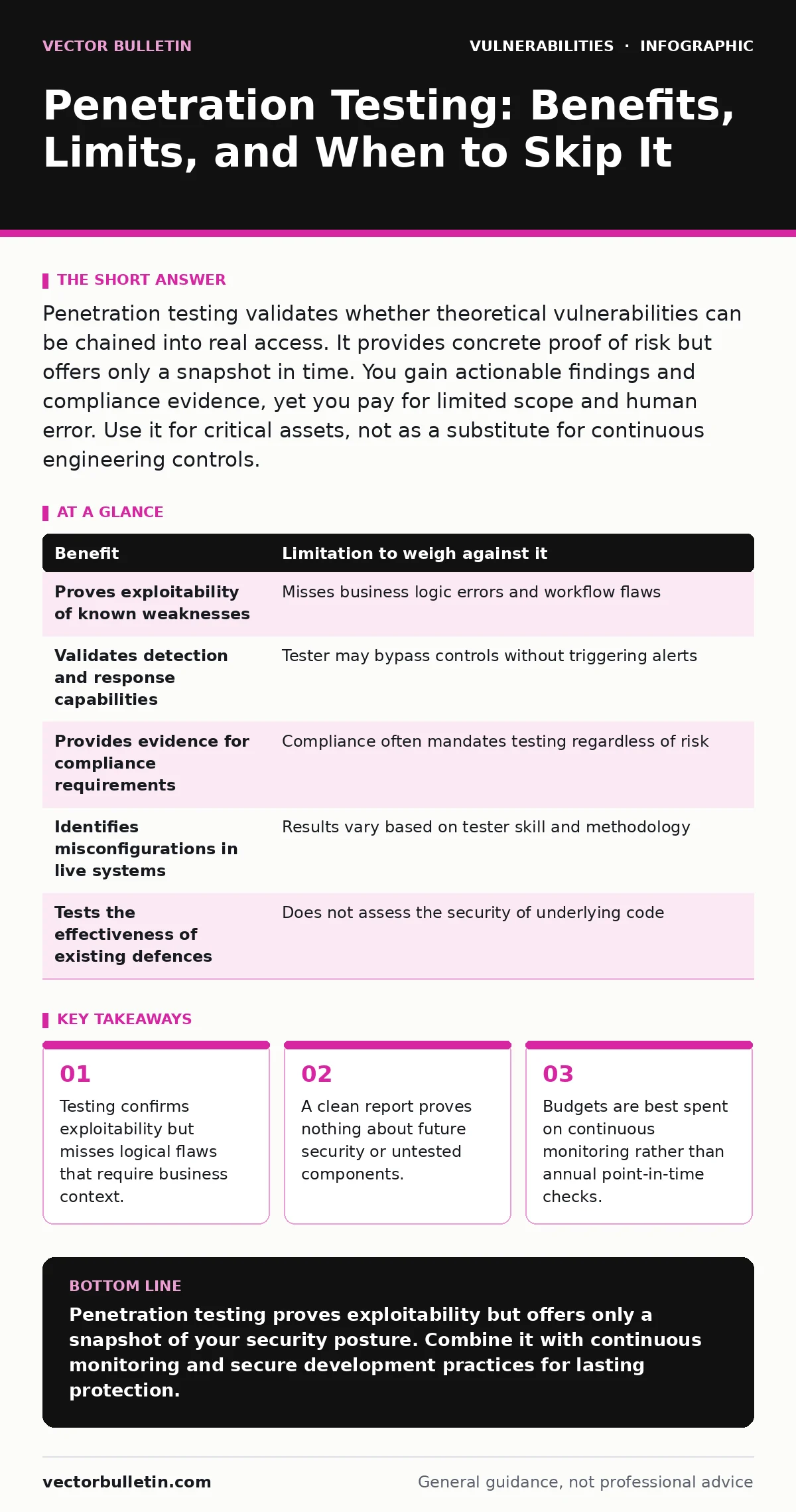
Penetration testing validates whether theoretical vulnerabilities can be chained into real access. It provides concrete proof of risk but offers only a snapshot in time. You gain actionable findings and compliance evidence, yet you pay for limited scope and human error. Use it for critical assets, not as a substitute for continuous engineering controls.
Why you commission a penetration test
You commission a penetration test to validate whether theoretical weaknesses can be turned into actual access. A vulnerability scanner identifies potential issues by matching signatures against a database. A penetration tester attempts to exploit those issues to achieve a specific objective. This distinction matters because many vulnerabilities are theoretical. They may exist in the code but remain unreachable due to network segmentation or configuration. A penetration test proves reachability.
It demonstrates that an attacker can move from the edge to the target. This proof is valuable for risk assessment. It turns abstract CVEs into concrete business risks. You can prioritise remediation based on actual impact rather than severity scores alone. The test also validates your detection capabilities. If the tester breaches the perimeter without alerting your security operations team, your monitoring is incomplete. This insight is often more valuable than the vulnerability itself.
The inherent limits of manual testing
A penetration test is a snapshot. It examines a specific set of assets at a specific moment in time. Software changes daily. New vulnerabilities emerge constantly. A clean report today does not guarantee security tomorrow. The tester works within a defined scope. Anything outside that scope is ignored. If you do not include a third-party integration in the scope, the tester will not touch it. This creates blind spots. Human testers are also limited by time and budget.
They cannot test every input combination. They rely on experience and intuition. This means they may miss obscure edge cases. A tester might focus on common attack vectors and ignore unusual ones. The quality of the test depends entirely on the tester’s skill. There is no standardised level of thoroughness. One tester might find three issues. Another might find thirty. You are buying human judgement, not a deterministic process.
Weighing benefits against limitations
You must balance the proof of exploitability against the narrow scope. The table below outlines the primary trade-offs. Each benefit has a corresponding limitation that reduces its overall value. You should consider these pairs when deciding whether to test. The benefit of finding chained vulnerabilities is real. The limitation of missing logical flaws is equally real. Do not assume a test covers all bases. It covers what the tester chooses to look for.
| Benefit | Limitation to weigh against it |
|---|---|
| Proves exploitability of known weaknesses | Misses business logic errors and workflow flaws |
| Validates detection and response capabilities | Tester may bypass controls without triggering alerts |
| Provides evidence for compliance requirements | Compliance often mandates testing regardless of risk |
| Identifies misconfigurations in live systems | Results vary based on tester skill and methodology |
| Tests the effectiveness of existing defences | Does not assess the security of underlying code |
When it is worth it
You should commission a penetration test when you need proof of exploitability for high-value assets. If you have a public-facing application handling sensitive data, the risk of breach is high. A test can reveal whether your defences hold against a skilled adversary. It is also worth it when you have made significant changes to your infrastructure. New cloud services, updated APIs, or migrated databases introduce new attack surfaces. A test validates that these changes did not introduce critical gaps.
Compliance requirements may also mandate testing. If your industry requires annual assessments, you must conduct them. However, use the test to improve your security posture, not just to tick a box. The value lies in the findings, not the certificate. You should also test when you suspect a specific weakness. If a vulnerability scanner flags a critical issue, a tester can confirm whether it is exploitable. This saves time by focusing resources on real threats.
When it is not worth it
You should skip penetration testing when you lack the basics. If you do not have an accurate IT asset inventory, you cannot define the scope. Testing unknown assets is a waste of money. You will test the wrong things and miss the real risks. It is also not worth it if you expect it to replace secure development practices. A penetration test cannot fix insecure code. It can only find symptoms of bad coding. You need secure code review to address the root cause.
Testing is a verification step, not a prevention step. If you rely on testing to find bugs, you are doing it wrong. Bugs should be caught before they reach production. Testing is also not worth it for low-risk internal tools. If a tool has no external access and handles no sensitive data, the cost of testing outweighs the benefit. Focus your budget on assets that matter. Do not spread your resources thin across every system. Depth is more valuable than breadth.
See also: National Vulnerability Database: Small Business Action Plan · Secure Code Review Checklist: Static Analysis and Logic Flaws
The hidden cost of false confidence
A clean penetration test report can create false confidence. You may believe your systems are secure because a skilled tester found nothing. This belief is dangerous. It can lead to complacency. You may reduce monitoring or delay patching. The tester was limited by scope and time. They did not test every possibility. The system may still have vulnerabilities. They are just outside the tester’s view. This is known as the survivorship bias.
You see the vulnerabilities that were found. You do not see the ones that were missed. Do not let a clean report lower your guard. Treat it as a baseline, not a guarantee. Continue to monitor and test. Use automated tools to catch new issues. Combine penetration testing with continuous security assessments. This approach reduces the risk of blind spots. It ensures that you are not relying on a single point in time.
Integrating testing with other controls
Penetration testing works best when integrated with other security controls. It should complement, not replace, your existing processes. For example, web application firewalls can block common attacks. A penetration test can verify that the firewall rules are effective. If the tester bypasses the firewall, you know the rules are insufficient. This feedback loop improves your defences. Testing also helps validate your vulnerability disclosure policies.
If an external researcher finds an issue, your team needs to respond. A penetration test simulates this scenario. It helps you practice your response procedures. You can identify gaps in your incident response plan. This preparation is critical for real-world incidents. Do not treat testing as an isolated event. Make it part of your continuous security strategy. This integration maximises the value of your investment.
Moving beyond the test
The real value of a penetration test lies in the remediation. Finding vulnerabilities is only the first step. You must fix them. Prioritise fixes based on risk. Not all vulnerabilities are equal. Some are easy to exploit. Others require specific conditions. Focus on the high-risk issues first. Track your progress. Ensure that fixes are deployed and verified. This verification is critical.
A fix may not work as expected. It may introduce new issues. You need to test the fix. This is often called regression testing. It ensures that the solution is effective. Do not ignore low-risk issues. They can be chained together to create high-risk scenarios. A small flaw in one component may enable a larger breach. Address all findings. This comprehensive approach strengthens your overall security posture.
The role of continuous assessment
Penetration testing is a point-in-time assessment. It does not provide continuous coverage. You need ongoing monitoring to catch new issues. Automated scanners can identify new vulnerabilities. They can check for misconfigurations. They can monitor for changes in your environment. This continuous assessment complements penetration testing. It fills the gaps between tests. It provides real-time visibility into your security posture.
You can respond to threats as they emerge. This proactive approach is more effective than reactive testing. It reduces the window of opportunity for attackers. You should combine both approaches. Use penetration testing for deep dives. Use automated tools for continuous monitoring. This hybrid strategy provides the best coverage. It balances depth with breadth. It ensures that you are not relying on a single method.
Key takeaways
- Testing confirms exploitability but misses logical flaws that require business context.
- A clean report proves nothing about future security or untested components.
- Budgets are best spent on continuous monitoring rather than annual point-in-time checks.
Penetration testing proves exploitability but offers only a snapshot of your security posture. Combine it with continuous monitoring and secure development practices for lasting protection.
Frequently asked questions
How often should we perform penetration testing?
Conduct penetration testing annually for compliance and after significant infrastructure changes. Critical systems may require more frequent testing to catch emerging risks.
Can automated tools replace penetration testing?
Automated tools cannot replace human judgement. They find known signatures but miss complex logic flaws and chained vulnerabilities that require contextual understanding.
What is the difference between a vulnerability scan and a penetration test?
A vulnerability scan identifies potential weaknesses using automated rules. A penetration test attempts to exploit those weaknesses to achieve a specific objective, proving real-world risk.
Should we disclose penetration test results publicly?
Disclose results only if required by compliance or if you have a vulnerability disclosure policy. Public disclosure of unpatched vulnerabilities exposes your organisation to immediate risk.
How this guide was produced: written by the Vector Bulletin editorial team with AI assistance, checked against the public references listed below, and reviewed when the facts change. See our editorial policy or report an error.