
Security Advisories: 6 Common Misreadings That Leave Systems Exposed
Treating advisory scores as absolute truth ignores the specific context of your network, leading to wasted effort and missed critical flaws.
Security advisories describe known flaws but do not assess your specific risk. Misreading them as immediate action items, universal threats, or complete inventories causes teams to patch low-risk items while ignoring complex logic errors. Correct reading requires mapping each advisory to your actual asset inventory and configuration.
Misreading: The score dictates the urgency
Vulnerability severity ratings provide a standardised method for comparing exploitability across different products, but they do not measure the damage a flaw causes in your environment. You treat a high score as an automatic mandate for immediate patching, ignoring whether the affected component is even present on your systems. The score reflects the ease of exploitation, not the consequence of success. A flaw with a moderate score might allow remote code execution on a public-facing server, while a severe score might apply to a feature disabled by default.
Correct reading: Treat the score as a sorting mechanism, not a decision engine. You must cross-reference the advisory with your IT asset inventory to determine if the vulnerable software is installed. If the software is absent, the score is irrelevant. If the software is present but isolated behind a firewall with strict ingress rules, the practical risk drops significantly. You assess the attack path, not just the vulnerability metric.
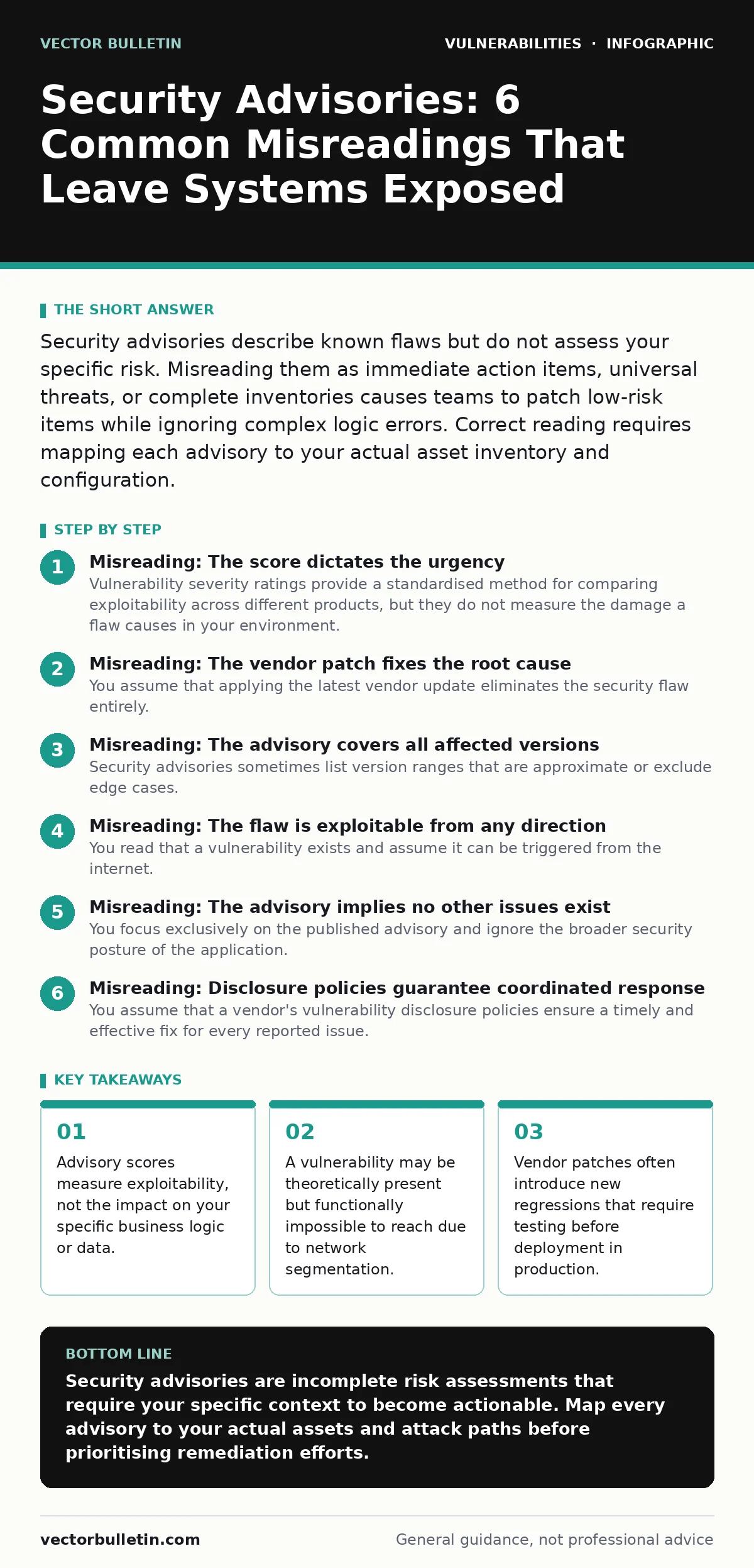
Misreading: The vendor patch fixes the root cause
You assume that applying the latest vendor update eliminates the security flaw entirely. Vendors often provide mitigations that reduce the attack surface rather than fixing the underlying logic error. These mitigations might disable a feature, change default settings, or add input validation that can be bypassed by sophisticated attackers. Relying on the patch as a silver bullet creates a false sense of security. The underlying architecture may still contain the weakness, waiting for a future bypass technique to emerge.
Correct reading: View the patch as a reduction in attack surface, not a complete cure. You should verify whether the update addresses the root cause or merely adds controls. For critical systems, you might need additional compensating controls, such as web application firewalls or network segmentation, to protect against partial fixes. Secure code review practices often reveal that vendor patches are imperfect, requiring your own internal validation before deployment.
Misreading: The advisory covers all affected versions
Security advisories sometimes list version ranges that are approximate or exclude edge cases. You assume that if your version is not explicitly listed in the "affected" section, your system is safe. This assumption fails when vendors use shared libraries or common codebases across different products. A flaw in a core component might affect multiple products that are not mentioned in the primary advisory. Conversely, an advisory might list a version that you have modified, rendering the standard fix ineffective or incompatible.
Correct reading: Verify the exact version strings against your local installations, including custom builds and forks. You should check for shared dependencies that might be vulnerable even if the main application version appears safe. Do not rely solely on the vendor's version list. Consult the National Vulnerability Database for broader context, as different databases may track the same flaw under different identifiers. Always assume that custom modifications could introduce new vulnerabilities or break existing fixes.
Misreading: The flaw is exploitable from any direction
You read that a vulnerability exists and assume it can be triggered from the internet. Many advisories describe flaws that require local access, specific user privileges, or a trusted network position. For example, a flaw might allow a local user to escalate privileges, but if your system has no local users and is accessed only via a single administrative account, the risk is negligible. Assuming universal exploitability leads to panic and unnecessary downtime. You waste resources patching systems that are physically or logically isolated from potential attackers.
Correct reading: Analyse the attack vector described in the advisory. Determine whether the flaw requires network access, local login, or physical proximity. If your architecture prevents the required access method, the vulnerability is not a practical threat. This analysis is central to effective penetration testing, where testers verify whether theoretical flaws are reachable in your specific environment. You map the advisory's requirements against your network topology and access controls.
Misreading: The advisory implies no other issues exist
You focus exclusively on the published advisory and ignore the broader security posture of the application. An advisory highlights one specific flaw, but it does not imply that the rest of the codebase is secure. Applications often contain multiple weaknesses, including insecure direct object references (IDOR) or cross-site scripting (XSS), which are not covered by a single advisory. Treating the advisory as a complete audit report leaves other entry points open. Attackers frequently chain a known, patched vulnerability with an unknown logic error to bypass defences.
Correct reading: Use the advisory as a starting point for a deeper investigation. You should assess the application for related vulnerabilities that share similar root causes. If an advisory reports a buffer overflow, check for other memory safety issues. If it reports an authentication bypass, review all identity verification mechanisms. This holistic approach ensures that you do not miss adjacent risks that could compound the impact of the disclosed flaw.
See also: Penetration Testing: Benefits, Limits, and When to Skip It · Secure Code Review Checklist: Static Analysis and Logic Flaws
Misreading: Disclosure policies guarantee coordinated response
You assume that a vendor's vulnerability disclosure policies ensure a timely and effective fix for every reported issue. Disclosure policies vary widely in quality and enforcement. Some vendors ignore reports, while others delay patches for months. Relying on the existence of a policy as proof of security maturity is dangerous. You might leave systems exposed for extended periods, waiting for a patch that never arrives or takes too long to develop. The policy is a procedural document, not a security guarantee.
Correct reading: Evaluate the vendor's historical response times and patch quality. You should not rely on the policy alone to determine risk. If a vendor has a poor track record, you must implement compensating controls immediately, rather than waiting for a fix. This might involve isolating the affected system, restricting access, or replacing the software. You treat the policy as a communication channel, not a risk mitigation strategy.
Misreading: The fix is backward compatible
You deploy a patch assuming it will not disrupt existing functionality. Vendors often change behaviour in security patches, breaking integrations, scripts, or legacy features. This regression risk is rarely highlighted in the advisory itself. You push the update to production and encounter outages, forcing a rollback that leaves the system vulnerable again. The cost of a failed patch deployment can exceed the cost of the vulnerability itself, especially in high-availability environments.
Correct reading: Test all patches in a staging environment that mirrors production. You must verify that the patch does not break critical workflows before deployment. Document any changes in behaviour and update your monitoring rules accordingly. This step is non-negotiable for maintaining operational stability. You balance the need for security with the requirement for reliability, ensuring that the fix does not introduce new operational risks.
Key takeaways
- Advisory scores measure exploitability, not the impact on your specific business logic or data.
- A vulnerability may be theoretically present but functionally impossible to reach due to network segmentation.
- Vendor patches often introduce new regressions that require testing before deployment in production.
Security advisories are incomplete risk assessments that require your specific context to become actionable. Map every advisory to your actual assets and attack paths before prioritising remediation efforts.
Frequently asked questions
Do I need to patch every vulnerability listed in an advisory?
No. You only need to patch vulnerabilities that affect systems present in your environment and reachable by potential attackers.
How do I verify if a patch is complete?
You must test the patched system in a staging environment and review the vendor's technical notes for any known limitations or workarounds.
What if the vendor does not provide a patch?
You must implement compensating controls, such as network segmentation or access restrictions, to mitigate the risk until a fix is available or the system is replaced.
Can a low-severity vulnerability be dangerous?
Yes. A low-severity flaw can be critical if it affects a high-value asset or can be chained with other vulnerabilities to gain broader access.
How this guide was produced: written by the Vector Bulletin editorial team with AI assistance, checked against the public references listed below, and reviewed when the facts change. See our editorial policy or report an error.