
Insecure Direct Object References (IDOR): Fixing Broken Access Control
IDOR persists not because developers ignore access rules, but because they assume the user interface hides the underlying data structure from the client.
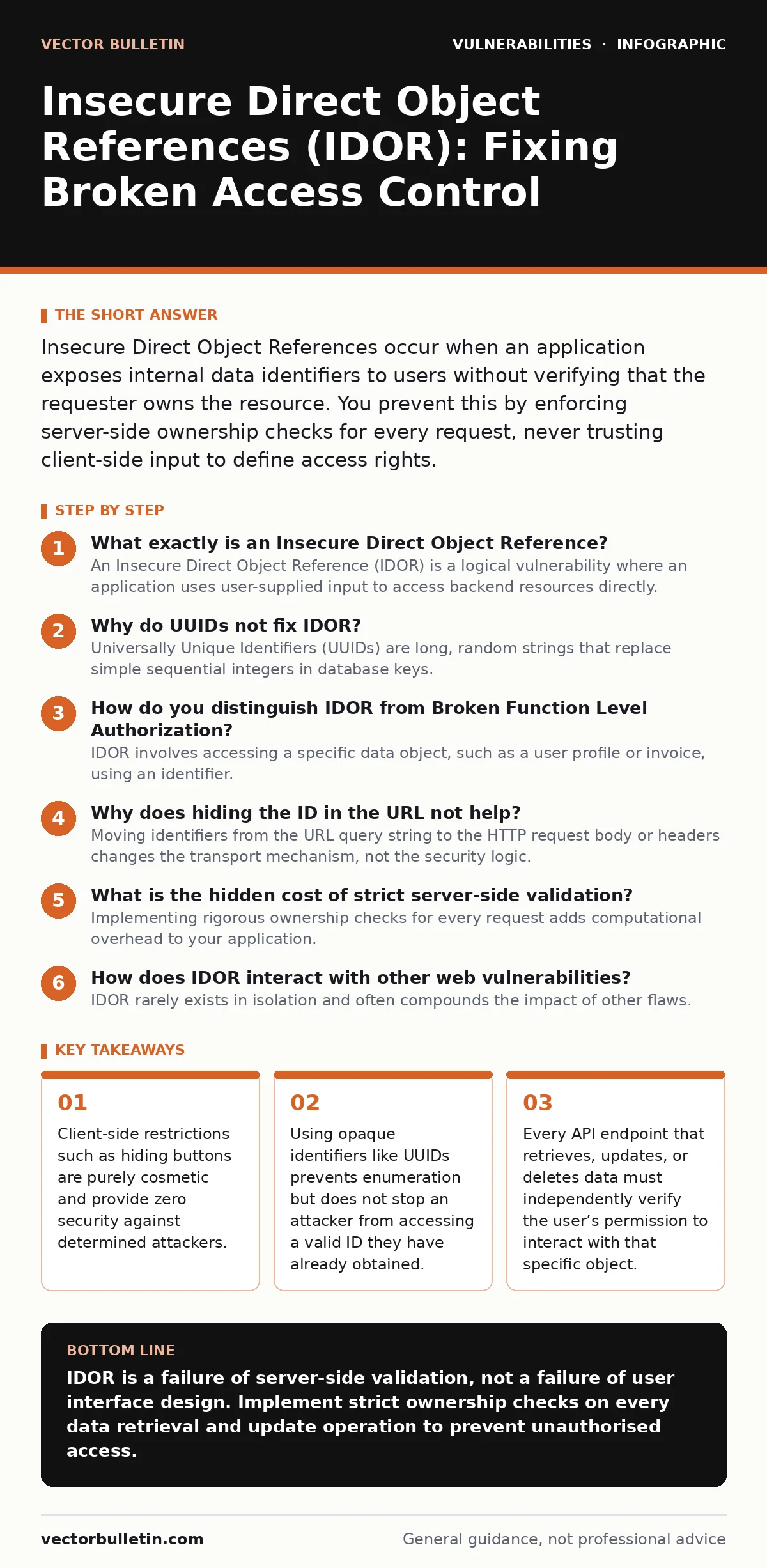
Insecure Direct Object References occur when an application exposes internal data identifiers to users without verifying that the requester owns the resource. You prevent this by enforcing server-side ownership checks for every request, never trusting client-side input to define access rights.
What exactly is an Insecure Direct Object Reference?
An Insecure Direct Object Reference (IDOR) is a logical vulnerability where an application uses user-supplied input to access backend resources directly. The application fails to verify that the user is authorised to access the specific resource identified by that input. This differs from standard authentication failures because the user is logged in and valid, but they are accessing data belonging to another user or system process.
The flaw arises from a mismatch between the data model and the access control logic. Developers often assume that because a user can only see their own records in the user interface, they cannot request other records. This assumption collapses when the client sends a modified request directly to the server, bypassing the interface entirely.
Why do UUIDs not fix IDOR?
Universally Unique Identifiers (UUIDs) are long, random strings that replace simple sequential integers in database keys. Using UUIDs makes it significantly harder for an attacker to guess valid resource identifiers through brute force. This technique, known as security through obscurity, reduces the attack surface for casual scanning tools.
However, UUIDs do not solve the underlying access control problem. If an attacker obtains a valid UUID through any means, such as a data leak or a cross-site scripting (XSS) attack, they can use it to access the associated resource. The server must still check whether the requester owns the object identified by the UUID. Without this check, the vulnerability remains fully exploitable regardless of the identifier format.
| Identifier Type | Guessability | Protection Level | Verification Requirement |
|---|---|---|---|
| Sequential Integer | High | None | Mandatory ownership check |
| UUID / GUID | Low | Enumeration resistant | Mandatory ownership check |
| Hashed Reference | Low | Internal mapping required | Mandatory ownership check |
How do you distinguish IDOR from Broken Function Level Authorization?
IDOR involves accessing a specific data object, such as a user profile or invoice, using an identifier. Broken Function Level Authorization occurs when a user is granted access to an entire function or capability they should not have. For example, a standard user accessing an admin dashboard is a function-level issue, while that user viewing another user’s private notes is an IDOR issue.
The distinction matters for remediation. Function-level issues are often fixed with role-based access control checks at the route or handler level. IDOR requires object-level checks within the data retrieval logic. You cannot fix IDOR by simply checking the user’s role; you must verify the relationship between the user and the specific data item.
Why does hiding the ID in the URL not help?
Moving identifiers from the URL query string to the HTTP request body or headers changes the transport mechanism, not the security logic. Some developers believe that hiding the parameter makes it invisible to attackers. This is a fundamental misunderstanding of how web clients and servers communicate.
An attacker can inspect network traffic using browser developer tools or proxy software. They will see the identifiers being transmitted regardless of where they are placed in the request structure. If the server accepts the identifier without verifying ownership, the location of that identifier in the request packet is irrelevant. The vulnerability exists in the server’s validation logic, not in the client’s request format.
What is the hidden cost of strict server-side validation?
Implementing rigorous ownership checks for every request adds computational overhead to your application. Each database query to verify permissions increases latency and consumes server resources. For high-throughput applications, this can lead to performance bottlenecks if not optimised correctly.
This cost often leads developers to implement caching or simplified checks that introduce edge cases. For instance, caching permission results might lead to stale authorisation states if user roles change dynamically. You must balance security rigor with performance, ensuring that the verification process does not become a single point of failure or a significant drag on response times.
See also: Shoulder Surfing Risks and Physical Security for Small Teams
How does IDOR interact with other web vulnerabilities?
IDOR rarely exists in isolation and often compounds the impact of other flaws. If an application is vulnerable to cross-site scripting (XSS), an attacker can inject a script to steal the victim’s session token and then use it to access resources via IDOR. The XSS flaw provides the authentication context, while the IDOR flaw provides the data access.
Furthermore, IDOR can facilitate directory listing exposure if the application returns directory structures or file paths in error messages. It also intersects with vulnerability severity ratings, where the impact of an IDOR is calculated based on the sensitivity of the exposed data. Understanding these intersections helps in prioritising fixes during a secure code review.
Can you secure IDOR without changing the database schema?
Yes, you can mitigate IDOR by adding application-layer checks without altering database structures. The standard approach is to include the current user’s identifier in the query conditions. Instead of querying for a record by its ID alone, you query for a record by its ID AND the owner’s user ID.
This ensures that the database engine returns no results if the user does not own the resource. However, this requires consistent implementation across all endpoints. A single endpoint that forgets to include the owner check creates a hole in the security perimeter. This consistency is difficult to maintain in large, legacy codebases where logic may be duplicated or inconsistent.
What is the role of indirect references?
Indirect references, or pointer tables, map a public-facing identifier to an internal database key. The application maintains a table that links a user’s session to specific resource access rights. When a request comes in, the server looks up the internal key based on the indirect reference and the user’s session.
This method adds an extra layer of indirection that breaks the direct link between the user’s input and the database record. It makes it harder for an attacker to traverse data relationships because they cannot guess the mapping. However, it adds complexity to the application logic and requires careful management of the pointer table to prevent memory leaks or orphaned entries.
How do you test for IDOR in your environment?
Testing requires two separate user accounts with different permission levels. Log in with the first account and identify a resource, noting the identifier used in the request. Log out and log in with the second account. Modify the request to use the identifier from the first account.
If the second account can view or modify the first account’s data, an IDOR is present. Automated scanners often miss logical flaws like IDOR because they cannot understand the business logic or data relationships. Manual testing remains the most effective method for discovering these vulnerabilities. Consider integrating these checks into your vulnerability disclosure policies to encourage responsible reporting.
Key takeaways
- Client-side restrictions such as hiding buttons are purely cosmetic and provide zero security against determined attackers.
- Using opaque identifiers like UUIDs prevents enumeration but does not stop an attacker from accessing a valid ID they have already obtained.
- Every API endpoint that retrieves, updates, or deletes data must independently verify the user’s permission to interact with that specific object.
IDOR is a failure of server-side validation, not a failure of user interface design. Implement strict ownership checks on every data retrieval and update operation to prevent unauthorised access.
Frequently asked questions
Is IDOR the same as SQL injection?
No, SQL injection allows an attacker to manipulate the database query itself, while IDOR allows an attacker to access data they are authenticated to reach but not authorised to see.
Can authentication tokens prevent IDOR?
Tokens prove identity, not authorisation. A valid token confirms who the user is, but the application must still check if that user owns the specific resource being requested.
Does HTTPS fix IDOR?
HTTPS encrypts data in transit but does not verify access rights. An attacker can still modify encrypted requests to request resources they do not own.
How does IDOR affect cloud storage?
Cloud storage buckets that expose keys or allow public listing are vulnerable. If the application logic does not verify that the user owns the object key, they can access any file in the bucket.
How this guide was produced: written by the Vector Bulletin editorial team with AI assistance, checked against the public references listed below, and reviewed when the facts change. See our editorial policy or report an error.