
Difference Between Cyber Hygiene and Cyber Security: Scope and Execution
Cyber hygiene is the preventative maintenance of systems, whereas cyber security is the active defence against external threats.
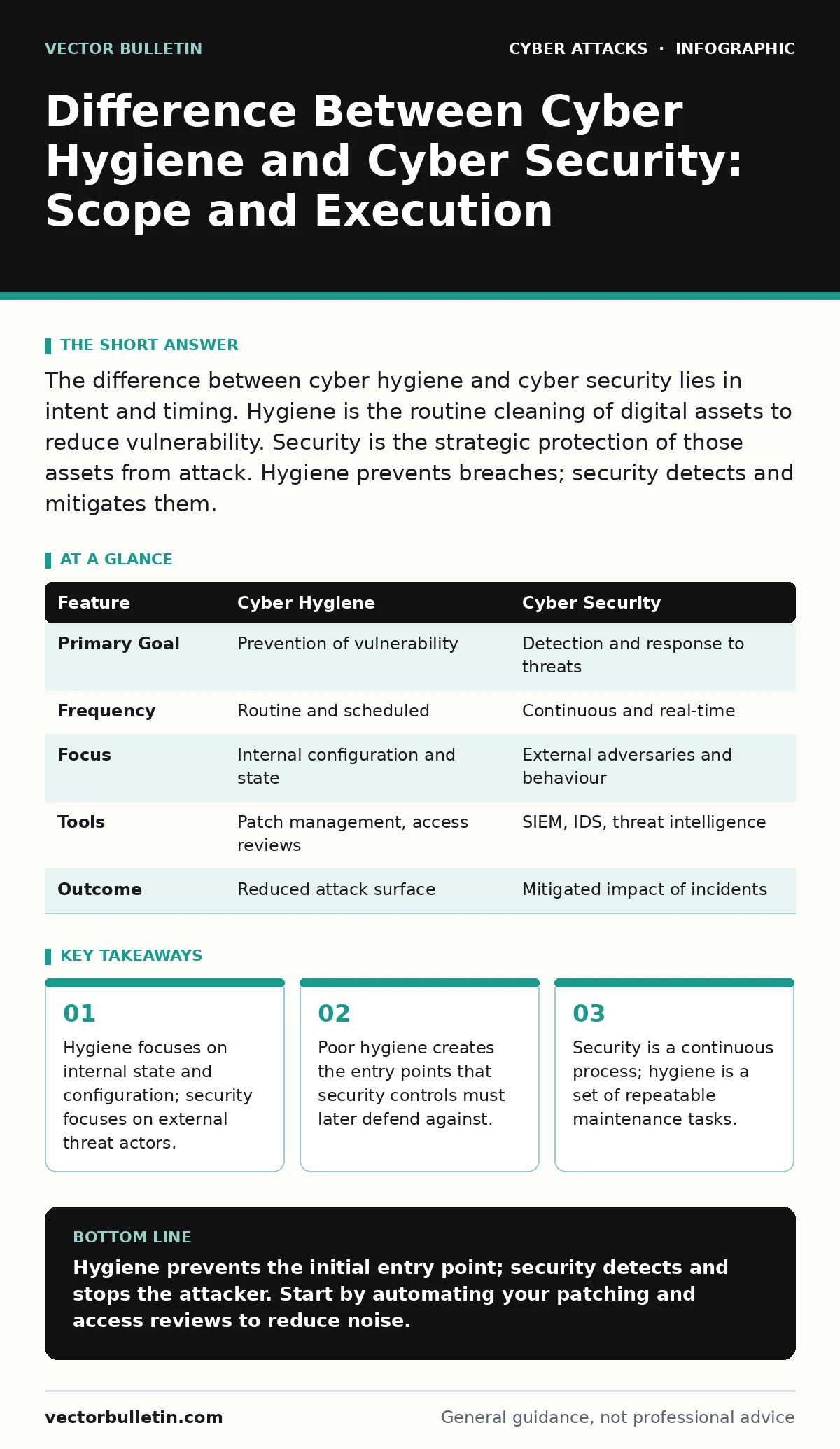
The difference between cyber hygiene and cyber security lies in intent and timing. Hygiene is the routine cleaning of digital assets to reduce vulnerability. Security is the strategic protection of those assets from attack. Hygiene prevents breaches; security detects and mitigates them.
What is the difference between cyber hygiene and cyber security?
The difference between cyber hygiene and cyber security is that hygiene refers to routine maintenance tasks, while security refers to the broader strategy of protection. Hygiene involves keeping systems updated, removing unnecessary software and enforcing basic access rules. Security encompasses threat intelligence, incident response and advanced monitoring. You perform hygiene to reduce the attack surface. You implement security to detect and stop adversaries who bypass those basic controls.
Imagine a house. Hygiene is locking the doors and clearing the garden. Security is the alarm system and the guard dogs. If you neglect hygiene, the doors remain unlocked. No amount of alarm sophistication can compensate for an open front door. Security teams often spend resources patching holes that hygiene would have prevented.
How does cyber hygiene reduce the attack surface?
Cyber hygiene reduces the attack surface by eliminating unnecessary components and standardising configurations. An attack surface is the sum of all points where an untrusted system can make contact with a trusted environment. Every unused port, every default password and every outdated library is a potential entry point. Removing these elements shrinks the area an attacker can probe.
This reduction is passive but powerful. Attackers frequently use automated tools to scan for known vulnerabilities. If you remove the vulnerable software, the scan returns nothing. This is more effective than trying to block the scan at the perimeter. It is cheaper to remove a service than to defend it.
Why does security fail when hygiene is ignored?
Security fails when hygiene is ignored because defensive controls cannot protect against internal misconfigurations. Firewalls and intrusion detection systems rely on accurate rules. If a system is running unsupported software, the security rules may not recognise the malicious traffic. The attacker enters through a gap that hygiene should have closed.
Consider a web server with default credentials. A perimeter firewall might allow the traffic because it looks like legitimate HTTP. The intrusion detection system might miss the login attempt because it is not flagged as anomalous. The breach occurs not because the security tools failed, but because the hygiene of credential management was absent.
What are the core components of digital hygiene?
Digital hygiene consists of 3 main pillars: patching, access control and data management. Patching ensures that known vulnerabilities in software are fixed. Access control ensures that only authorised users can reach sensitive resources. Data management ensures that information is backed up and encrypted.
Patching is not just about installing updates. It involves testing those updates for compatibility before deployment. Access control is not just about passwords. It involves reviewing permissions regularly to remove access for departed employees. Data management is not just about storage. It involves verifying that backups are restorable.
How does security extend beyond routine maintenance?
Security extends beyond routine maintenance by focusing on active defence and threat hunting. While hygiene keeps the system clean, security watches for signs of intrusion. This involves monitoring logs, analysing network traffic and investigating anomalies. Security teams look for patterns that indicate an attacker is present, even if they have bypassed basic controls.
This active stance requires specialised tools and skills. Security operations centres use security information and event management systems to correlate data from multiple sources. They look for indicators of compromise that hygiene alone cannot detect. Hygiene prevents the initial entry; security detects the lateral movement.
See also: Log Management FAQs: Storage, Retention, and Detection Limits
When does good hygiene not prevent a breach?
Good hygiene does not prevent a breach when the attack vector is social engineering or zero-day exploits. Social engineering tricks users into bypassing security controls willingly. Zero-day exploits target vulnerabilities that are unknown and therefore unpatched. In these cases, the system is clean, but the user or the code is compromised.
Social engineering often relies on urgency or fear. A user may grant access to an attacker who claims to be IT support. No amount of patching can stop a user from handing over credentials. This is why security awareness training is part of security, not just hygiene. Hygiene handles the machine; security handles the human.
How do these concepts interact in practice?
These concepts interact in practice through a cycle of improvement. Hygiene reduces the noise that security teams must analyse. When systems are well-maintained, alerts are more likely to be genuine threats. Security findings often feed back into hygiene policies. If an attacker exploits a specific misconfiguration, that misconfiguration is added to the hygiene checklist.
This feedback loop ensures that both domains evolve. Security identifies new threats; hygiene adapts to mitigate them. The relationship is symbiotic. Weak hygiene overwhelms security with false positives. Weak security leaves hygiene gaps unexploited until they are used.
| Feature | Cyber Hygiene | Cyber Security |
|---|---|---|
| Primary Goal | Prevention of vulnerability | Detection and response to threats |
| Frequency | Routine and scheduled | Continuous and real-time |
| Focus | Internal configuration and state | External adversaries and behaviour |
| Tools | Patch management, access reviews | SIEM, IDS, threat intelligence |
| Outcome | Reduced attack surface | Mitigated impact of incidents |
What is the hidden cost of poor hygiene?
The hidden cost of poor hygiene is the increased complexity of security operations. When systems are messy, security tools generate more alerts. Analysts spend time investigating false positives instead of real threats. This leads to alert fatigue, where genuine attacks are missed because the team is overwhelmed.
Poor hygiene also increases the time required for incident response. When a breach occurs, responders must navigate a chaotic environment. They cannot quickly determine what is normal and what is malicious. This delays containment and increases damage. Clean systems allow for faster and more accurate response.
How do you balance hygiene and security efforts?
You balance hygiene and security efforts by automating routine tasks and focusing human expertise on analysis. Automation handles patching, log collection and basic access reviews. This frees security analysts to focus on threat hunting and incident response. The goal is to make hygiene so efficient that it requires minimal human intervention.
This balance requires investment in tooling and process. You must define clear standards for what constitutes good hygiene. You must implement tools that enforce those standards. Without automation, hygiene becomes a burden that teams neglect. Without clear standards, security lacks a solid foundation.
Key takeaways
- Hygiene focuses on internal state and configuration; security focuses on external threat actors.
- Poor hygiene creates the entry points that security controls must later defend against.
- Security is a continuous process; hygiene is a set of repeatable maintenance tasks.
Hygiene prevents the initial entry point; security detects and stops the attacker. Start by automating your patching and access reviews to reduce noise.
Frequently asked questions
Is cyber hygiene the same as basic security?
No. Hygiene is the maintenance of systems to prevent vulnerability. Security is the active defence against threats. Hygiene is a subset of security but focuses on prevention through cleanliness.
Do I need security tools if I have good hygiene?
Yes. Good hygiene reduces risk but does not eliminate it. Attackers use techniques that bypass hygiene controls. Security tools are necessary to detect and respond to these advanced threats.
How often should I review my cyber hygiene?
You should review hygiene continuously. Patching should be automatic. Access reviews should be monthly. Configuration audits should be quarterly. Regular reviews ensure that hygiene standards are maintained.
Can automation replace human security analysts?
No. Automation handles routine hygiene tasks and basic alert triage. Human analysts are needed for complex threat analysis, incident response and strategic decision-making. Automation supports, not replaces, human expertise.
How this guide was produced: written by the Vector Bulletin editorial team with AI assistance, checked against the public references listed below, and reviewed when the facts change. See our editorial policy or report an error.