
Log Management FAQs: Storage, Retention, and Detection Limits
Centralised logging creates a single point of failure that attackers target to erase their tracks before detection occurs.
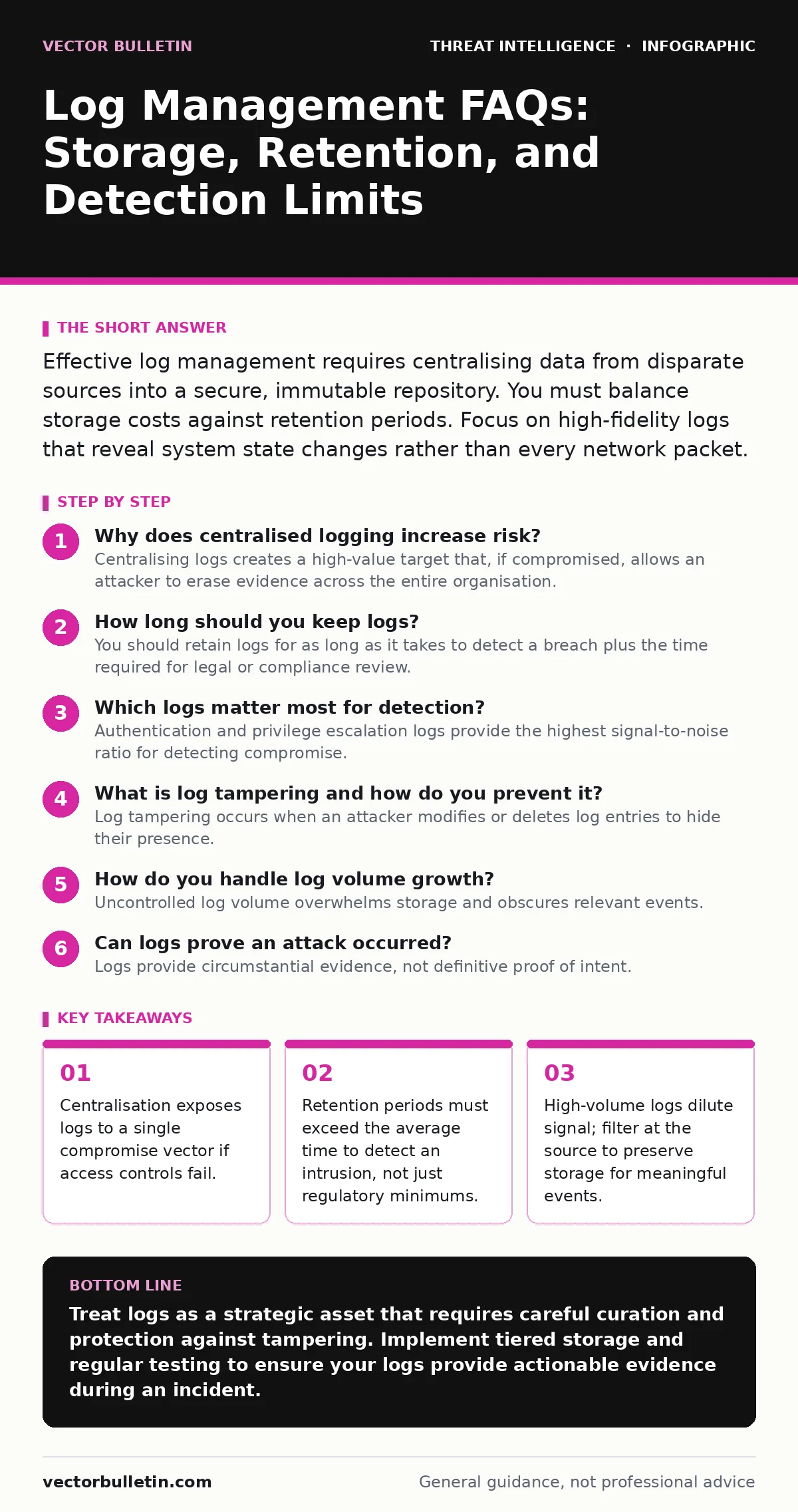
Effective log management requires centralising data from disparate sources into a secure, immutable repository. You must balance storage costs against retention periods. Focus on high-fidelity logs that reveal system state changes rather than every network packet.
Why does centralised logging increase risk?
Centralising logs creates a high-value target that, if compromised, allows an attacker to erase evidence across the entire organisation. When you aggregate data from servers, firewalls, and endpoints into a single platform, you simplify analysis but also concentrate risk. If the logging infrastructure lacks strict access controls, a single breach can wipe the historical record. This is why many teams mirror logs to a separate, air-gapped storage system. The primary system handles real-time analysis, while the secondary copy ensures evidence survives a targeted attack. This redundancy is vital for forensic investigations where the attacker has already modified local logs.
How long should you keep logs?
You should retain logs for as long as it takes to detect a breach plus the time required for legal or compliance review. Many organisations default to thirty or ninety days because it is cheap, but sophisticated adversaries often dwell in networks for months. If you delete logs after thirty days, you lose the ability to correlate early reconnaissance with later exploitation. The cost of storage is usually lower than the cost of a forensic investigation without evidence. Consider tiered storage where recent logs are fast and expensive, while older logs are compressed and cold. This approach extends retention without breaking the budget.
Which logs matter most for detection?
Authentication and privilege escalation logs provide the highest signal-to-noise ratio for detecting compromise. Every login attempt, successful or failed, tells you who is trying to enter the system. Changes to user permissions reveal if an account has gained unauthorized access to sensitive areas. Network connection logs show where data is moving, but they are often too voluminous to analyse manually. Focus on logs that describe changes to the system state rather than routine traffic. These logs are smaller and more likely to contain anomalies that indicate malicious activity.
What is log tampering and how do you prevent it?
Log tampering occurs when an attacker modifies or deletes log entries to hide their presence. This is a common step in the post-exploitation phase of an attack. To prevent this, use write-once storage or append-only logs that cannot be altered after creation. Digital signatures can verify that log entries have not been changed since they were generated. If an attacker gains admin access, they can often redirect logging to a dummy file. You must monitor the logging service itself for signs of manipulation, such as unexpected stops or config changes.
How do you handle log volume growth?
Uncontrolled log volume overwhelms storage and obscures relevant events. You must filter logs at the source to discard routine, low-value data. For example, successful HTTP requests to static assets rarely indicate a threat. Configure agents to send only errors, warnings, and authentication events. This reduces bandwidth and storage costs while improving detection accuracy. Regularly review your collection rules to ensure they align with current threats. As applications change, new log sources may emerge that require filtering.
| Log Source | High Value | Low Value | Retention Strategy |
|---|---|---|---|
| Authentication | Success/Fail | Routine checks | Full retention |
| Web Server | Errors | Static assets | Filtered retention |
| Firewall | Denied connections | Allowed traffic | Sampled retention |
| DNS | Unusual queries | Standard lookups | Full retention |
See also: AI transparency definition and how it works in practice
Can logs prove an attack occurred?
Logs provide circumstantial evidence, not definitive proof of intent. An attacker can craft traffic that looks legitimate in logs. They may use stolen credentials, making their actions appear as normal user behaviour. Correlation across multiple log sources increases confidence in detection. If an authentication log shows a login from a new location and a file access log shows sensitive data retrieval, the combination is suspicious. However, only human investigation can confirm malicious intent. Logs are the starting point for analysis, not the final verdict.
How do you integrate logs with threat intelligence?
Integrating logs with external threat intelligence allows you to detect known malicious indicators in real-time. You can feed indicators of compromise from open-source intelligence (OSINT) feeds into your log analysis platform. This enables automated alerts when a log entry matches a known bad IP address or domain. However, false positives can occur if the intelligence feed is inaccurate. You must validate indicators before acting on them. This integration turns passive logs into active detection mechanisms.
What is the role of log normalization?
Log normalization converts data from different sources into a common format. This allows you to correlate events across disparate systems without writing custom parsers for each. Standard formats like Common Event Format provide a baseline for structure. Without normalization, you cannot easily search for a user across multiple systems. The effort required to normalize logs is significant but pays off in detection speed. It also simplifies the integration of new log sources into your platform.
How do you test your log management strategy?
Regularly test your logging pipeline by generating simulated malicious activity. This verifies that logs are collected, stored, and searchable as expected. You can use tools that mimic common attack techniques to ensure your system detects them. This process reveals gaps in coverage or configuration errors. It also helps you refine your detection rules. Without testing, you assume your logs are useful until an incident proves otherwise.
What is the hidden cost of log management?
The hidden cost of log management is the time spent tuning detection rules and investigating false positives. As you collect more data, the noise increases, requiring more analyst effort. Poorly configured alerts lead to alert fatigue, where real threats are ignored. You must continuously refine your rules to maintain signal quality. This ongoing maintenance is often underestimated in budgeting. Effective log management is not a set-and-forget task.
Key takeaways
- Centralisation exposes logs to a single compromise vector if access controls fail.
- Retention periods must exceed the average time to detect an intrusion, not just regulatory minimums.
- High-volume logs dilute signal; filter at the source to preserve storage for meaningful events.
Treat logs as a strategic asset that requires careful curation and protection against tampering. Implement tiered storage and regular testing to ensure your logs provide actionable evidence during an incident.
Frequently asked questions
Should I log every network packet?
No, full packet capture is too voluminous for most environments. Focus on metadata and connection logs unless you have specific forensic requirements.
How do I secure my log storage?
Use encryption at rest and in transit. Restrict access with multi-factor authentication and audit who accesses the logs.
Can I use logs for compliance?
Yes, but ensure your retention periods and access controls meet specific regulatory requirements. Consult legal counsel for precise mandates.
What is log shipping?
Log shipping is the process of forwarding logs from source devices to a central collector. It ensures data is moved quickly and securely.
How this guide was produced: written by the Vector Bulletin editorial team with AI assistance, checked against the public references listed below, and reviewed when the facts change. See our editorial policy or report an error.