Open-Source Intelligence (OSINT): 10 FAQs Answered
OSINT relies on public data that attackers also use, meaning your visibility is often matched by theirs unless you apply strict context validation.
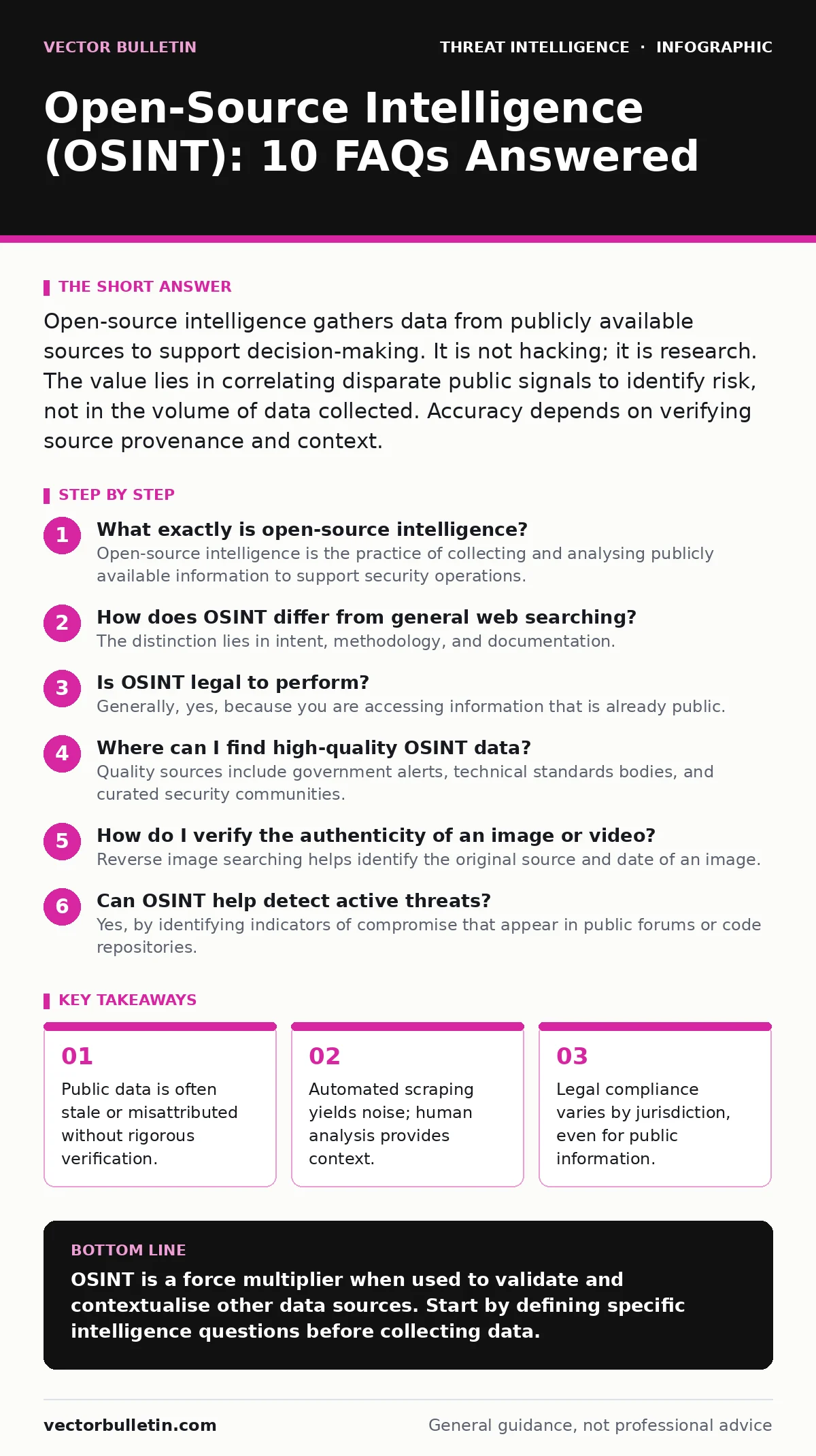
Open-source intelligence gathers data from publicly available sources to support decision-making. It is not hacking; it is research. The value lies in correlating disparate public signals to identify risk, not in the volume of data collected. Accuracy depends on verifying source provenance and context.
What exactly is open-source intelligence?
Open-source intelligence is the practice of collecting and analysing publicly available information to support security operations. It draws from news outlets, social media, government publications, and technical repositories. The term "open-source" refers to the accessibility of the data, not the software used to collect it. You are analysing what anyone can see, but with a specific analytical framework.
How does OSINT differ from general web searching?
The distinction lies in intent, methodology, and documentation. A web search answers a specific query; OSINT builds a narrative from multiple sources to answer a complex question. You must document the provenance of every piece of data to ensure it can be audited later. Without this chain of custody, the intelligence is merely an opinion.
Is OSINT legal to perform?
Generally, yes, because you are accessing information that is already public. However, laws regarding data protection and computer misuse vary significantly by jurisdiction. Accessing data may be legal, but how you store, process, or share that data may not be. For example, aggregating public profiles into a database might violate privacy regulations in certain regions. Always consult local legal counsel before establishing large-scale collection pipelines.
Where can I find high-quality OSINT data?
Quality sources include government alerts, technical standards bodies, and curated security communities. Information Sharing and Analysis Centres (ISACs) provide sector-specific intelligence that is often more reliable than general feeds. Public code repositories and domain registration records offer technical indicators. The key is to prioritise primary sources over secondary summaries.
How do I verify the authenticity of an image or video?
Reverse image searching helps identify the original source and date of an image. You should also examine metadata, if available, for camera model and location data. Contextual clues, such as lighting, shadows, and background landmarks, can confirm or refute a location claim. Do not trust a single source; cross-reference with other independent reports.
See also: What Is the Cyber Kill Chain: A Structural Breakdown of Attack Phases · Threat Actors Meaning: How to Identify and Attribute Cyber Operations
Can OSINT help detect active threats?
Yes, by identifying indicators of compromise that appear in public forums or code repositories. Attackers often reuse tools or infrastructure, leaving digital footprints in plain sight. Correlating these public indicators with your internal log management systems can reveal early signs of intrusion. This requires integrating OSINT feeds into your existing monitoring stack.
What are the common pitfalls of automated OSINT collection?
Automation often fails to capture nuance, leading to false positives. Scripts may scrape outdated data or misinterpret satirical content as factual. Without human oversight, you risk alert fatigue and wasted resources. Automation should handle collection and initial filtering, while humans handle context and validation.
How does OSINT interact with the deep web?
The deep web consists of online content not indexed by standard search engines, including private databases and academic journals. OSINT primarily focuses on the surface web, but skilled analysts may use legal access to deep web resources for broader context. Do not confuse the deep web with the dark web, which requires specific software to access. See our guide on the deep web for further clarification on indexing limitations.
| Source Type | Reliability | Speed | Legal Risk |
|---|---|---|---|
| Government Alerts | High | Medium | Low |
| Social Media | Low | High | Medium |
| Code Repositories | High | High | Low |
| Forum Posts | Variable | High | Medium |
How do I avoid OSINT burnout?
Focus on specific questions rather than continuous monitoring. Define clear operational requirements before starting collection. Use automation to filter noise, but reserve human effort for high-value analysis. Regularly review your sources to ensure they remain relevant and accurate.
Can OSINT replace other security tools?
No, OSINT provides context but cannot detect internal network activity. It complements tools like honeypots, which lure attackers to reveal their methods. OSINT tells you what is happening outside; internal sensors tell you what is happening inside. Integrating both provides a complete picture of your security posture.
Key takeaways
- Public data is often stale or misattributed without rigorous verification.
- Automated scraping yields noise; human analysis provides context.
- Legal compliance varies by jurisdiction, even for public information.
- OSINT complements, but does not replace, closed-source threat feeds.
OSINT is a force multiplier when used to validate and contextualise other data sources. Start by defining specific intelligence questions before collecting data.
Frequently asked questions
How do I start an OSINT programme?
Begin by identifying the specific questions your team needs answered. Select a few reliable sources and establish a manual workflow before automating.
Is OSINT free?
Many sources are free, but time and expertise are costs. Some curated feeds require payment, but the value lies in the analysis, not the data.
Can OSINT track individual employees?
It can identify publicly shared information about employees. Use this data to assess phishing risk, not to monitor personal activity.
How often should I update my OSINT sources?
Regularly, as sources change quality and availability. Review your source list quarterly to remove outdated or unreliable feeds.
How this guide was produced: written by the Vector Bulletin editorial team with AI assistance, checked against the public references listed below, and reviewed when the facts change. See our editorial policy or report an error.