
Threat Actors Meaning: How to Identify and Attribute Cyber Operations
Attribution often fails because threat actors use stolen credentials and compromised infrastructure to hide their true origin and intent.
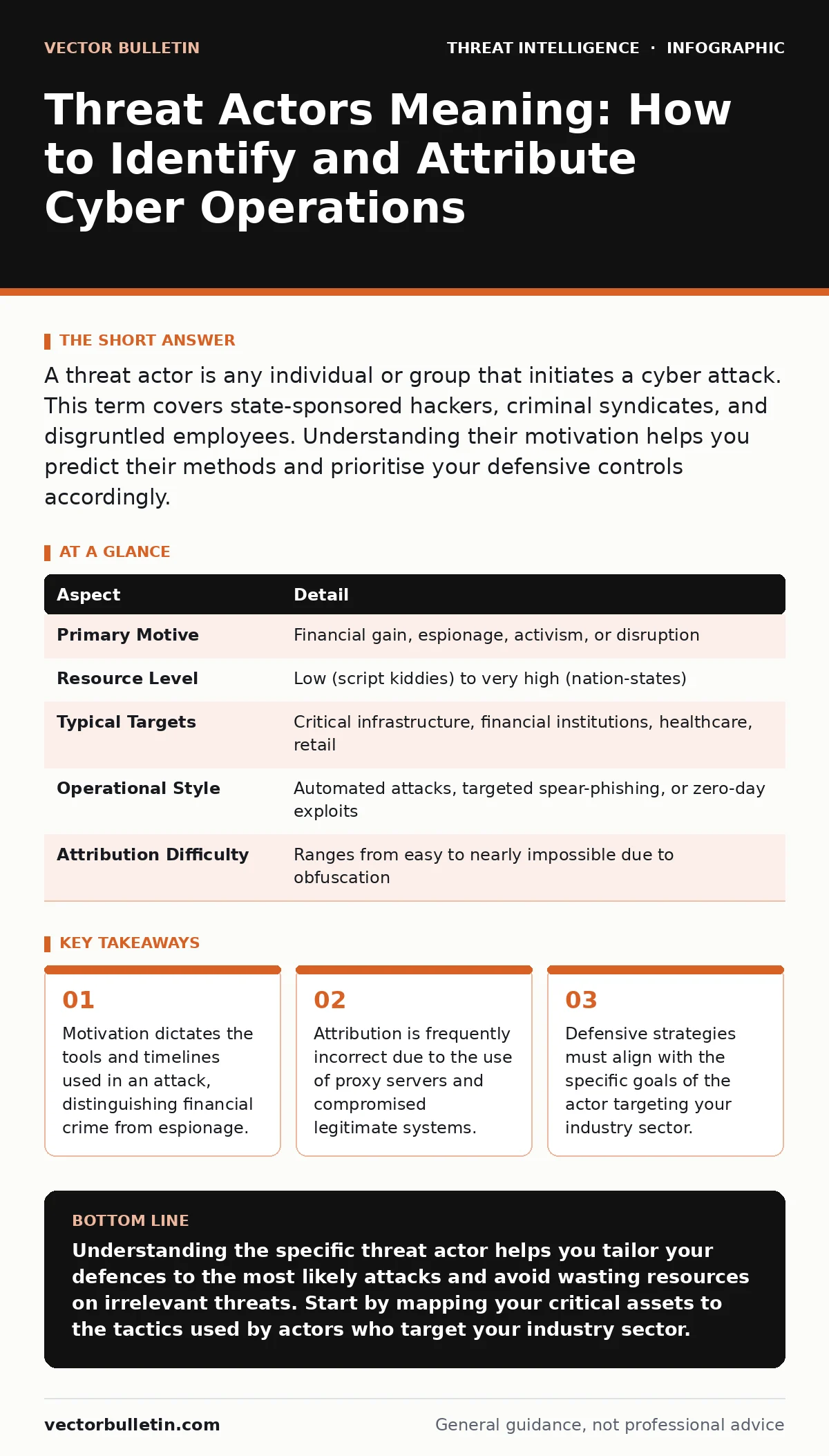
A threat actor is any individual or group that initiates a cyber attack. This term covers state-sponsored hackers, criminal syndicates, and disgruntled employees. Understanding their motivation helps you predict their methods and prioritise your defensive controls accordingly.
Everyday Analogy for Threat Actors
Imagine a house burglary. You do not simply label the event as "a burglary". You consider who did it. A desperate teenager might smash a window to grab visible electronics. A professional crew might drill the lock, disable the alarm, and take only high-value items. The damage looks similar, but the response differs entirely. You call the police for the teenager.
You install better locks and insurance for the pros. Cybersecurity operates on the same principle. The term threat actor defines the "who" behind the digital breach. It shifts the focus from the technical exploit to the human or organisational motive. This distinction determines how you harden your environment and how you recover from the incident.
Threat Actors Meaning
Threat actors meaning refers to the individuals, groups, or organisations that initiate cybersecurity incidents. The definition includes anyone with the capability and intent to cause harm to digital systems. This category ranges from lone hackers seeking notoriety to large state-sponsored units conducting espionage. The term does not imply a single type of criminal.
It encompasses a wide spectrum of motivations, from financial gain to political sabotage. Understanding this definition helps security teams move beyond generic alerts. It allows them to contextualise an alert based on the likely behaviour of the specific group responsible. You cannot defend against an unknown enemy effectively. You must first define who they are and what they want.
At a Glance: Threat Actor Profiles
| Aspect | Detail |
|---|---|
| Primary Motive | Financial gain, espionage, activism, or disruption |
| Resource Level | Low (script kiddies) to very high (nation-states) |
| Typical Targets | Critical infrastructure, financial institutions, healthcare, retail |
| Operational Style | Automated attacks, targeted spear-phishing, or zero-day exploits |
| Attribution Difficulty | Ranges from easy to nearly impossible due to obfuscation |
How Threat Actors Operate
Threat actors follow structured methodologies to achieve their objectives. They rarely act randomly. Most adhere to frameworks that describe the stages of an attack. The cyber kill chain model breaks this down into phases, from reconnaissance to actions on objectives. Understanding these phases helps you disrupt the process early. For example, if you know an actor relies on email phishing for initial access, you can strengthen email filtering.
If another actor uses stolen credentials, you enforce multi-factor authentication. The operational style reveals the actor's sophistication. State-sponsored actors often develop custom malware to avoid detection. Criminal groups frequently use off-the-shelf ransomware kits to maximise profit with minimal effort. Knowing the toolset helps you tune your detection rules. You look for the specific indicators of compromise associated with that group.
Who Threat Actors Affect
Threat actors select targets based on value and vulnerability. Financial institutions attract criminals seeking direct monetary theft. Governments and defence contractors attract state-sponsored actors seeking intellectual property. Healthcare organisations attract both, due to the value of patient data and the critical nature of their services. Small businesses are not immune.
They often lack the resources for strong security, making them attractive for ransomware attacks. The impact extends beyond the immediate victim. A breach in a supplier can compromise the entire supply chain. This ripple effect means you must consider the security posture of your partners. You cannot assume safety because your own defences are strong. A weak link in the ecosystem exposes you to the same threat actors.
See also: Malware Analysis Explained: How to Dissect Threats Safely · Lateral Movement Response: Containment, Recovery and Prevention Steps
What to Do About Threat Actors
Defending against threat actors requires a layered approach. You must align your controls with the likely adversary. Start by identifying what they want. If they want data, focus on encryption and access controls. If they want disruption, focus on resilience and backups. Implementing MITRE ATT&CK Navigator techniques helps you map your defences to known tactics. This framework provides a common language for describing adversary behaviour.
It allows you to see gaps in your coverage. You can then prioritise improvements based on the most relevant threats. Regular testing of your incident response plans ensures you can react quickly. Simulation exercises reveal weaknesses before real actors exploit them. You must also monitor for unusual activity. Anomaly detection systems can spot deviations from normal behaviour, even if the specific malware is unknown.
What People Usually Get Wrong
Many organisations assume that attribution is straightforward. It is not. Threat actors use fast flux DNS to hide their command and control servers. They route traffic through compromised systems in other countries. This makes the apparent source of the attack misleading. You might block an IP address in one country, while the actor operates from another. Another common mistake is focusing only on external threats.
Insider threats are often more dangerous. They have legitimate access and know the system layout. Disgruntled employees or negligent staff can cause significant damage. You must monitor insider activity with the same rigour as external traffic. Log management practices must capture these internal actions. Without detailed logs, you cannot reconstruct the events of an insider breach.
Common Mistakes in Attribution
Attribution errors can lead to wasted resources. You might invest in defences against a threat that does not target your industry. Conversely, you might ignore a real threat because you misidentify the actor. Always verify intelligence with multiple sources. Look for patterns in the code, the timing, and the language used. Honeypots can help you gather data on attacker behaviour without risking production systems.
These decoy systems attract attackers and reveal their tools and techniques. However, honeypots must be isolated carefully. A compromised honeypot can become a launchpad for attacks on your real network. Proper segmentation prevents this risk. You must also consider the possibility of false flags. Some actors mimic the style of other groups to confuse defenders. This adds another layer of complexity to attribution efforts.
Deep Web and Threat Actor Infrastructure
Threat actors often operate in the deep web. This part of the internet is not indexed by standard search engines. It provides a level of anonymity that surface web platforms lack. Forums on the deep web allow actors to share tools, techniques, and stolen data. Monitoring these channels provides early warning of emerging threats. You can see which vulnerabilities are being discussed and which exploits are being sold.
This intelligence helps you prioritise patching efforts. You can address the most actively exploited vulnerabilities first. However, accessing the deep web requires specialised tools and skills. It also carries legal and security risks. You must ensure that your monitoring activities comply with local laws. Unauthorised access to deep web sites can have serious consequences.
Key takeaways
- Motivation dictates the tools and timelines used in an attack, distinguishing financial crime from espionage.
- Attribution is frequently incorrect due to the use of proxy servers and compromised legitimate systems.
- Defensive strategies must align with the specific goals of the actor targeting your industry sector.
Understanding the specific threat actor helps you tailor your defences to the most likely attacks and avoid wasting resources on irrelevant threats. Start by mapping your critical assets to the tactics used by actors who target your industry sector.
Frequently asked questions
Are threat actors always hackers?
No. Threat actors include insiders, nation-states, and criminal groups. The term refers to the source of the threat, not just technical skill.
How do I know who is attacking me?
Exact attribution is difficult. Look for patterns in malware code, communication protocols, and target selection to identify likely groups.
Can I stop all threat actors?
No. You can reduce risk and detect attacks faster. Complete prevention is impossible due to the evolving nature of threats.
Do small businesses need to worry about threat actors?
Yes. Criminal groups often target small businesses for easy wins. Basic hygiene and backups are critical defences.
How this guide was produced: written by the Vector Bulletin editorial team with AI assistance, checked against the public references listed below, and reviewed when the facts change. See our editorial policy or report an error.