
Deep Web Misconceptions: Correcting Threat Intelligence Errors
Most operational risk stems from the surface web, yet teams waste resources chasing ghosts in the deep web due to fundamental taxonomy errors.
The deep web comprises any content not indexed by standard search engines, including private databases and internal portals. It is not synonymous with the dark web, which requires specific software to access. Confusing these layers leads to wasted intelligence efforts and misplaced fear.
Misreading: The deep web is a hidden criminal underworld
Correct reading: The deep web is simply any part of the internet that search engines cannot index. This includes your bank’s online portal, your company’s internal HR system, and private medical records. These pages require authentication or are dynamically generated, so crawlers skip them. The term describes technical inaccessibility to bots, not moral ambiguity. Criminal activity exists here, but it is a tiny fraction of the total volume. The vast majority of deep web traffic is legitimate, private, and mundane.
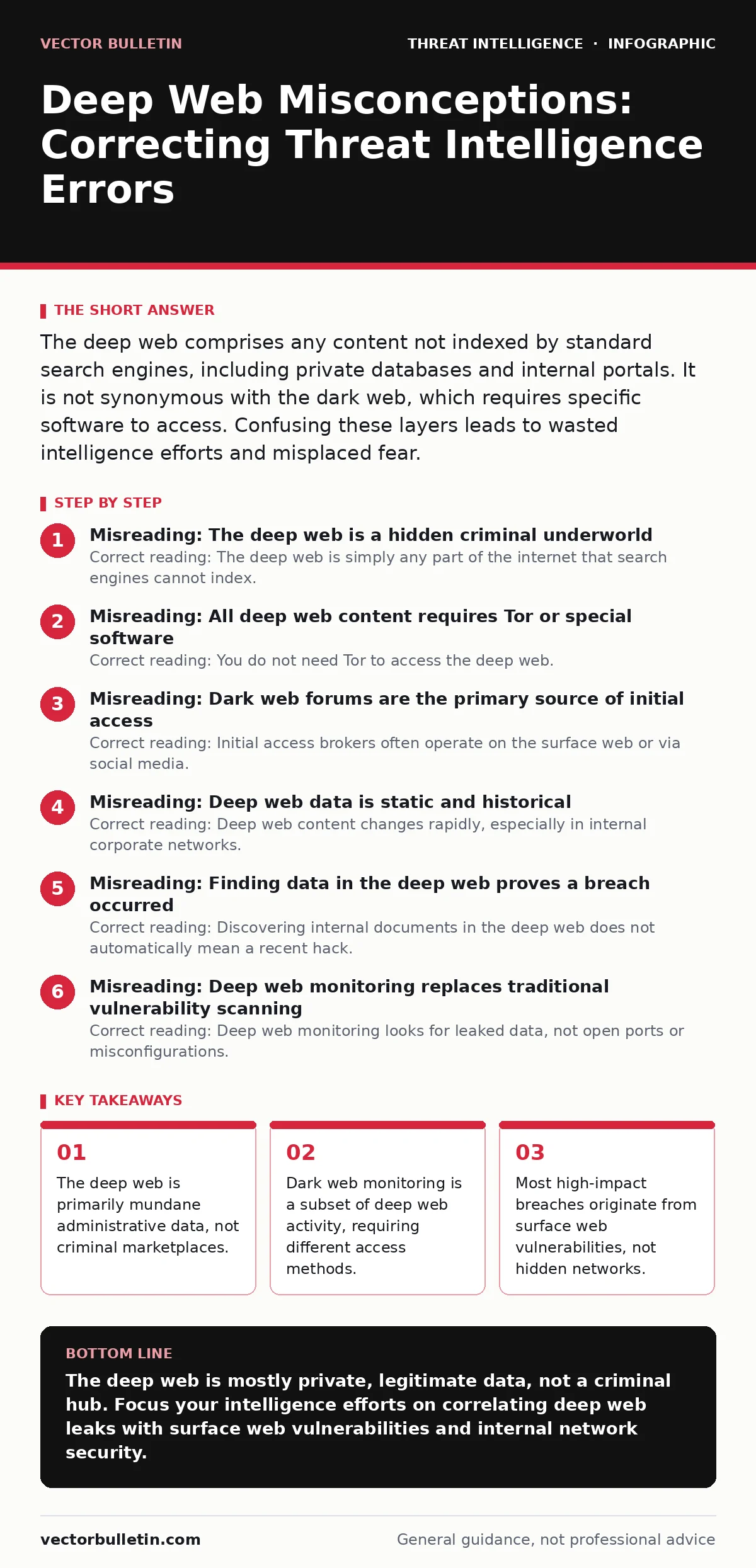
Misreading: All deep web content requires Tor or special software
Correct reading: You do not need Tor to access the deep web. You access it every time you log into your email or check your credit score. These services exist outside the indexable surface web because they are gated by login walls. Tor is a tool for accessing the dark web, a small, intentional subset of the deep web designed for anonymity. The dark web uses onion routing to hide server locations. The deep web does not inherently hide location or identity; it merely hides content from public listing.
Misreading: Dark web forums are the primary source of initial access
Correct reading: Initial access brokers often operate on the surface web or via social media. They use standard websites, Telegram channels, or LinkedIn to sell credentials. While some trade on dark web forums, the convenience of surface web platforms makes them more attractive for quick transactions. Relying solely on dark web monitoring misses the majority of credential theft. Attackers prefer speed and ease of payment over anonymity in the early stages. Surface web scraping often yields more actionable intelligence on immediate threats. See our guide on open-source intelligence (OSINT) for methods to track these public channels.
Misreading: Deep web data is static and historical
Correct reading: Deep web content changes rapidly, especially in internal corporate networks. Employee directories, project management tools, and cloud storage buckets are updated daily. Threat actors exploit this dynamism to find new entry points. Static snapshots of deep web assets become obsolete quickly. Continuous monitoring of internal assets is more valuable than periodic deep web scans. You must treat your own deep web footprint as a moving target. This requires rigorous log management to track access patterns and changes.
Misreading: Finding data in the deep web proves a breach occurred
Correct reading: Discovering internal documents in the deep web does not automatically mean a recent hack. Data may have been leaked months ago and only recently surfaced in a search. It may also be outdated test data or publicly available information that was misclassified as private. Context is required to determine recency and impact. False positives waste incident response time. Verify the metadata and hash of the files to confirm their origin and age. Do not assume a breach without corroborating evidence from your own systems.
See also: Malware Analysis Explained: How to Dissect Threats Safely
Misreading: Deep web monitoring replaces traditional vulnerability scanning
Correct reading: Deep web monitoring looks for leaked data, not open ports or misconfigurations. It cannot detect an unpatched server or a weak firewall rule. These technical flaws exist on the surface or internal network, regardless of indexing status. Vulnerability scanning checks the health of your infrastructure. Deep web monitoring checks the integrity of your data. Both are necessary but serve different purposes. Relying on one while ignoring the other leaves critical gaps. You need both technical security and data loss prevention.
Misreading: The deep web is the main vector for lateral movement
Correct reading: Lateral movement occurs inside your network after initial access. It uses internal protocols, shared drives, and administrative privileges. The deep web is external to your perimeter. While stolen credentials from the deep web might enable entry, the movement itself happens internally. Focusing on the deep web ignores the internal pathways attackers use. You must secure internal networks and segment them properly. See our guide on lateral movement for strategies to contain internal threats.
Misreading: Deep web intelligence is purely technical
Correct reading: Deep web intelligence often involves human behaviour and social engineering. Attackers gather personal details from non-indexed professional networks or alumni databases. This information helps craft convincing phishing emails. Technical data is only part of the picture. Understanding how employees share information is equally critical. Training staff on data hygiene reduces the value of deep web leaks. Security is as much about people as it is about systems.
Misreading: Deep web threats are isolated and unconnected
Correct reading: Deep web data often correlates with surface web activity. A leak in a private forum may reference a public website vulnerability. Attackers combine data from multiple sources to build a comprehensive profile. Isolated analysis misses these connections. You must correlate deep web findings with surface web intelligence. This holistic view reveals the full attack chain. Use frameworks like the MITRE ATT&CK Navigator to map these techniques.
Misreading: Deep web monitoring is a one-time exercise
Correct reading: The deep web is dynamic, with new content appearing constantly. One-time scans provide only a snapshot. Continuous monitoring is required to detect new leaks or changes. Automated tools help, but human analysis remains necessary. False positives require manual verification. Resources must be allocated for ongoing review. This is not a set-and-forget solution. It requires sustained effort and attention.
Misreading: The deep web is more dangerous than the surface web
Correct reading: The surface web hosts the majority of malware distribution and phishing campaigns. Most users interact with the surface web daily, making it a larger attack surface. The deep web is harder to access and less frequented by casual users. While high-value targets may be discussed in the deep web, the volume of attacks is higher on the surface. Do not neglect surface web security in favour of deep web monitoring.
Misreading: Deep web data is always accurate
Correct reading: Information in the deep web can be outdated, incorrect, or fabricated. Hackers may post false data to mislead defenders. Automated scrapers may misinterpret context. Human verification is essential. Cross-reference findings with other sources. Do not act on unverified intelligence. Accuracy is as important as access. See our guide on security metrics for ways to measure the quality of your intelligence.
Misreading: Deep web monitoring requires expensive proprietary tools
Correct reading: Many open-source tools and free services provide deep web monitoring capabilities. You do not need expensive commercial products to start. Basic scripting and public databases can yield valuable insights. The challenge is analysis, not access. Invest in skilled analysts rather than just tools. Human expertise is the differentiator. Technology alone cannot interpret context.
Misreading: The deep web is only relevant for large organisations
Correct reading: Small and medium-sized enterprises also have deep web footprints. Their data may be less valuable, but it is still targeted. Smaller organisations often have weaker security controls. Attackers may use them as stepping stones to larger targets. Do not assume you are too small to be noticed. Basic hygiene and monitoring are necessary for all sizes. See our guide on honeypots for low-cost ways to detect intrusion attempts.
Misreading: Deep web threats are static and predictable
Correct reading: Attackers adapt their tactics as monitoring improves. They move to new platforms and use different encryption methods. The deep web landscape changes constantly. Static defence strategies fail. You must update your monitoring techniques regularly. Stay informed about emerging trends. Flexibility is key to effective defence.
Key takeaways
- The deep web is primarily mundane administrative data, not criminal marketplaces.
- Dark web monitoring is a subset of deep web activity, requiring different access methods.
- Most high-impact breaches originate from surface web vulnerabilities, not hidden networks.
- Automated scraping of non-indexed content often yields false positives and noise.
The deep web is mostly private, legitimate data, not a criminal hub. Focus your intelligence efforts on correlating deep web leaks with surface web vulnerabilities and internal network security.
Frequently asked questions
Is the deep web illegal to access?
No. Accessing the deep web is legal as it includes private, authenticated services like banking and email. Only accessing illegal content or services is unlawful.
How do I monitor the deep web for my company?
Use a combination of automated tools and manual analysis. Focus on specific keywords related to your brand and sensitive data types. Correlate findings with internal logs.
Can I use Tor to access the deep web?
Tor accesses the dark web, a subset of the deep web. Most deep web content is accessed via standard browsers with login credentials. Tor is not required for general deep web access.
What is the difference between deep web and dark web?
The deep web is any non-indexed content, including private databases. The dark web is a specific part of the deep web that requires special software like Tor to access and is designed for anonymity.
How this guide was produced: written by the Vector Bulletin editorial team with AI assistance, checked against the public references listed below, and reviewed when the facts change. See our editorial policy or report an error.