What Is the Cyber Kill Chain: A Structural Breakdown of Attack Phases
The cyber kill chain forces defenders to act before data exfiltration, shifting the focus from perimeter defence to internal behavioural anomalies and early-stage reconnaissance.
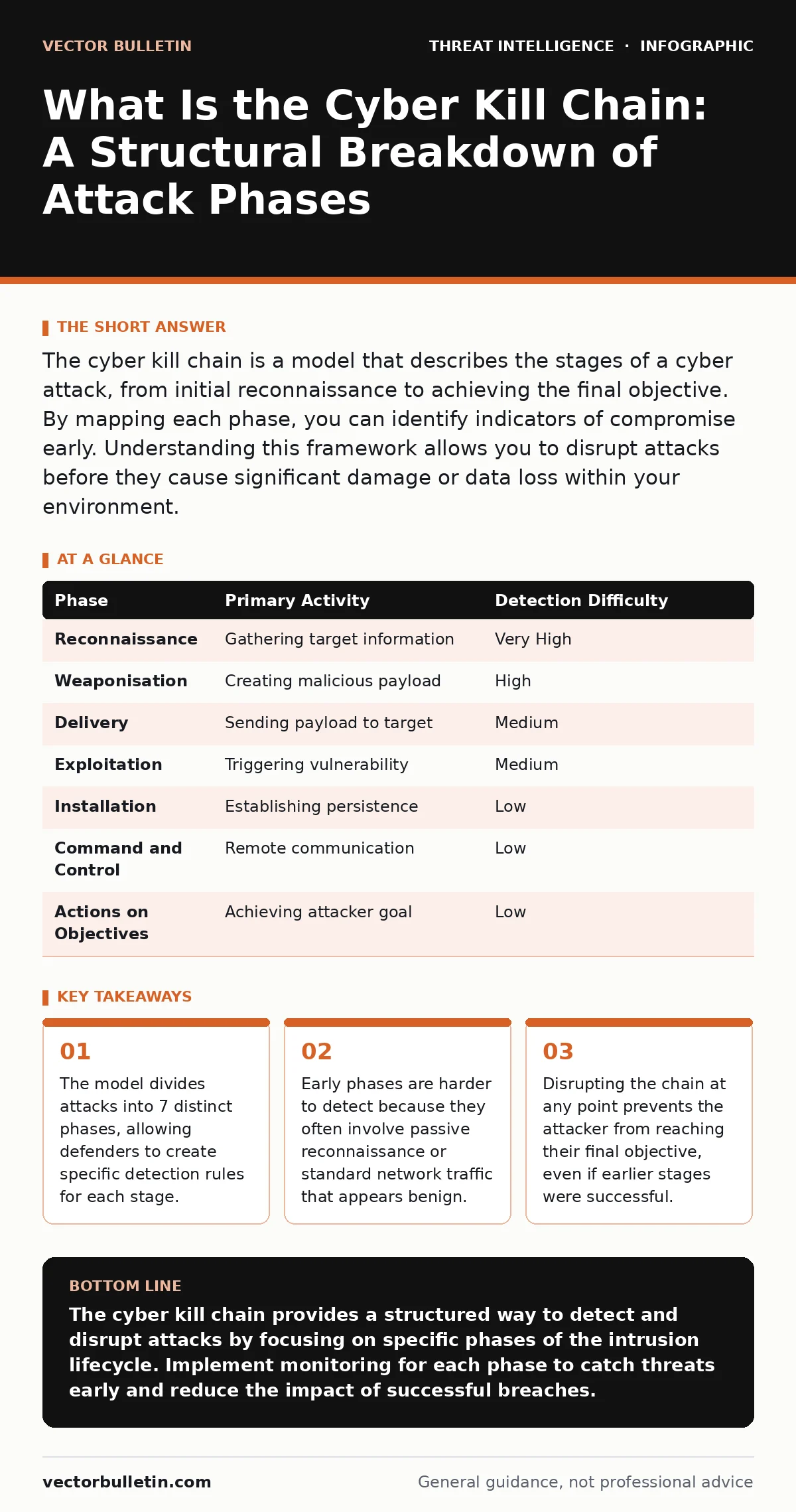
The cyber kill chain is a model that describes the stages of a cyber attack, from initial reconnaissance to achieving the final objective. By mapping each phase, you can identify indicators of compromise early. Understanding this framework allows you to disrupt attacks before they cause significant damage or data loss within your environment.
What is the cyber kill chain
The cyber kill chain is a conceptual model that breaks down a cyber attack into sequential phases. It originates from military terminology, describing the steps required to neutralise a target. In cybersecurity, it maps the adversary’s journey from initial interest in your organisation to the completion of their mission. The model assumes that an attacker must successfully complete each phase to move to the next. This linear assumption creates a framework for detection. You can build defences that trigger alerts when specific actions occur. The model helps you understand that an attack is not a single event.
It is a series of deliberate steps. Each step leaves a trace. Finding these traces early allows you to stop the attack. The model does not cover every possible attack vector. It focuses on persistent, targeted intrusions. It is less useful for opportunistic, one-off exploits. Understanding the structure helps you prioritise your monitoring efforts. You can allocate resources to the phases where detection is most difficult. The model encourages a proactive stance. You wait for the attacker to make a mistake. You do not just react to a breach.
The 7 phases of the attack
The model defines 7 distinct phases. Each phase has specific technical indicators. Reconnaissance involves the attacker gathering information about your organisation. They look for employee names, email formats, and technology stacks. This phase is passive. It leaves few traces on your network. Weaponisation involves creating a malicious payload. The attacker combines exploit code with a delivery mechanism. They might create a PDF that executes code when opened. Delivery is the method of sending the weapon to the target.
This could be a phishing email, a compromised website, or a physical device. Exploitation occurs when the payload executes. It takes advantage of a vulnerability in your software or hardware. Installation follows. The attacker installs a tool to maintain access. This tool often hides itself from standard system views. Command and Control (C2) establishes a channel for remote control. The attacker sends instructions to the installed tool. Actions on Objectives is the final phase. The attacker achieves their goal. This might be data theft, system disruption, or ransomware encryption.
| Phase | Primary Activity | Detection Difficulty |
|---|---|---|
| Reconnaissance | Gathering target information | Very High |
| Weaponisation | Creating malicious payload | High |
| Delivery | Sending payload to target | Medium |
| Exploitation | Triggering vulnerability | Medium |
| Installation | Establishing persistence | Low |
| Command and Control | Remote communication | Low |
| Actions on Objectives | Achieving attacker goal | Low |
How the model works in practice
The model works by forcing you to look for specific behaviours. You do not just look for known bad files. You look for the actions that precede them. Suppose an attacker sends a phishing email. Most teams focus on the attachment. The kill chain approach asks you to look at the email header. You check the sender’s domain reputation. You look for unusual timing. You monitor for the delivery mechanism. If the email is opened, you monitor for exploitation. You look for process creation from unexpected applications. If exploitation succeeds, you look for installation. You check for new services or scheduled tasks.
The model creates a timeline. You can reconstruct the attack by linking events. This reconstruction helps you understand the scope. It also helps you improve your defences. You identify which phase failed to trigger an alert. You then build a rule for that phase. The model turns chaos into a sequence. You can automate responses for each phase. You can isolate a host upon detection of C2 traffic. You can block the sender’s domain upon delivery detection. The model provides a common language. It allows your team to discuss attacks clearly. It reduces ambiguity in incident reports.
What people usually get wrong
Many teams misunderstand the linear nature of the model. They assume attacks always follow the 7 steps. Modern attackers often skip phases. They might use valid credentials to bypass exploitation. They might use cloud APIs to avoid installation. The model assumes a persistent threat. It does not fit fast, opportunistic attacks. Another common error is focusing only on the final phase. Teams wait for data exfiltration to act. This is too late. The value of the model is in early detection.
You must detect reconnaissance or weaponisation. These phases are subtle. They require advanced monitoring. Some teams treat the model as a checklist. They tick off phases as they secure them. This creates a false sense of security. Security is not a series of gates. It is a continuous process. The model is a lens, not a shield. It helps you see the attack. It does not stop it automatically. You must build the controls. You must tune the alerts. You must respond quickly. The model is a tool for thinking. It is not a tool for fixing.
Integration with other frameworks
The cyber kill chain works best when combined with other models. It provides a high-level view of the attack. Other models provide granular detail. For instance, the MITRE ATT&CK Navigator offers a matrix of techniques. It maps specific tactics to the kill chain phases. You can use ATT&CK to define your detection rules. You can see which techniques your controls cover. You can identify gaps in your defence. The kill chain helps you prioritise these gaps.
You focus on the phases where you are weakest. You also need to understand who you are defending against. Threat actors vary in sophistication. Some use simple scripts. Others use custom malware. Your defences must match the threat. You do not need military-grade defences for a script kiddie. You do need them for a state-sponsored group. The kill chain helps you tailor your approach. You can adjust your monitoring depth. You can focus on the phases relevant to your threat.
See also: Lateral Movement Response: Containment, Recovery and Prevention Steps
What to do about it
You must implement detection for each phase. Start with reconnaissance. Monitor your public footprint. Use open-source intelligence (OSINT) to see what attackers see. Remove unnecessary information. Reduce your attack surface. Next, focus on delivery. Filter your email and web traffic. Block known malicious domains. Use fast flux DNS detection to identify shifting infrastructure. Then, monitor for exploitation. Patch your systems regularly. Use application whitelisting. Prevent unauthorised code execution. For installation, monitor for changes to system files. Use integrity monitoring.
Detect new services or accounts. For command and control, monitor outbound traffic. Look for unusual destinations. Use honeypots to attract attacker attention. These decoys provide early warning. Finally, protect your data. Encrypt sensitive information. Monitor for unusual access patterns. Detect lateral movement within your network. Isolate compromised hosts. Use log management to correlate events. Store logs securely. Analyse them for patterns. The model requires continuous effort. You must update your rules. You must test your defences. You must learn from each incident.
Limitations of the framework
The model has inherent limitations. It assumes a physical breach. It does not cover cloud-native attacks well. Cloud environments lack traditional boundaries. Attackers can move laterally without installing tools. They can use legitimate APIs. The model struggles with insider threats. An insider does not need to exploit a vulnerability. They already have access. The model also assumes a single target. Advanced attackers pivot between targets.
They use one system to attack another. The kill chain does not capture this complexity. It is a simplified view. You must supplement it with other models. You must understand your specific environment. You must adapt the model to your needs. Do not apply it rigidly. Use it as a starting point. Build on it with your own insights. The model is a map. It is not the territory. It helps you navigate. It does not replace your judgement.
Key takeaways
- The model divides attacks into 7 distinct phases, allowing defenders to create specific detection rules for each stage.
- Early phases are harder to detect because they often involve passive reconnaissance or standard network traffic that appears benign.
- Disrupting the chain at any point prevents the attacker from reaching their final objective, even if earlier stages were successful.
The cyber kill chain provides a structured way to detect and disrupt attacks by focusing on specific phases of the intrusion lifecycle. Implement monitoring for each phase to catch threats early and reduce the impact of successful breaches.
Frequently asked questions
Does the cyber kill chain apply to ransomware?
Yes, ransomware follows the kill chain phases. It involves delivery, exploitation, and installation before encrypting data. Detecting early phases can prevent encryption.
How is the kill chain different from MITRE ATT&CK?
The kill chain is a high-level, linear model. MITRE ATT&CK is a detailed, non-linear matrix of techniques. They complement each other. ATT&CK provides depth; the kill chain provides structure.
Can I automate responses based on the kill chain?
Yes, you can automate responses for specific phases. For example, you can block C2 traffic automatically. You can isolate hosts upon detection of installation. Automation speeds up response.
Is the cyber kill chain outdated?
It is not outdated, but it is incomplete. It misses non-linear attacks and cloud-native threats. Use it alongside other models for a complete view. It remains a useful foundational concept.
How this guide was produced: written by the Vector Bulletin editorial team with AI assistance, checked against the public references listed below, and reviewed when the facts change. See our editorial policy or report an error.