
Edge Computing Security: Protecting Small Sites Without Heavy Infrastructure
Moving processing to the edge shifts the attack surface from central servers to physical devices, requiring different containment strategies than traditional cloud models.
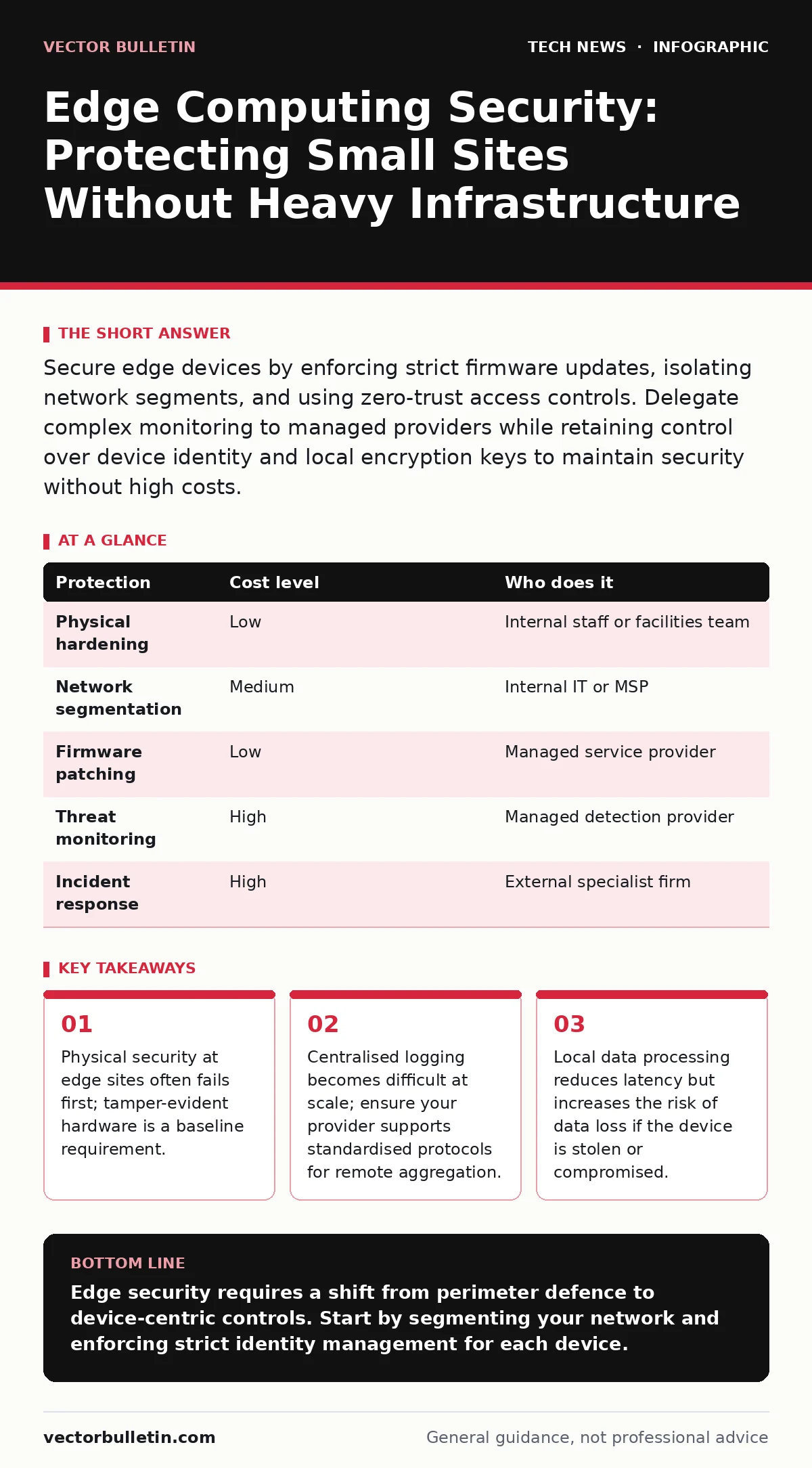
Secure edge devices by enforcing strict firmware updates, isolating network segments, and using zero-trust access controls. Delegate complex monitoring to managed providers while retaining control over device identity and local encryption keys to maintain security without high costs.
The Shift in Attack Surface
Edge computing moves data processing closer to where it is generated, rather than sending it to a central cloud. For small businesses, this reduces latency and bandwidth costs. It also changes how you defend your infrastructure. The central fortress model no longer applies.
You now have dozens or hundreds of small perimeters. Each sensor, gateway, or local server is a potential entry point. If an attacker compromises one device, they may pivot to others. The distance from your central security operations centre makes detection slower.
This architecture assumes that the network between the edge and the cloud is hostile. You must design for failure. Assume that any device connected to the internet is exposed. Your defence strategy must rely on device identity and data integrity, not just network perimeter defence.
Physical Access Risks
Edge devices are often placed in unsecured locations. Warehouses, retail shops, and outdoor sites lack the physical security of a data centre. An attacker who can touch the device can often bypass software controls. They may extract storage drives, reset passwords, or install hardware keyloggers.
Physical security is the first layer of defence. Use enclosures that require special tools to open. Tamper-evident seals alert you if someone has opened the device. Some devices include internal switches that wipe memory or shut down if the case is removed.
Do not rely on obscurity. Hiding a device in a cabinet does not stop a determined attacker. Combine physical barriers with logical controls. If the device is stolen, ensure the data on it is useless without the encryption keys.
Network Segmentation at the Edge
Edge devices often connect to operational technology networks. These networks control machinery or building systems. Mixing IT and OT traffic increases risk. A compromised sensor could send malicious commands to industrial equipment.
Segment your network. Use virtual local area networks to isolate edge devices from corporate computers. Limit the ports and protocols each device can use. This technique reduces the impact of a breach. If one segment is compromised, the attacker cannot easily move laterally.
Review your firewall rules regularly. Default configurations often allow too much traffic. Disable unused services on the device. Ensure that only authorised management stations can access the device configuration interface. This limits the window of opportunity for an attacker.
Identity and Access Management
Centralised identity management is difficult at the edge. Devices are spread out and may have intermittent connectivity. You cannot rely on constant authentication with a central server. Local caching of credentials is often necessary.
Use certificate-based authentication instead of passwords. Digital certificates are harder to steal and replay. Each device should have a unique identity. This allows you to revoke access to a specific device if it is lost or compromised.
Implement least privilege principles. The device should only have the permissions it needs to function. If a sensor only needs to send data, it should not have write access to the database. Restricting permissions limits the damage if the device is hijacked.
Affordable Monitoring Strategies
You cannot monitor every edge device with the same intensity as a server room. Resource constraints mean you must prioritise. Focus on anomalies that indicate compromise. Look for unexpected traffic patterns or configuration changes.
Use lightweight agents that consume minimal resources. These agents report basic health and status metrics. Aggregate this data in a central dashboard. This gives you visibility without overwhelming your network.
Consider managed detection and response services. These providers monitor your edge environment for you. They have the expertise and tools to detect threats that you might miss. This shifts the operational burden while maintaining security visibility.
See also: Personal data for small businesses: how to collect less and survive · Vulnerability Disclosure Policies for Small Teams
What to Delegate
Small teams lack the bandwidth to manage complex edge security. Delegate tasks that require specialised skills or 24/7 attention. Keep control over strategic decisions and critical assets.
Outsource vulnerability management. Providers can scan your devices for known weaknesses and apply patches. This ensures you stay protected against emerging threats. Retain control over which patches are applied and when.
Delegate incident response planning. Work with a provider to create a playbook for edge breaches. Define who does what when a device is compromised. This ensures a swift and coordinated response.
| Protection | Cost level | Who does it |
|---|---|---|
| Physical hardening | Low | Internal staff or facilities team |
| Network segmentation | Medium | Internal IT or MSP |
| Firmware patching | Low | Managed service provider |
| Threat monitoring | High | Managed detection provider |
| Incident response | High | External specialist firm |
Questions for Your Provider
Before delegating edge security, vet your provider. Ask specific questions to ensure they understand your unique constraints. Do not accept generic answers.
- How do you handle device identity and certificate rotation?
- What is your process for patching devices with intermittent connectivity?
- How do you detect lateral movement from a compromised edge device?
- Can you provide logs in a standard format for your own SIEM?
- What is the mean time to detect an edge device compromise?
Refer to our guide on remote desktop security if your team manages edge devices remotely. Ensure that remote access sessions are encrypted and audited. Also, review our article on API key security as edge devices often communicate via APIs. Ensure these keys are rotated regularly and stored securely.
Key takeaways
- Physical security at edge sites often fails first; tamper-evident hardware is a baseline requirement.
- Centralised logging becomes difficult at scale; ensure your provider supports standardised protocols for remote aggregation.
- Local data processing reduces latency but increases the risk of data loss if the device is stolen or compromised.
Edge security requires a shift from perimeter defence to device-centric controls. Start by segmenting your network and enforcing strict identity management for each device.
Frequently asked questions
Do I need a firewall for every edge device?
Not necessarily. Use network segmentation to isolate groups of devices. A single firewall can protect multiple segments if configured correctly.
How do I patch devices that are offline?
Use staged patching. Apply updates when the device reconnects. Ensure your patching solution supports offline queues and automatic installation upon reconnect.
Is edge computing more secure than cloud?
It shifts the risk. Cloud centralises data, making it a high-value target. Edge distributes data, reducing the impact of a single breach but increasing the number of potential entry points.
Can I use open-source tools for edge security?
Yes. Many open-source solutions offer robust monitoring and management. However, they require more internal expertise to maintain and secure.
How this guide was produced: written by the Vector Bulletin editorial team with AI assistance, checked against the public references listed below, and reviewed when the facts change. See our editorial policy or report an error.